
Sales Management Training: Build Consistent Execution Across Your Team
Develop managers who can coach, inspect performance and improve execution through other people. Give them the skills and capacity to do the job.
By Iain Swanston, Founder, Klozers
- Updated 15 October 2026
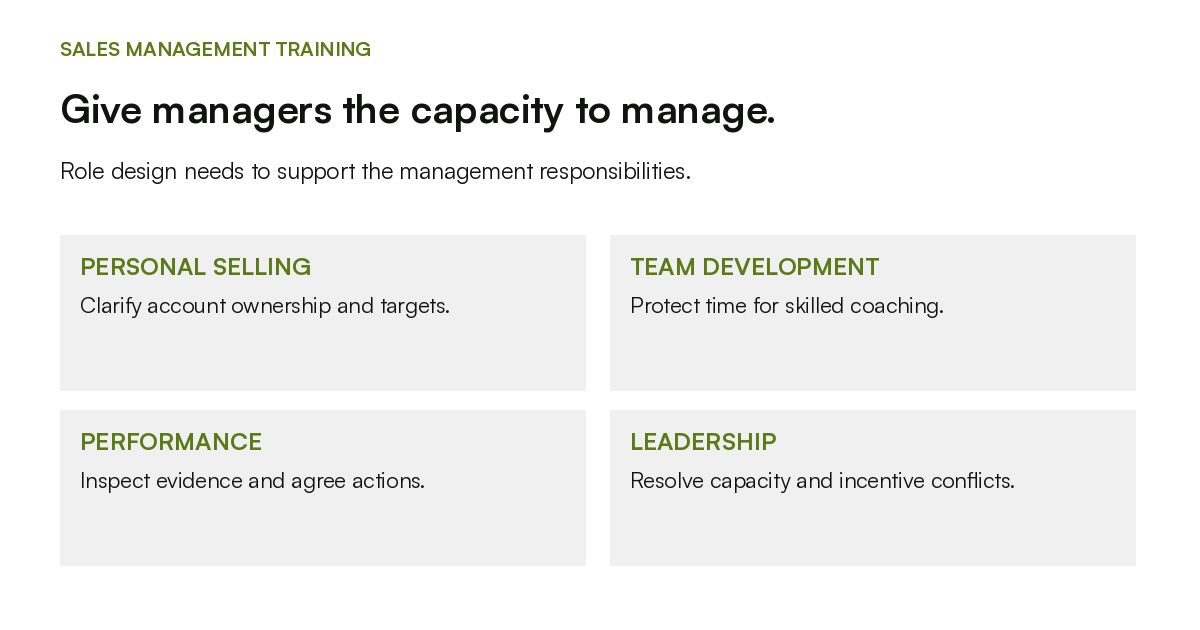
Sales management training is useful when it develops clear management behaviours and the organisation gives managers time to apply them. Assess management potential separately from selling performance, develop skilled coaching and agree how managers will inspect evidence, support people and follow through on actions.
Key takeaways
- Give managers capacity to manage.
- Assess management ability separately from sales results.
- Make skilled coaching a core responsibility.
- Set clear standards and review real evidence.
What should sales management training change?
Sales management training should develop the behaviours managers need to improve execution through other people. That includes setting priorities, making effective selling practices clear, inspecting evidence, coaching specific development needs and following through on agreed actions.
The starting point is the management problem. If managers spend their time rescuing deals, repeating CRM updates or chasing activity without improving its quality, another presentation on leadership is unlikely to resolve it. Development needs to connect to the routines they use with their team.
This page helps sales leaders and HR teams decide what needs to change. The existing sales management development programme provides the detailed programme information. Here, the focus is the operating requirement and the conditions managers need to apply their learning.
Can a manager carrying a sales target find time to manage?
Where a sales manager carries a personal sales target, their own opportunities can compete with coaching, recruitment and performance management. That is a practitioner observation, not a claim that every sales organisation uses the same role design.
The Centre for Creative Leadership identifies balancing personal work with leadership and prioritising competing demands as challenges for new managers. Its research concerns managers across functions rather than sales managers specifically. It supports reviewing workload, but does not establish the prevalence of personal sales quotas. Read the CCL research summary.
Before commissioning training, agree what management work the role must deliver. Review account ownership, administrative demands, team size and the basis of reward. Protect realistic time for observation, feedback and follow-up. A manager cannot reliably develop a team if every urgent personal opportunity displaces that work.
Training can help managers prioritise and delegate. Senior leaders must also address capacity and conflicting expectations. The development plan should make clear which activities stop, move to someone else or receive less time.
Does being a great salesperson make someone a great manager?
A strong sales record demonstrates selling performance. It does not, by itself, demonstrate the ability to coach, delegate, recruit or handle difficult performance conversations. Promotion changes the job and the skills required to do it.
Benson, Li and Shue’s published research on sales workers found that firms placed too much weight on selling performance in promotion decisions relative to characteristics that better predicted managerial performance. This is sales-specific evidence for assessing management potential separately. It does not imply that strong sellers cannot become effective managers. Read Promotions and the Peter Principle.
Assess candidates against management responsibilities before promotion. Ask how they explain effective practice, give feedback, work through another person and respond when performance falls short. After promotion, support the shift from personally solving every problem to helping the team improve its own execution.
Why should coaching be a core management responsibility?
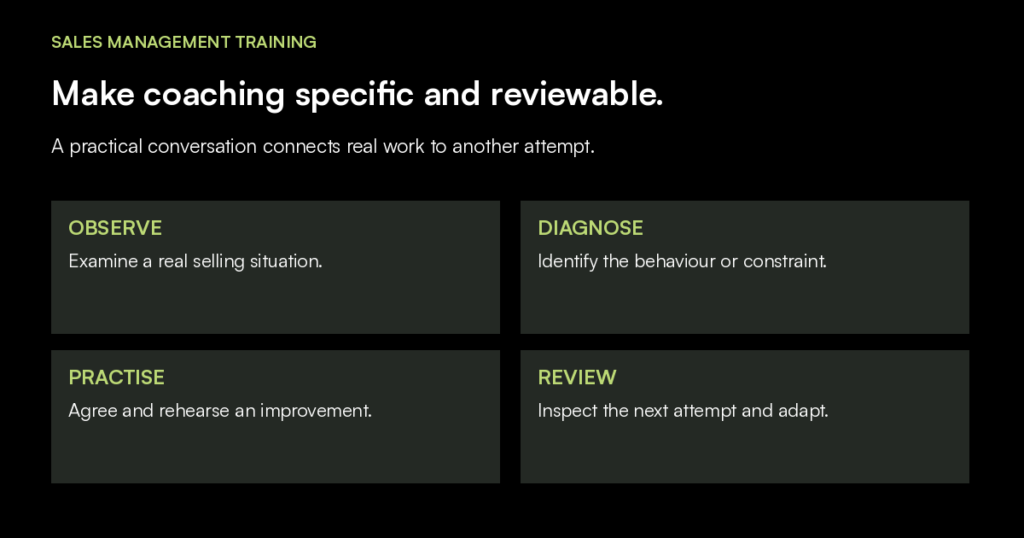
Coaching should be a planned part of sales management. Managers need to observe selling work, identify a specific development need, provide useful feedback and review the next attempt. A pipeline update alone does not fulfil that responsibility.
Dahling and colleagues studied 1,246 sales representatives in 136 teams within a pharmaceutical organisation over a year. Managers’ coaching skill was related to annual sales-goal attainment. When coaching skill was low, more frequent coaching had a negative relationship with attainment. The study supports attention to quality as well as frequency; it does not guarantee a result for another organisation. Read the coaching study.
Without manager coaching, sellers may still learn from peers, training and their own practice. However, development becomes more dependent on individual initiative. Organisations should make skilled coaching an explicit responsibility and give managers the capacity to deliver it.
A practical conversation examines one behaviour in a real situation. Establish what happened, explore the seller’s reasoning, agree an improvement and revisit it. Taking over the deal may solve an immediate problem while leaving the development need unchanged.
Discuss the management behaviours your organisation needs to improve. We can help define a practical development requirement.
How should managers inspect performance and create accountability?
Define what good execution looks like before inspecting it. Capture effective practices already used inside the organisation, then make the relevant expectations clear enough for managers and sellers to use. Klozers starts with internal best practice before adding external methods.
Inspect evidence from opportunities, customer conversations and account plans. If a seller says an opportunity is qualified, ask what supports that judgement and what remains unknown. The purpose is to identify risk and the next action, rather than require a longer retelling of the CRM record.
Accountability needs an agreed action, owner and review date. Distinguish a skill gap from unclear priorities, insufficient capacity or a process obstacle. Coaching is appropriate for some problems; other problems require a leadership or operational response.
For organisations needing consistency across teams, Gold Selling Standards connects development to explicit sales execution standards. Manager training supports application; wider operating standards make expectations less dependent on each manager’s personal interpretation.
How do employment-rights changes affect recruitment and development?
Recruitment, clear expectations and timely development deserve management attention. The business implication of stronger employment protection is to improve selection and early support, rather than rely on replacing a recruit after an avoidable mismatch.
As at 6 October 2026, GOV.UK states that the qualifying period for most ordinary unfair-dismissal claims in Great Britain will fall from two years to six months from 1 January 2027. Northern Ireland has a different qualifying period, usually one year. Some claims already have no qualifying period. Check the government guidance.
The change does not prevent dismissal for poor performance. Acas explains that capability can be a reason for dismissal, following a fair procedure, with support and opportunities to improve. Dismissal should be a last resort. Read the Acas capability guidance.
Managers should work with HR on role requirements, consistent selection criteria, onboarding and documented performance reviews. Assess relevant selling behaviours and ability to learn, rather than relying only on confidence in an interview. This is a management implication of the guidance, not evidence that the legal change improves recruitment outcomes.
When is sales management development most useful?
Newly promoted managers need support changing from personal selling to responsibility for a team. Experienced managers may need development when coaching is irregular, pipeline reviews reveal little evidence or performance conversations are repeatedly deferred.
Growth into new locations can expose differences in management practice. A programme can help leaders agree shared expectations while allowing for the local selling context. Where managers repeatedly rescue deals, development should examine delegation, coaching and the underlying capability gap.
These are illustrative use cases, not reported client outcomes. Select the requirement before choosing content. If the problem is overloaded roles or conflicting incentives, include the senior leadership decisions needed alongside manager development.
How should you choose the approach and review progress?
Ask how development will use your managers’ own team situations, pipeline evidence and coaching conversations. Agree a practical output: a clearer management routine, a coached behaviour or a specific change to how performance is reviewed.
Klozers bespoke organisational sales training can develop agreed capabilities within a private company engagement delivered in person. The scope should confirm participant preparation, application and reinforcement. Do not assume every organisation needs the same modules.
Review whether managers used the agreed routines and whether their execution improved. Track commercial results separately, recognising other influences. A useful programme gives leaders evidence of management practice and a clear decision about what needs further support.
- Describe one selling problem.
- Collect examples from real work.
- Define the behaviour that needs to change.
- Agree a practical output and manager review.

Iain has trained and coached B2B sales teams since 2008. He was Lead Trainer and Coach at Microsoft Scotland. Before that he sold capital equipment and managed sales teams in the UK and North America. He served as an Associate at Strathclyde University Business School, where he delivered the sales content for the Masters in Entrepreneurship from 2015 to 2019.
Tell us about your management challenges, team structure and development priorities. We can help connect manager development to real application.