
Sales Negotiation: Why the Best Deal Works for Both Sides
By Iain Swanston, Founder, Klozers
- Updated 8 November 2026
Key takeaways
- Winning a concession is not necessarily the same as creating a successful agreement.
- An agreement must be mutually beneficial, compatible and deliverable, not simply signed.
- Contracts have legal value, but they cannot replace the willingness and ability to perform.
- Long-term B2B negotiation requires honesty, clear obligations and the discipline to walk away when necessary.
What is sales negotiation?
Why winning the negotiation can mean losing the customer
Imagine a supplier persuades a customer to accept a delivery date that the supplier cannot reliably meet. The supplier may celebrate the signature. The customer may believe it has secured a valuable concession. Yet the agreement contains the conditions for a future dispute.
The same problem works in reverse. A buyer might insist on terms that make the supplier’s delivery economically unviable. The apparent negotiating victory may lead to reduced service, strained relationships or an early breakdown.
Mutual benefit is not enough without mutual compatibility
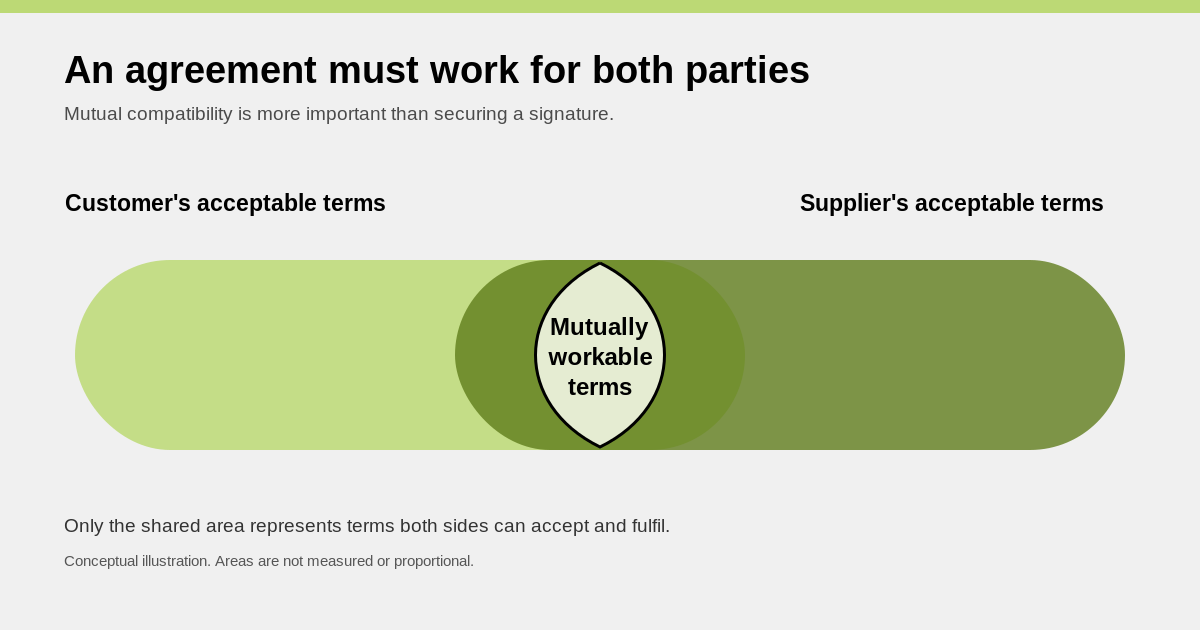
Both parties can see benefits in a deal and still hold expectations that cannot coexist. A customer may need a rapid implementation while the supplier needs information, access and approvals that the customer cannot provide in time. Until those dependencies are resolved, the agreement is not commercially compatible.
Compatibility means that the promises, resources, constraints and expectations of each party can operate together. It requires explicit discussion of what each party will do, by when, and what happens when circumstances change.
Why contracts cannot replace commercial commitment
A contract is not worthless. Properly formed contracts can create enforceable obligations and provide remedies, sometimes without litigation. But legal rights do not automatically produce a functioning commercial relationship.
If delivery fails, enforcement can be costly and disruptive. Even where a party has a strong legal position, it may still lose time, trust or an important opportunity. Negotiators should therefore aim for agreements that people are willing and able to honour, rather than relying on the threat of enforcement to make an impractical deal work.
Why honesty matters in B2B negotiation
Some negotiation advice concentrates on leverage, pressure and the tactical advantage available to one party. Those skills may have a place in particular circumstances, but they are not a substitute for truthful representation of capabilities, constraints and intentions.
Deliberately misleading a buyer about delivery, inventing alternatives or concealing material limitations can undermine the relationship the agreement is supposed to establish. Long-term B2B business depends on repeat decisions: renewals, recommendations, expansions and the willingness to resolve problems together.
The approach here differs from treating negotiation as a contest to be won at any cost. Techniques associated with adversarial negotiations should be assessed carefully before applying them to ongoing customer relationships. The important test is not whether a tactic secures a concession today, but whether the resulting agreement remains credible tomorrow.
Win-win negotiation is a practical discipline
Win-win does not mean both sides obtain everything they ask for, nor does it require splitting every difference. It means both parties can accept the trade-offs because the agreement addresses their legitimate priorities.
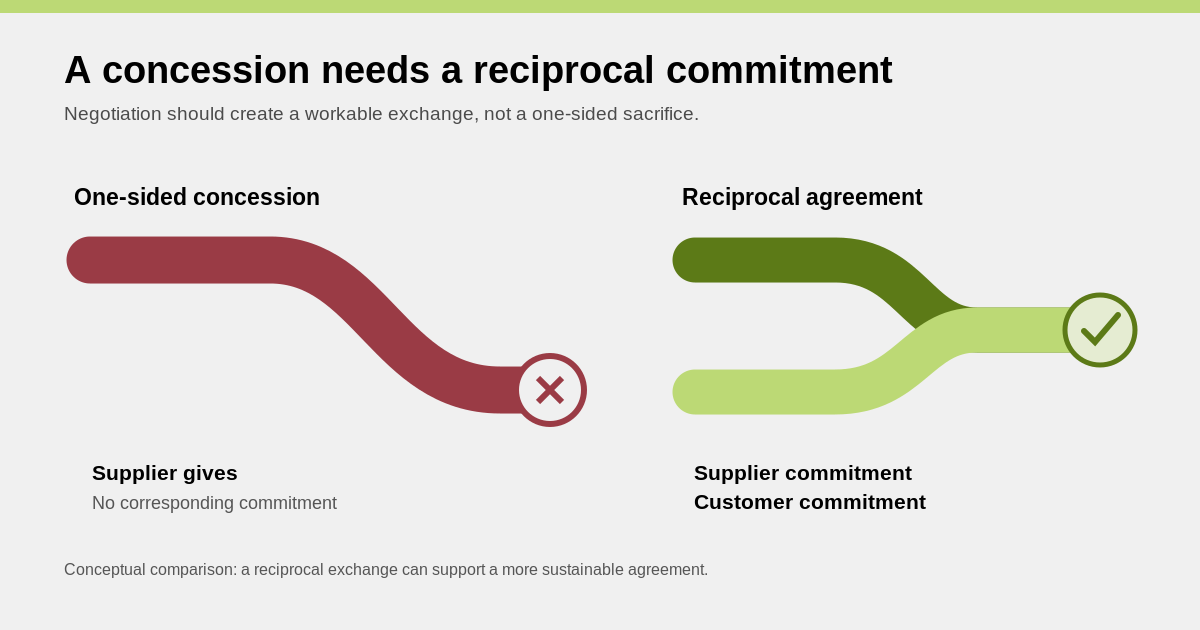
A seller may agree to a revised payment schedule in exchange for a firmer commitment or a different delivery timetable. A customer may accept a narrower scope to obtain a reliable launch date. The value of a concession depends on what it enables for both parties, not simply its face value.
Negotiate the whole agreement, not just the price
When discussions narrow to price, important commercial issues can disappear. Before conceding, establish what the buyer is trying to achieve. Is the concern affordability, internal approval, uncertainty about results or a genuine difference in perceived value?
Consider the scope of work, responsibilities, delivery sequence, support requirements, payment terms and the evidence that will establish whether the agreement has succeeded. A concession should have a clear purpose and, where appropriate, a reciprocal commitment.
Understand who owns the decision and the outcome
The Economic Buyer may control the investment decision, while the Economic Owner is accountable for the business result. These roles are not necessarily held by the same person. A proposal that satisfies purchasing requirements but leaves the person responsible for implementation unable to deliver is vulnerable.
Negotiators should identify the relevant stakeholders, establish what each needs and confirm that the final terms reflect operational realities as well as purchasing authority.
Recognise when the agreement will not work
Warning signs include commitments that depend on unconfirmed resources, unrealistic deadlines, responsibilities left undefined, price reductions that undermine delivery, and parties who interpret the same terms differently. Pressure to sign before these issues are addressed is another reason to examine the agreement carefully.
Walking away can be the most responsible choice when there is no credible way to satisfy both parties’ essential requirements. A deal that cannot be delivered is not improved by securing a signature.
Developing negotiation capability across a sales team
Sales leaders should begin by examining where their existing agreements encounter difficulty. Review discount requests, handovers, changes to scope, implementation problems and disputed commitments. Look for patterns in preparation, stakeholder understanding and the way concessions are agreed.
Development should use relevant commercial situations and allow sellers to practise explaining value, testing assumptions, discussing constraints and reaching reciprocal commitments. Managers can then review how those behaviours are applied in live opportunities. This reflects Klozers’ inside-out approach: understand current practice before deciding what to change.
For organisations seeking structured support, bespoke sales training can address negotiation alongside value-based selling and commercial execution. Related reading includes sales negotiation training, selling value rather than price and objection handling.
Final thought: negotiate for the relationship you want to keep
The strongest commercial agreement is not the one that looks most impressive on signing day. It is the one both parties understand, can fulfil and have good reason to sustain. Honesty, compatibility and long-term thinking are therefore commercial disciplines, not simply ethical preferences.