
Sales Training Guide: Change Behaviours to Improve Results
A practical guide for B2B leaders who want training to change how their teams sell. Define the behaviour, design the intervention and manage the change after the workshop.
By Iain Swanston, Founder, Klozers
- Updated 15 October 2026
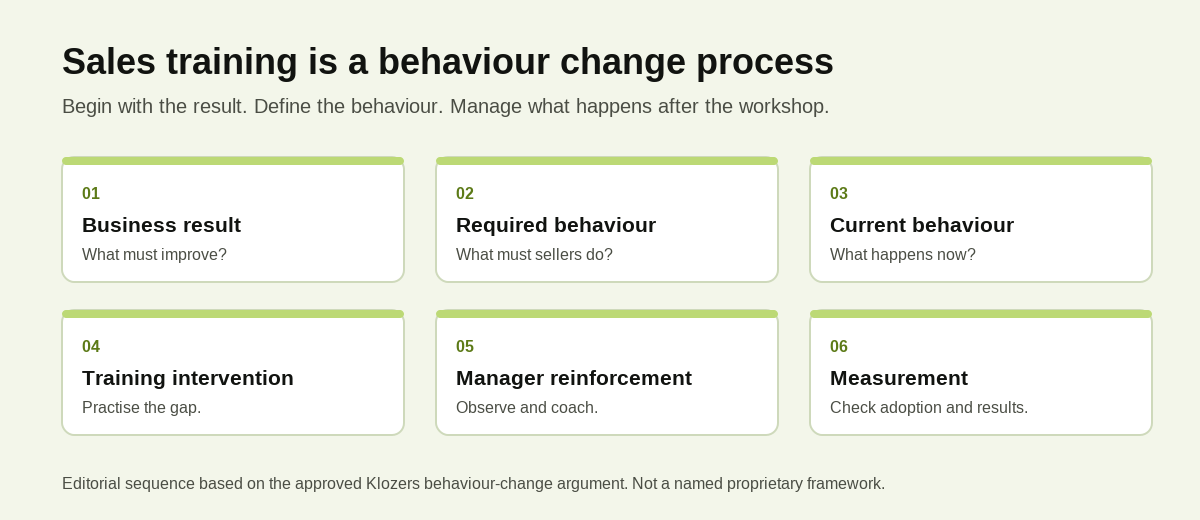
Effective B2B sales training starts with the result the business needs, identifies the selling behaviours that influence that result, and then builds training around the gap between current and required practice. A workshop alone is not a change programme. Managers must reinforce the new behaviours and review evidence of adoption after delivery.
Key takeaways
- Start with a business result and the observable selling behaviours that affect it.
- Interview top performers before selecting external content or a sales methodology.
- Use live opportunities to practise the required behaviours during the workshop.
- Give managers an explicit reinforcement role and measure behaviour after training.
What is sales training?
Sales training is a planned intervention that develops the knowledge, skills and behaviours people need to sell effectively. In B2B organisations, this can include prospecting, discovery, qualification, account management, negotiation and sales leadership. The choice of subject matters, but the intended change in day-to-day selling matters more.
Training should answer a specific question: what must a salesperson do differently in a real customer conversation or deal? A workshop on discovery is only useful if sellers subsequently ask better questions, confirm business consequences and use what they learn to progress opportunities.
“If you want to change sales results, you have to change the behaviours that produce them. That makes sales training a change management job, not just a training job.”
Iain Swanston, Founder, Klozers
Why is sales training also a change management task?
If you want to change a sales team’s results, you need to change the inputs that influence those results. One of the most important inputs is behaviour: whom sellers contact, which questions they ask, how they confirm value and what commitments they secure. Results are also influenced by market conditions, proposition, pricing and lead quality, so training cannot control every outcome.
Changing behaviour means more than explaining a technique. People need a reason to change, an opportunity to practise, feedback and an expectation that the new behaviour will continue. Sales managers need to observe what happens after the workshop and respond when established habits return.
Treat the workshop as part of the change, not the whole change.
How do you identify what your sales team needs to change?
Begin with one commercial problem rather than a list of popular course topics. For example, if qualified opportunities are not progressing, examine how sellers establish buyer priorities and confirm next steps before deciding that the team needs closing training.
A result could be a higher proportion of qualified opportunities progressing to a decision. A behaviour could be confirming the decision process with the customer and recording an agreed next action. The result is a lagging measure; the behaviour can be observed during the sales process.
Review a sample of real opportunities, call notes and manager observations. Ask what evidence shows that the expected behaviour took place. Do not infer a capability gap from a missed target alone. The issue might be poor account selection, weak positioning or an internal approval process that training will not repair.
Interview the people who already achieve the desired outcome consistently. Ask how they prepare, what they do in customer conversations and which decisions they make differently. Compare their practices with those of the wider team. This is the starting point of Klozers’ bespoke programme design, not an optional exercise after a methodology has been selected.
Which types of sales training should a B2B company consider?
Choose the format according to the behaviour, the team and the working environment. A facilitated workshop can establish a shared approach and create time for practice. Individual coaching can help a manager address a specific gap. Sales simulations can reveal decisions made across a more complex selling scenario. None is automatically appropriate for every team.
- Skills workshops: practise discovery, value conversations, prospecting or negotiation against real customer situations.
- Role-specific programmes: address the distinct requirements of account managers, SDRs, enterprise sellers or sales leaders.
- Manager coaching: reinforce the behaviours selected for change and review evidence from live opportunities.
- Sales simulations: observe how sellers make decisions across a scenario and identify where practice differs from stated knowledge.
For a team-wide intervention, see bespoke sales training programmes. For the broader programme catalogue, see sales training courses.
Klozers builds private sales workshops around the behaviours your team needs to change, then supports managers as those behaviours are applied.
Interview top performers
Practise on live opportunities
Participant-written action plans
Manager reinforcement
How should a sales training workshop be designed?
Design begins with the behaviour, not a presentation. Decide what participants must demonstrate by the end of the session and how that will be checked in live work afterwards. Use the organisation’s own customers, sales cycle and active opportunities wherever appropriate.
Klozers interviews the client’s top performers before designing a programme. Leadership then agrees the priority topics and reviews the proposed content. During delivery, participants apply the ideas to their own opportunities rather than discussing a fictional case. This keeps the content connected to existing strengths as well as the gaps the business needs to address.
Consider a sales team that gives discounts early in negotiations. A useful workshop would examine the conversations that precede discount requests, practise establishing commercial value and agree which questions sellers should ask before discussing concessions. The change plan would then require managers to review those behaviours in subsequent opportunities.
What happens after the sales training workshop?
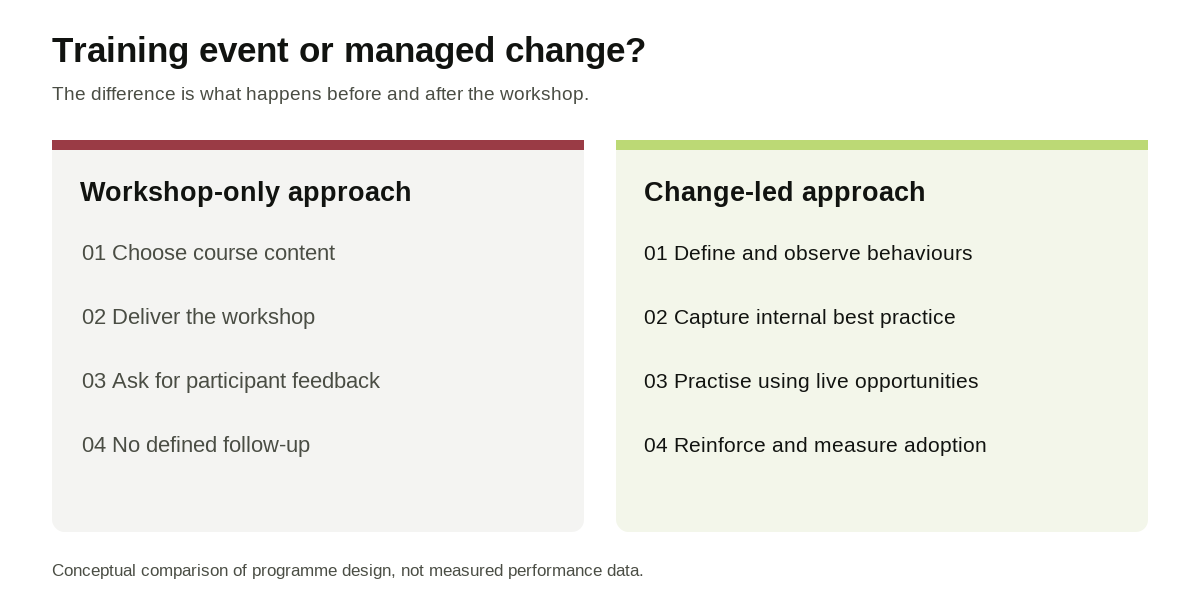
Before the session ends, each participant should record what they will do differently and where they will apply it. Klozers uses a participant-written 90 Day Action Plan rather than issuing a generic list of actions after the event. Managers receive an embed plan that defines how to reinforce the agreed behaviours.
Follow-up conversations at 30, 60 and 90 days can examine what was attempted, what evidence exists and where support is still needed. These are Klozers programme practices, not a claim that every organisation needs an identical timetable. The important point is that the behaviour remains visible after the trainer has left.
How do you measure whether sales training worked?
Measure learning, behaviour and commercial outcomes separately. A participant may understand a technique without using it. A seller may adopt a new behaviour before the commercial result is visible. Both observations are useful and neither should be confused with the other.
Agree a baseline before the workshop. For each topic, select an observable behaviour and a relevant commercial measure. For example, record whether sellers confirm the customer’s decision process in qualified opportunities, then review the proportion of opportunities that progress with an agreed next step. Compare equivalent periods and account for changes in lead quality or market conditions where possible.
Klozers’ B2B Sales Landscape Report surveyed 40 B2B sales leaders across 15 countries between July 2024 and February 2025; 65% of respondents directly managed sales teams. This is a description of the research sample, not evidence that any particular training intervention increases sales. For evidence on workplace learning transfer, Lacerenza and colleagues’ 2018 review of team development interventions discusses the roles of needs analysis, practice, feedback and workplace support. It examined team and leadership development across settings, not sales training specifically.
How should you choose a sales training provider?
Ask prospective providers to show how they diagnose a capability gap, use your existing best practices, design practice around your selling environment and support managers after delivery. Request a clear explanation of what will be measured and who will be responsible for follow-up. A recognisable methodology is not evidence that the proposed programme fits your team.
Distinguish the person funding the programme from the person accountable for changing sales results. HR/L&D may commission the intervention while the Sales Director or CRO owns the commercial outcome. Both need to agree what success means, but their responsibilities are not interchangeable.
If the provider only describes course content, ask what happens in the weeks after the workshop. For further context, read why sales training fails and how sales training workshops are delivered.
Test one behaviour before commissioning training.
Choose one commercial problem and check whether a change in selling behaviour would address it.
- Select one recurring problem, such as qualified deals progressing without a confirmed decision process.
- Name the behaviour that would reduce the problem and describe what evidence would demonstrate it.
- Review three current opportunities with a sales manager and record whether the behaviour occurred.
- Ask a top performer how they handle the same situation, then decide whether training, process change or management support is needed.
Frequently asked questions
What should a sales training programme include?
A diagnosis of the required behaviour, practice using real selling situations, individual actions, manager reinforcement and a way to measure adoption.
How long should sales training last?
The workshop length depends on the gap and the team. The change plan should continue after delivery so managers can observe whether the agreed behaviours are used.
Is bespoke sales training better than a standard methodology?
Not automatically. Begin with existing internal best practice and the capability gap. Add an external method only where it addresses a need that is not already met.
Who is responsible for results after training?
The commercial owner remains responsible for sales results. HR/L&D may commission and coordinate the programme, while sales managers observe and reinforce behaviour in live work.
How do you calculate sales training ROI?
Agree a baseline, track the targeted behaviours and monitor related commercial outcomes. Do not attribute every revenue change to training without considering other factors.

Iain has trained and coached B2B sales teams since 2008. He was Lead Trainer and Coach at Microsoft Scotland. Before that he sold capital equipment and managed sales teams in the UK and North America. He served as an Associate at Strathclyde University Business School, where he delivered the sales content for the Masters in Entrepreneurship from 2015 to 2019.
Discuss the results you need, the behaviours that influence them and the support required after delivery.