
Sales Pipeline: How to Build and Manage Opportunities That Can Actually Close
A sales pipeline is the sales team’s working view of the opportunities it is actively trying to win. A useful pipeline is not the one with the biggest headline value. It is the one where opportunities deserve to be there, stages are supported by evidence and the next action is clear.
By Iain Swanston, Founder, Klozers
- Updated 15 september 2026
A sales pipeline is a structured view of individual sales opportunities that are being actively managed towards a buying decision. It normally records the opportunity, value, stage, owner, expected timing and next action. Unlike a sales funnel, which measures conversion across groups of leads and prospects, a pipeline helps salespeople decide what to do with specific opportunities.
- A large pipeline is not necessarily a strong pipeline. Qualification and buyer evidence matter more than headline value.
- Opportunities should progress because something meaningful has changed in the customer’s buying process, not because the salesperson feels positive.
- Removing an opportunity that will not close does not weaken the pipeline. It reveals that the pipeline was already weaker than reported.
- A pipeline concentrated in old late-stage deals should trigger investigation into qualification, access to decision-makers and buyer progression.
- A stronger pipeline gives salespeople more credible alternatives. That can improve their negotiating position, although pipeline strength alone does not determine negotiation outcomes.
What makes a good sales pipeline?
A good pipeline contains qualified opportunities that justify sales time. Each opportunity should have enough evidence to support its current stage, a clear next action and a credible reason to believe the customer is still progressing towards a decision.
This is different from trying to make the CRM look full. A pipeline can show impressive coverage while containing old opportunities, weakly qualified prospects and deals where the seller has had no meaningful customer interaction for weeks.
The wider question of where opportunities should come from sits in our go-to-market strategy hub. This page starts once a genuine sales opportunity exists.
How should sales pipeline stages work?
Pipeline stages should help the salesperson and manager understand what has actually happened in the buying process. They should not simply record seller activity.
For example, sending a proposal does not automatically prove that an opportunity deserves to move forward. The customer may not have agreed the problem, involved the right stakeholders, confirmed the decision process or validated the proposed solution.
A practical approach is to define what must be true before an opportunity enters each stage. Depending on your sales process, that might include evidence that the problem and required outcome are understood before moving from discovery, or evidence that the relevant stakeholders have validated the solution before moving into commercial discussions.
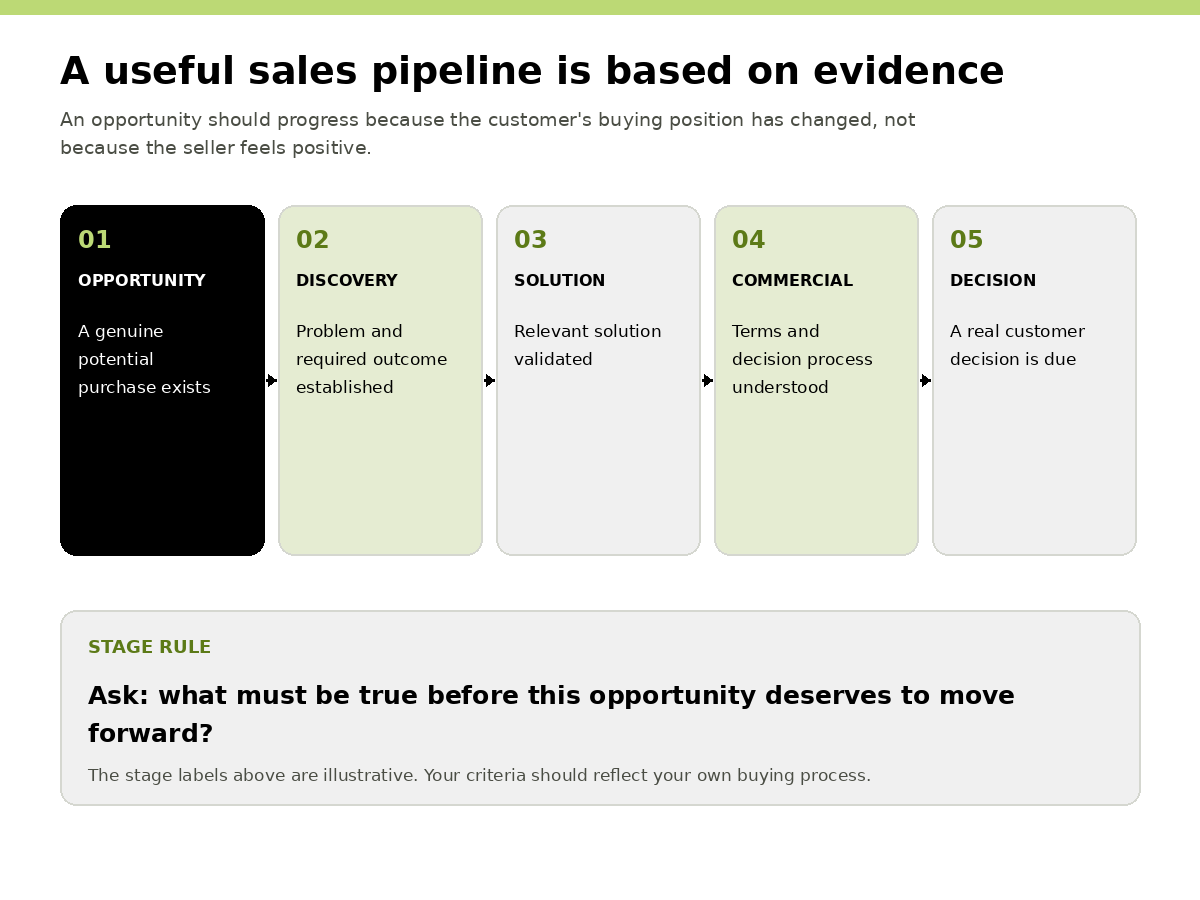
The labels and criteria should reflect your own market and buying process. What matters is that the team uses the same definitions and that progression is based on evidence rather than optimism.
Why do salespeople hold on to deals that are unlikely to close?
There is rarely one reason. Poor qualification, optimism, sunk effort, unclear stage criteria and reluctance to record a loss can all keep weak opportunities open.
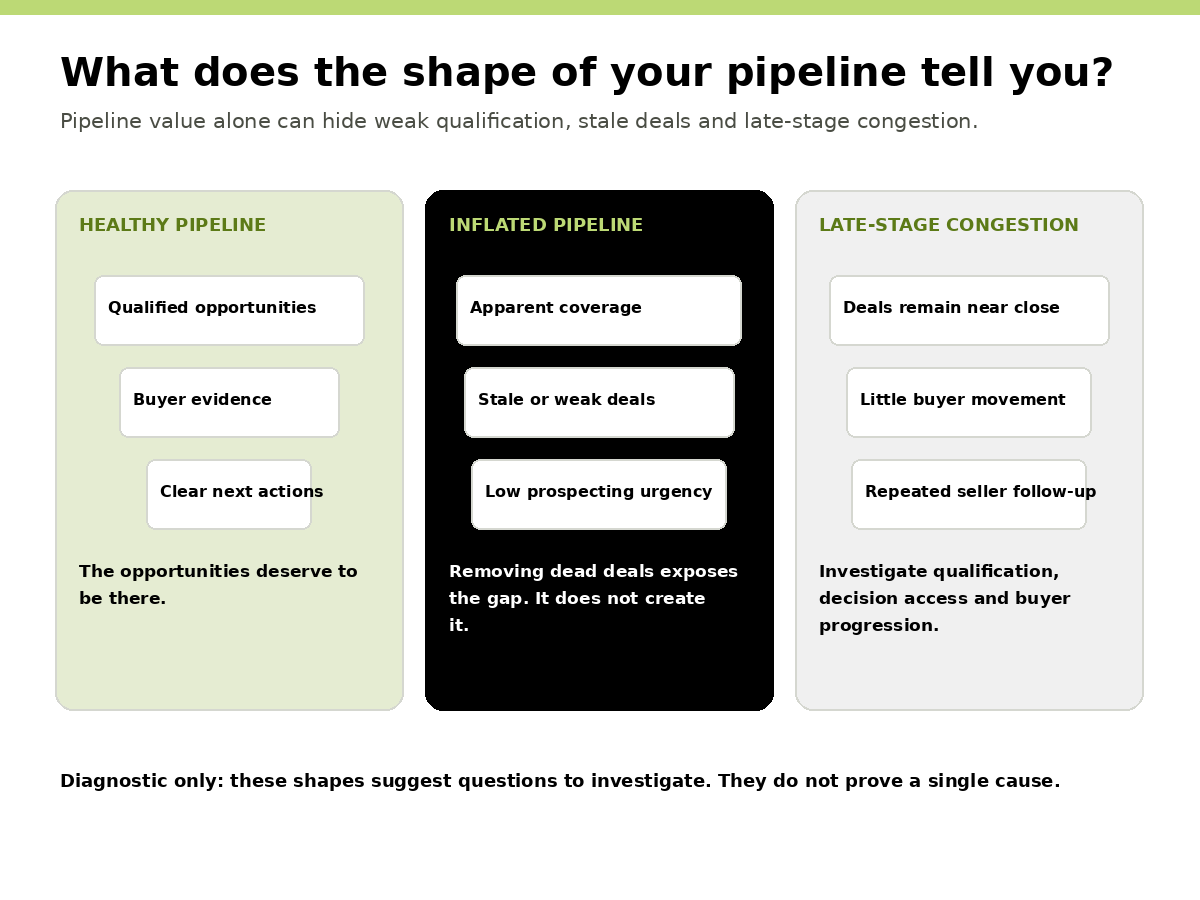
There is also a practical pressure that managers should recognise. Removing an opportunity makes the salesperson’s reported pipeline smaller. If there are not enough genuine opportunities underneath it, disqualifying the deal exposes the need to create new pipeline.
That can create a temptation to keep marginal opportunities alive. Continuing to follow up an existing deal can also feel easier than returning to prospecting. We treat this as a behavioural risk to investigate, not as an assumption about every salesperson.
This is why pipeline coverage is only useful when the opportunities included in the calculation are genuinely qualified. A large multiple of target provides little reassurance if a significant part of the value no longer meets the agreed qualification and stage criteria.
We do not recommend a universal pipeline coverage ratio. The appropriate level depends on your conversion rates, sales cycle, opportunity definition, deal mix and timing.
What does the shape of your sales pipeline tell you?
The distribution of opportunities across stages can highlight where to investigate, but it does not prove the cause.
If a large proportion of deals remain near the end of the pipeline without closing, ask three questions. First, should those opportunities still be qualified? Second, are salespeople working with the people involved in the decision rather than relying on a contact who cannot progress it? Third, has the customer actually moved forward, or has only the seller completed another activity?
Late-stage congestion can have other causes, including changes in customer priorities, internal approval, procurement, funding or a buying process that has paused. The pipeline should prompt investigation rather than automatic diagnosis.
How does pipeline quality affect sales negotiation?
A strong pipeline does not guarantee a strong negotiation. Negotiation outcomes also depend on customer value, alternatives, differentiation, authority, preparation and skill. But pipeline quality can affect the salesperson’s position.
If one opportunity represents most of a salesperson’s realistic chance of making target, there is greater pressure to protect that deal. That can make it harder to walk away from poor terms or resist unnecessary concessions.
Negotiation research supports the underlying principle. Harvard Law School’s Program on Negotiation describes a strong BATNA, the best alternative to a negotiated agreement, as a source of bargaining power because credible alternatives improve the ability to reject an unattractive agreement.
In sales, a healthy pipeline can contribute to those alternatives. This is an inference from negotiation research rather than evidence that pipeline size directly determines sales negotiation outcomes.
External evidence: Program on Negotiation at Harvard Law School: BATNA and sources of negotiating power.
Is sales pipeline the same as sales forecast?
No. Pipeline value is the value of active opportunities. A forecast is an assessment of what is expected to close within a defined period.
Simply multiplying each opportunity by a standard stage probability can create a weighted pipeline, but that should not be confused with certainty. A £100,000 opportunity shown at 50% does not mean £50,000 of revenue will arrive.
Accurate opportunity data still matters. In a Klozers survey of 40 B2B sales leaders across 15 countries, 77.5% rated forecasting as highly critical while only 20% reported full confidence in forecast accuracy. This research studied sales leaders and forecasting, not individual salesperson pipeline behaviour.
The practical lesson for this page is narrower: if stage, value, timing and qualification are unreliable, any forecast built from that data starts with a weak foundation.
How should salespeople manage their sales pipeline?
- Requalify opportunitiesDo not assume a deal remains qualified because it qualified when it entered the pipeline. Customer circumstances change.
- Check the stage evidenceAsk what has changed in the customer’s buying process and whether that evidence supports the recorded stage.
- Record the next actionAn active opportunity should have a meaningful next step. Repeated seller follow-up without customer commitment is not the same as progression.
- Remove opportunities that no longer qualifyDo not preserve reported coverage by retaining deals that no longer justify sales time.
- Respond to the real gapIf cleaning the pipeline leaves too little genuine opportunity, address prospecting and opportunity creation rather than putting dead deals back into the number.
For the wider planning connection, see how to write a sales plan. SaaS teams looking specifically at recurring-revenue funnel structure can use our SaaS sales funnel guide.
Sales pipeline FAQs
What should be included in a sales pipeline?
Include genuine sales opportunities that meet your agreed qualification criteria. Record the information needed to manage them, such as value, stage, owner, expected timing and next action.
How often should a sales pipeline be reviewed?
There is no universal review frequency we recommend. The cadence should reflect sales-cycle length, deal velocity and management needs. The important point is that stale information is corrected before it drives decisions.
Should every lead go into the sales pipeline?
No. Leads belong upstream until there is sufficient evidence that a genuine sales opportunity exists. The exact qualification threshold should be defined by the business.
Why is my sales pipeline full but sales are low?
Investigate whether opportunities are genuinely qualified, whether stage progression is supported by buyer evidence, whether deals are ageing without movement and whether the team has access to the people involved in the decision.
Is a sales pipeline the same as a sales funnel?
No. A funnel measures aggregate conversion across groups of leads and prospects. A pipeline manages individual active opportunities.
We will start with what already works, define the gaps and build the workshop around your live opportunities.