
Why Sales Training Fails
Not because the content is wrong. Because of what happens in the room, what happens in the ninety days after it, and the fact that nothing ever expires.
By Iain Swanston, Founder, Klozers
- Updated 18 agosto 2026
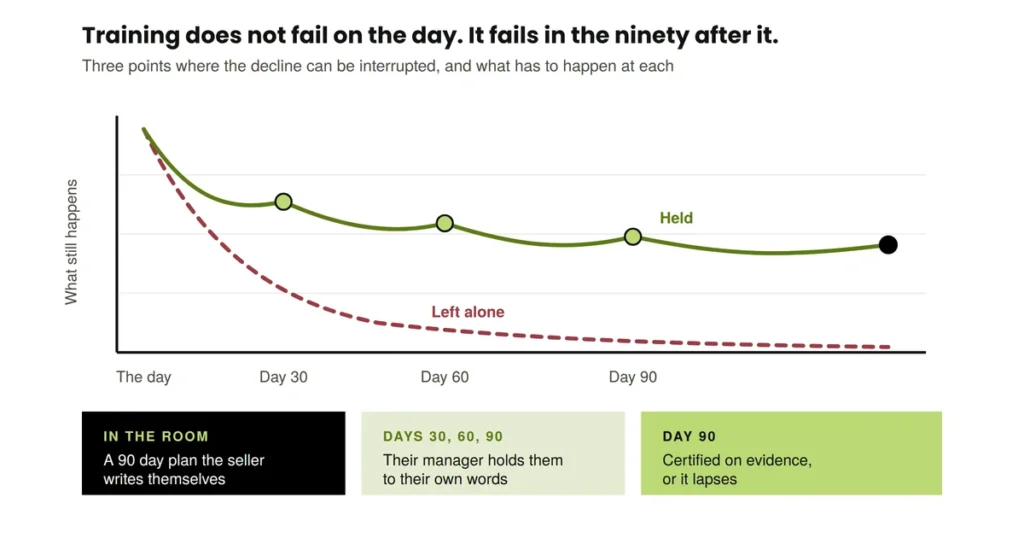
Sales training fails for three reasons, and none of them is the content. The day is built to be watched rather than worked, so nothing is produced. Nothing reinforces it afterwards, so it is forgotten within weeks. And nothing ever expires, so nobody has to maintain it. Fix all three and training holds. Fix one and it does not.
- Forgetting is not a motivation problem. It is how memory works, and it has been measured since 1885.
- A day spent watching slides leaves nothing behind. A day spent building a plan leaves a plan.
- People defend what they wrote themselves. Ownership comes from authorship, not from agreement.
- Reinforcement is a manager’s job, and managers need their own plan to do it.
- A certificate that never expires only records attendance. If nothing lapses, nothing has to be maintained.
Why does sales training fail?
Ask most sales leaders and you get an answer about the provider. The trainer was too generic, the content was theory, the team did not engage.
Sometimes that is true. Usually it is not, and you can tell because the same result occurs with a different provider two years later. When the result is the same across different suppliers, the supplier is not the cause.
What fails is the design around the day. Three things go wrong, in sequence, and each one makes the next inevitable.
What does the research actually say about forgetting?
You will see a figure quoted everywhere that 84% of sales training is forgotten within 90 days. That number comes from vendor research rather than an independent study, and it is repeated far more often than it is checked.
The underlying science is much older and much better established. Hermann Ebbinghaus measured memory decay in 1885, and later research has confirmed the pattern he found. A 2015 replication published in PLOS ONE by Murre and Dros at the University of Amsterdam reproduced his curve: recall fell to 33.7% after one day, 27.8% after two days, and 21.1% after 31 days.
Roughly a fifth left after a month, without reinforcement. That is not a comment on your team. It is a property of human memory, and any training design that ignores it is designed to fail.
Which means the question is not how to teach better. It is what happens on days two through ninety.
The first failure: the day is built to be watched, not worked
Most sales training is a presentation. A trainer works through a deck, the room listens, there is a role play after lunch, and everyone leaves with a folder of materials.
Nothing has been produced. The participants have received something rather than made something, and something you are given is easier to set aside than something you made.
The alternative is not a better presentation. It is not using one at all.
At Klozers there are no slides. The learning is in a detailed workbook, so the time in the room can be spent working, and the day is built around a 90 Day Action Plan that each participant completes during the day. After each topic, they write what they are going to do about it on their own live accounts. At the end of the day they do not have notes on what a trainer said. They have a plan they wrote themselves, about deals they own.
That distinction matters more than anything else in the day, and it is not really about training at all. It is about authorship. People argue with a plan they were given and defend a plan they wrote. When people are busy and something has to be dropped, the plan that survives is the one with their own name on it.
| How most training days run | How a Klozers day runs |
|---|---|
| A deck presented to the room | No slides. A workbook carries the learning |
| A generic case study | The team’s own live opportunities |
| Participants receive material | Participants produce a plan |
| Actions written by the trainer | Actions written by the seller |
| Ends when the room empties | Ends with something the manager can inspect |
Every workshop is built from a blank page around your team’s own live deals. No slides. Every topic carries a KPI you agree up front, then track and prove afterwards.
Pre and post assessment, so you see the change
Worked on your real deals, in the room
Manager Embed Plan and calls at 30, 60 and 90 days
Delivered in person by a practitioner, not a presenter
Trusted by teams at Microsoft, Panasonic, TikTok, Bizerba, Marangoni and Lathams.
The second failure: nothing embeds it afterwards
A plan written on the day is still only a plan. What decides whether it survives is whether anybody asks about it.
In most organisations nobody does. The manager was not in the room, does not know what was agreed, and has a forecast to worry about. Three weeks later the plan is filed away and the training is remembered as a pleasant day.
So the manager needs their own plan. Klozers issues a Manager Embed Plan alongside the training, setting out exactly how to reinforce what was agreed, with follow-up calls at 30, 60 and 90 days.
The mechanism that matters is small and specific. The manager holds the salesperson to the plan the salesperson wrote. Not to a course, not to the trainer’s framework, not to the manager’s own preference. To their own words, in their own handwriting, about their own accounts.
That changes the conversation entirely. There is nothing to disagree about. Nobody argues that the standard is unfair, because they set it. The only question left is whether it happened, which is a far easier conversation and a far more useful one.
The third failure: nothing expires
Almost every sales training certificate is issued on the last day of the course. It records that a person attended. It never expires, so it never has to be maintained, and it tells you nothing about how that person will run a deal in March.
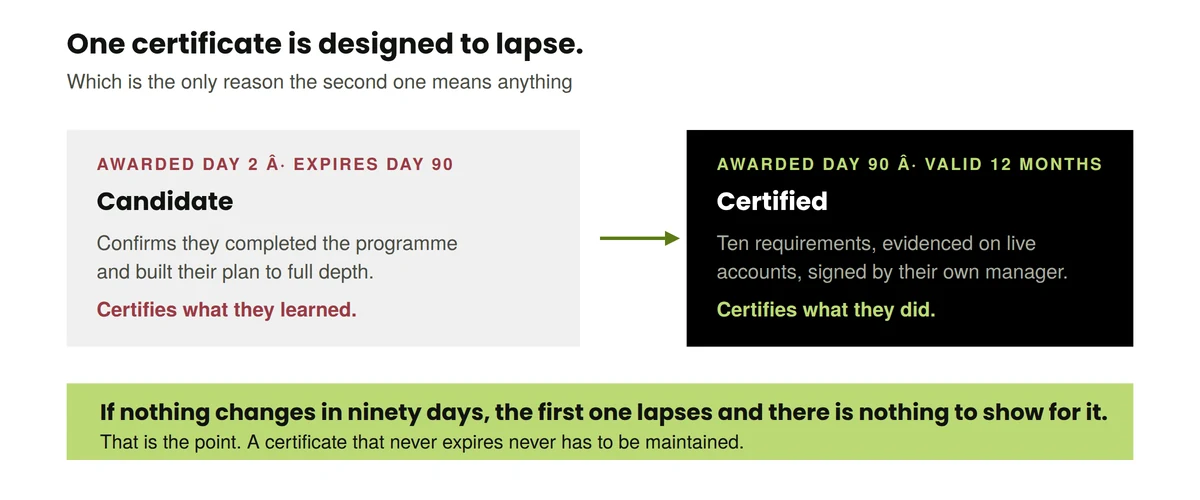
Klozers issues two, and the first one is designed to lapse.
Candidate is awarded on day two. It confirms the participant completed the programme and built their plan to full depth. It expires at day 90. If nothing changes in those ninety days it simply lapses, and there is nothing to show for the investment.
Certified is awarded at day 90, on evidence. Ten execution requirements, evidenced on live accounts as the work happened, assessed at 30, 60 and 90 days and signed off by the participant’s own manager. It is valid twelve months and renewed on evidence, not by attending something else.
Two things about that are unusual enough to be worth stating plainly.
Your manager assesses. We issue. Klozers designs the standard and awards the certification, but never marks a requirement as evidenced. The person with the visibility is the person who signs, which means we cannot mark our own work.
It expires on purpose. Behaviour deteriorates under pressure. That is the entire reason the programme exists, so a certification that never expired would contradict its own argument.
"Not a theoretical course. I left with a clear plan for my own accounts."
Workshop delegate
When is training not the answer at all?
Sometimes the honest answer is that no training design will fix it.
If every seller interprets “qualified” differently, if every manager coaches to personal preference, if the forecast is a collection of opinions, then you do not have a skills gap. You have no agreed definition of how a deal should be run, and training a team to be better at an undefined job will not help.
That is a governance problem, and the fix is a written standard your managers can inspect against. We cover how operating standards replace training cycles separately, because it is a different decision with a different owner: it needs your CRO or VP of Sales, not your L&D team.
The order matters. Diagnose first, then embed, then govern. Imposing a standard on a team that has never been shown what good looks like produces box-ticking rather than change.
How do you tell whether a provider has solved this?
Four questions, and you can ask them on a first call.
- What will my team physically hold at the end of the day? If the answer is a workbook and a set of slides, nothing was produced.
- Who wrote the actions? If the trainer wrote them, ownership never transferred.
- What does my manager get? If the answer is a summary email, reinforcement is not part of the design.
- What happens at day 90 if nothing changed? If the answer is nothing, then there is no consequence, and no consequence means no change.
The last question is the one that shows the difference between providers. A design where nothing lapses is a design where nobody has to do anything.
If you want to see what a diagnostic looks like before any of this, read how sales simulation solves the retention problem, or browse all sales training courses to see how each part connects.
You do not need a provider to find out whether your last investment held. You need four questions and the person who attended.
- Ask someone who went on the last training day to show you what they left with. Not describe it. Show you.
- Ask what they committed to doing differently, and whether it is written down anywhere.
- Ask their manager when they last discussed it. If the answer is the week after, the reinforcement stopped there.
- Ask what would have happened if nothing had changed. If the answer is nothing, you now know why it did not.
Common questions about why sales training fails
Is sales training worth it at all?
Yes, when it is designed to hold up once people are busy again. Training improves capability, and capability is necessary. What it does not do on its own is control execution, which is why the design around the day matters more than the day itself.
How long does sales training last before it is forgotten?
Without reinforcement, most of it is gone within a month. The 2015 PLOS ONE replication of Ebbinghaus put recall at around a fifth after 31 days. That is the default, not a worst case.
Whose job is reinforcement?
The line manager’s. They are the only person with enough contact to notice a change in behaviour within weeks rather than at the end of a quarter. But they need their own plan and their own checkpoints, or reinforcement becomes something they intend to do.
Why should a sales certification expire?
Because behaviour deteriorates under pressure, which is the reason the training happened. A certification that never expires records attendance. One that lapses at 90 days unless it is evidenced records behaviour, and has to be maintained to stay true.
We have tried training twice and it did not stick. What do we do differently?
Start by finding out what is actually breaking rather than buying more content. A simulation or a structured deal review will tell you whether the gap is skill, process or standards, and those have very different answers.
Iain has spent over 30 years in B2B sales, selling, training and leading teams both domestically and internationally. He serves as an Associate at Strathclyde University Business School, where he has delivered the sales content for the Masters in Entrepreneurship since 2015. Klozers builds sales programmes from what a client’s own top performers already do, and delivers them on the client’s live deals.
You are buying a change in how your team sells, and the proof that it worked. A short call to work out what would need to change, and a date that works