
Sales Technology: What It Can Help With and What It Cannot Fix
Sales technology can make useful sales work easier to execute, inspect and repeat. It cannot repair weak targeting, an unclear value proposition, a poorly structured sales process or missing selling skills.
By Iain Swanston, Founder, Klozers · Updated October 2026
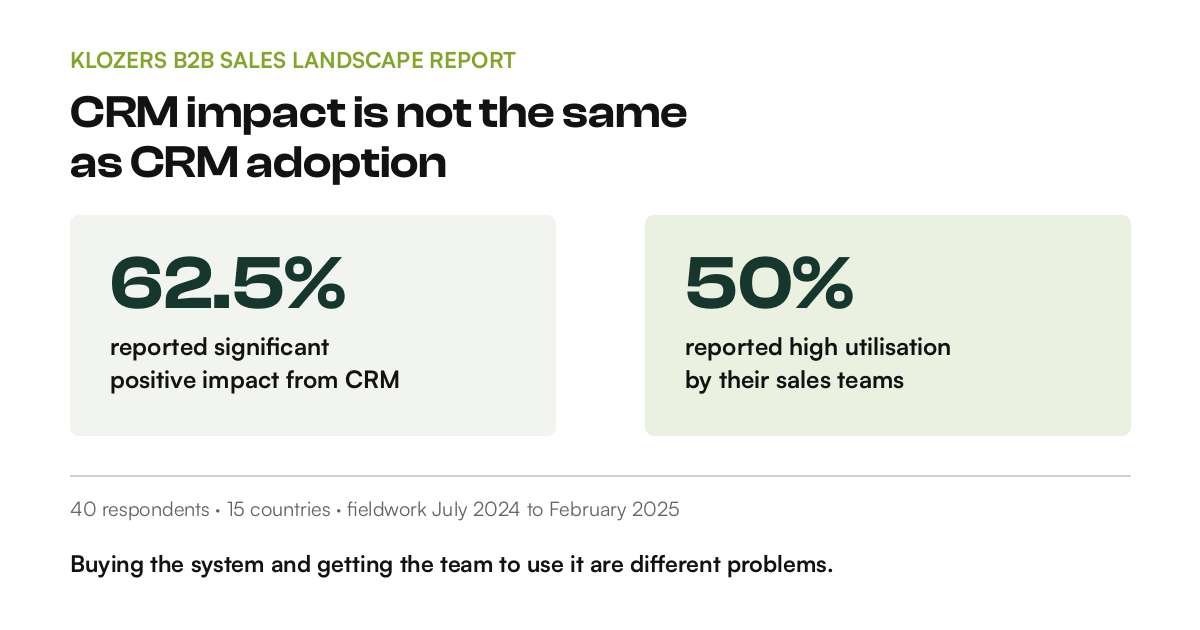
Klozers B2B Sales Landscape Report. 40 respondents across 15 countries, fieldwork July 2024 to February 2025.
Sales technology is software and digital infrastructure used to support sales work, from prospect research and communication to CRM, opportunity management, forecasting, coaching and AI-assisted tasks. It creates value when it supports a sound sales process and useful sales behaviour. It does not fix the commercial foundations of selling by itself.
- Start with the sales problem, not the software.
- Technology cannot fix weak targeting, value proposition, sales-process structure or selling capability.
- A useful tool still fails if the team does not adopt it and follow the agreed process.
- AI adds data-security, accuracy and governance questions alongside its productivity benefits.
- Measure technology by the sales work it improves, not by the number of features available.
What should sales technology actually do?
Sales technology should help your team perform useful sales work more consistently. That might mean finding information faster, recording customer activity, coordinating follow-up, improving visibility of opportunities, preparing for meetings, analysing conversations or reducing repetitive administration.
The important word is support. Technology is a tool used to execute a sales strategy. It is not the sales strategy itself.
That distinction matters because technology projects often start with capability. A sales leader sees what a platform can do and then looks for somewhere to use it. A better starting point is the commercial problem. What is not working? What behaviour, decision or process needs to change? Only then should you ask whether technology can help.
Start with the sales problem, not the software.
What can sales technology not fix?
Technology does not fix sales. It cannot decide which market deserves your attention, create a credible reason for a buyer to choose you, repair a sales process that does not match how customers buy, or give a salesperson skills they have not developed.
Automating a weak process can make the weakness happen faster and at greater scale. A CRM field cannot create a value proposition. An AI prompt cannot decide which market the business should prioritise. A sequencing platform cannot make an irrelevant message relevant.
“Technology can support the way you sell. It cannot decide who you should sell to, why they should buy from you or repair a sales process that does not work.” Iain Swanston, Founder, Klozers
Build the sales system before you add more software.
If the issue sits in targeting, value proposition, process or selling capability, address that first. We can work with your team on the commercial foundations and selling capability that technology needs to support.
Where can sales technology help?
Once the commercial foundations are sound, technology can remove friction from many parts of B2B selling. CRM can provide a shared record of customer activity and opportunity status. Research tools can reduce the time required to understand an account. Communication tools can help salespeople coordinate contact across channels. Conversation analysis can give managers more evidence for coaching. Forecasting systems can make pipeline assumptions easier to inspect.
AI expands that list. It can help salespeople summarise information, prepare questions, draft material, analyse large amounts of text and reduce some administrative work. Those uses can be valuable when the output is checked and the underlying sales judgement remains with the salesperson or manager.
The test is not whether a tool has useful features. The test is whether those features improve a specific part of the work your team needs to do.
Which sales technology categories matter?
It is more useful to group sales technology by the job it performs than by vendor. The categories will change as products add features, but the underlying sales work changes more slowly.
Customer and opportunity records give the team a shared view of accounts, contacts, activity, opportunities and commitments. Prospect and account research helps salespeople identify relevant organisations and prepare for conversations. Communication and outreach supports calls, email, social contact and follow-up. Pipeline and forecasting helps managers inspect opportunity status, assumptions and likely outcomes. Conversation and coaching technology can provide evidence from calls and meetings for review. AI assistance can help with research, summarising, preparation, drafting and analysis.
Those categories overlap. That is another reason not to begin with a shopping list. One platform may perform several jobs, while a sales team may already have unused capability inside systems it owns. Adding another application can increase integration work, duplicate data and give salespeople another place to look for the same information.
For each category, ask the same question: what specific sales work should improve, and how will you know that it has improved? If there is no clear answer, the technology requirement is not yet defined.
Can sales technology become a distraction?
Yes. A sales team can spend significant time researching, configuring, prompting, reviewing dashboards, maintaining data and moving between systems without creating more customer conversations or progressing more opportunities.
Klozers practitioner guidance: AI research creates a particular risk because it can always produce another piece of information. A salesperson preparing for a prospect can continue researching long after they have enough context to make a relevant approach. We have not found primary research that proves AI prospect research causes sales procrastination, so this should not be treated as a measured finding.
The practical control is to define what “enough” looks like. If the salesperson understands who they are contacting, why the account may be relevant and what credible reason they have for starting a conversation, further research should have to justify the extra time it consumes.
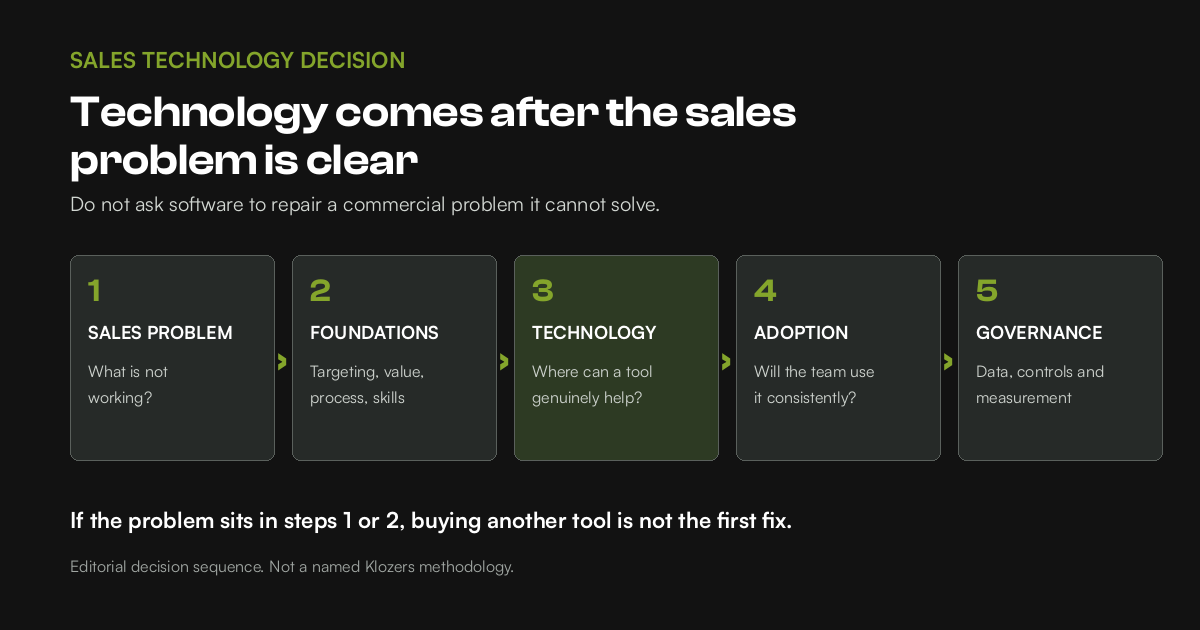
Editorial decision sequence: technology follows the commercial problem and sales foundations. It is not a named Klozers methodology.
Why does adoption matter as much as capability?
A technically capable system creates little value if salespeople avoid it, use it inconsistently or maintain important information somewhere else.
Klozers’ B2B Sales Landscape Report illustrates the gap. 62.5% of 40 respondents reported a significant positive impact from CRM, yet only 50% reported high utilisation by their sales teams. The respondents came from 15 countries and the fieldwork ran from July 2024 to February 2025. In the same research, 22.5% named low user adoption as their largest CRM challenge.
That does not prove that adoption caused or prevented CRM impact. It does show that perceived value and consistent utilisation are different questions.
Before introducing technology, define who will use it, when they will use it, what information must be recorded, what existing activity it replaces and how managers will inspect whether the process is being followed. If a new system simply adds another layer of work, resistance should not be surprising.
How should sales teams use AI safely?
AI adoption needs operating rules as well as training. Salespeople routinely handle names, contact details, meeting notes, commercial information, proposals and customer data. They should not assume that every AI service is an appropriate place to enter that information.
The UK’s Information Commissioner’s Office states that organisations using AI to process personal data must comply with data-protection principles and take a risk-based approach. Its guidance also says personal data must be processed with appropriate security and that AI can make existing security risks harder to manage. The National Cyber Security Centre recommends controls over what data AI systems can access and how generated content is handled according to its sensitivity.
For a sales team, that means agreeing approved tools, defining what information can and cannot be entered, applying the organisation’s data-protection requirements, checking outputs before they reach customers and keeping human responsibility for commercial decisions. This is governance, not a reason to avoid AI.
ICO guidance on AI and data protection provides the authoritative UK data-protection context.
How should you choose sales technology?
Begin with the work. Write down the sales problem in plain language and identify the behaviour or decision that would need to improve for the problem to change. Then check whether the foundations are already in place.
If targeting is wrong, fix targeting. If the value proposition is weak, work on the value proposition. If the sales process does not reflect the buying process, redesign the process. If salespeople lack the skill to run discovery or progress an opportunity, develop the skill.
Only then define the role for technology. Decide what it should make faster, easier, more visible or more consistent. Set the adoption expectations and governance controls before rollout, not after the team has already formed its own habits.
Finally, measure the result that justified the investment. Usage is useful to know, but usage alone is not the business case. The measure should connect to the work the technology was introduced to improve.
Do this on Monday
Name one sales problem.
Write it without naming a tool or vendor.
Check the foundations.
Decide whether the real issue is targeting, value proposition, process or selling capability.
Define technology's job.
State exactly what work a tool should make faster, easier, more visible or more consistent.
Set adoption and governance rules.
Agree who uses it, what process they follow, what data is permitted and how success will be measured.
Frequently asked questions
What is an example of sales technology?
A CRM is a common example. Other categories include prospect research, communication, conversation analysis, forecasting and AI-assisted sales tools. The category matters less than the sales work the technology is intended to support.
Can sales technology improve sales performance?
It can support performance by reducing friction, improving visibility and making useful activity easier to repeat. It cannot by itself fix poor targeting, a weak value proposition, a badly designed sales process or missing selling skills.
Why do sales technology projects fail to gain adoption?
There is no single cause. Problems can include extra administration, unclear value to the salesperson, weak management expectations, poor process design or introducing a system that does not fit the work. Diagnose the adoption problem rather than assuming more training will solve it.
What should sales teams consider before using AI?
Define approved tools, permitted data, checking requirements and human responsibility. Where personal data is processed, UK data-protection obligations apply. Security and data minimisation should be considered before routine use.
Iain has spent over 30 years in B2B sales, selling, training and leading teams both domestically and internationally. He serves as an Associate at Strathclyde University Business School, where he has delivered the sales content for the Masters in Entrepreneurship since 2015. Klozers builds sales programmes from what a client’s own top performers already do, and delivers them on the client’s live deals.
Build the sales system before you add more software.
If the issue sits in targeting, value proposition, process or selling capability, address that first. We can work with your team on the commercial foundations and selling capability that technology needs to support.