
Enterprise Sales Training
Develop the skills required to progress complex B2B opportunities involving multiple stakeholders, competing priorities and longer decision processes. The programme starts with how your team already sells and builds the capabilities needed for your enterprise sales environment.
By Iain Swanston, Founder, Klozers
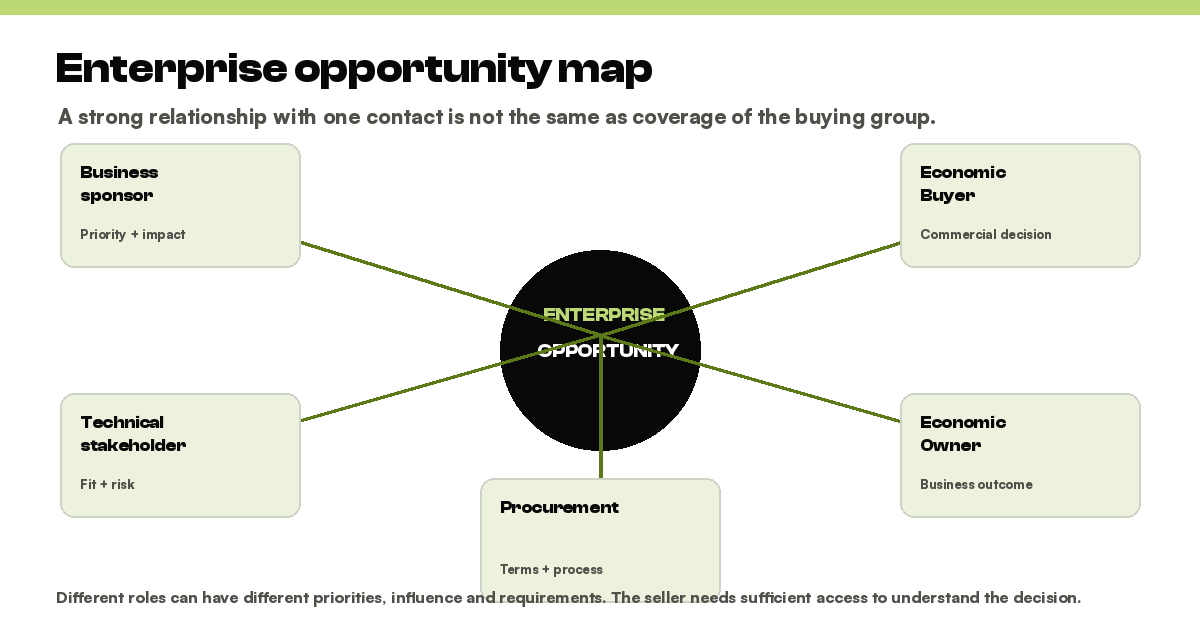
Enterprise opportunities require enough stakeholder access to understand how the buying decision will be made.
Enterprise sales training develops the behaviours required to progress complex opportunities when no single buyer can make the decision alone. It helps salespeople map the buying group, run deeper discovery, communicate value to different stakeholders, build senior-level access, multi-thread relationships and progress the opportunity through an agreed decision process.
- Enterprise sales is not ordinary B2B selling with a bigger deal value. Complexity changes how the opportunity has to be managed.
- A strong relationship with one contact does not provide complete access to a multi-stakeholder decision.
- Different stakeholders can have different priorities, risks and requirements.
- Enterprise salespeople need to create value for the buying group while understanding the commercial decision process.
- The training is built around the client’s enterprise sales environment and existing internal best practice.
What makes enterprise sales different?
Enterprise sales normally involves larger organisations, more stakeholders and a more complex decision process than a straightforward transactional sale. The complexity does not come from deal value alone. It comes from the number of people involved, the different interests they represent, the information they require and the process the customer uses to reach a decision.
Enterprise sales is not ordinary B2B selling with a bigger deal value. Complexity changes how the opportunity has to be managed.
A salesperson can have a strong relationship with an individual contact and still have insufficient access to understand the opportunity. The contact may support the proposal without controlling the budget, owning the business outcome, assessing technical risk or managing the procurement process.
The course therefore develops the ability to understand the wider buying group. That includes identifying the Economic Buyer and Economic Owner as different roles where they are different people, understanding stakeholder priorities, establishing where access is missing and agreeing how the opportunity should progress.
Klozers does not begin by replacing the client’s existing sales process with an external methodology. We identify the practices already producing effective enterprise selling inside the organisation, document what should be retained and add capability where there are gaps.
Who is Enterprise Sales Training for?
The course is designed for organisations whose salespeople need to win and progress complex B2B opportunities.
Enterprise account executives
Salespeople responsible for complex new-business opportunities involving several customer stakeholders.
Business development managers
People developing larger target accounts where access and stakeholder coverage matter before a proposal can progress.
Account teams
Commercial and technical colleagues who need to work together across a complex buying group.
Mid-market suppliers selling into enterprise organisations
Teams that need to navigate the complexity of a large customer’s decision process even though their own organisation is smaller.
What does the Enterprise Sales Training course cover?
Enterprise Sales Training is customised around the client’s sales environment. The following capability areas define the approved structure for this refresh.
Understand the enterprise buying environment
Identify what makes the target opportunity complex, how the customer is likely to organise the decision and where the salesperson needs more information before progressing.
Map the buying group
Identify relevant stakeholders, their roles, influence, priorities and current level of access. Participants distinguish the Economic Buyer from the Economic Owner rather than assuming one person automatically performs both roles.
Run enterprise discovery
Understand the business priorities behind the opportunity, the impact of the problem or opportunity, stakeholder-specific requirements and the decision context.
Build the business case
Connect the proposed solution to the outcomes and value the customer is trying to create. Participants learn to avoid relying on one generic value proposition for stakeholders with different priorities.
Multi-thread the opportunity
Reduce dependence on a single relationship by developing the stakeholder access required to understand and support the buying decision.
Reach senior decision-makers
Develop a credible reason for senior stakeholders to engage and prepare conversations around their priorities rather than the seller’s need for access.
Progress complex opportunities
Clarify the decision process, commitments, actions, responsibilities and next steps needed to move the opportunity forward without confusing seller activity with customer progress.
Negotiate and close enterprise business
Prepare for commercial negotiation, manage the interests involved in the final decision and protect value while working towards an agreement the customer can approve and implement.
Build enterprise capability around the way your customers buy
We identify what already works in your enterprise sales environment before adding new content. The programme can then focus on the stakeholder, discovery, value and opportunity-management capabilities that need to improve.
How is Enterprise Sales Training delivered?
The course is delivered privately and in person for your organisation. Choose a one-day or two-day format depending on the depth of the capability requirement and the amount of practice required.
The final content is adapted to your market, sales process, customer environment and existing internal best practice.
What does B2B buying research tell us about complex decisions?
Gartner B2B buying research
Complex B2B purchases involve buying groups rather than a single decision-maker, increasing the need to understand several stakeholder perspectives.
Group
The sales implication is stakeholder coverage, not dependence on one supportive contact.
Gartner buying journey research
B2B buying is not a simple linear progression. Customers can revisit buying tasks as they work towards a decision.
Non-linear
The salesperson needs to understand what the customer still needs to resolve rather than assume seller activity equals buyer progress.
Complex B2B buying
Different stakeholders can bring different requirements and concerns to the same purchase.
Multiple
Value and risk need to be understood across the buying group, not only through one contact.
These findings describe B2B buyer behaviour. They do not measure the performance impact of this Klozers course.
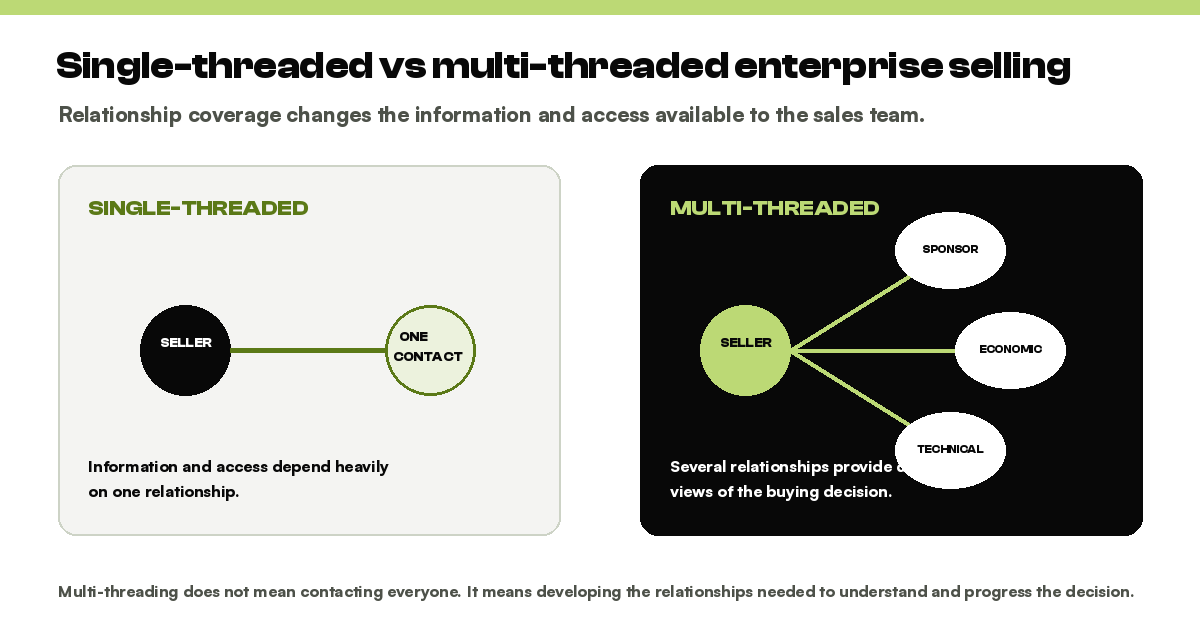
Multi-threading develops the relationships needed to understand and progress the decision. It does not mean contacting every person in the customer organisation.
Is Enterprise Sales Training right for your team?
Designed for
- Salespeople working on complex B2B opportunities with multiple stakeholders.
- Teams that rely too heavily on a single contact inside important opportunities.
- Salespeople who need stronger senior-level access and stakeholder discovery.
- Organisations that want enterprise sales capability built around their existing process and best practice.
Not designed for
- Teams whose immediate requirement is basic sales fundamentals.
- Salespeople who only need a narrow specialist skill such as negotiation.
- Organisations looking for a fixed external methodology regardless of their existing sales environment.
- Teams whose main problem is sales management rather than complex opportunity capability.
How much does Enterprise Sales Training cost?
Price per person
Private in-person organisational delivery. Final scope depends on team size, customisation, location and whether the programme runs for one or two days.
From £720
€880 · US $990 · AUS $1445
What moves the price
- Number of participants.
- One-day or two-day delivery.
- Depth of discovery and customisation.
- Delivery location and associated requirements.
All prices exclude applicable taxes.
What is included
- Discovery to understand the enterprise sales environment and capability requirement.
- Programme design around internal best practice and identified gaps.
- In-person facilitation and practical application.
- Exercises based on relevant stakeholder, opportunity and customer situations.
- Application planning for live enterprise opportunities.
What happens after the course?
Participants apply the agreed behaviours to live enterprise opportunities. Sales managers can reinforce the same standards through opportunity reviews, coaching and normal sales management activity.
Frequently asked questions
What is enterprise sales?
Enterprise sales is complex B2B selling where an opportunity typically involves several stakeholders, different priorities and a more involved decision process. Complexity, rather than deal value alone, is the defining issue for the training.
Do we need to be an enterprise company to use this training?
No. The course is also relevant to smaller and mid-market suppliers selling into enterprise organisations because the complexity sits in the customer’s buying environment.
Is the course customised?
Yes. Klozers identifies effective internal practice first, then builds the programme around the client’s market, sales process, customer environment and capability gaps.
How is Enterprise Sales Training delivered?
Delivery is in person for one or two days. The final format depends on the depth of the requirement and the amount of practical application needed.
Does the course teach a fixed enterprise sales methodology?
No. The programme starts with how the organisation already sells and retains effective internal practice before additional tools or approaches are introduced.
Why is one strong contact not enough in an enterprise sale?
A strong internal contact can be valuable, but that relationship only gives the salesperson one view of the decision. The contact may understand the operational problem without owning the budget. They may support the proposed solution without controlling technical approval, procurement or the business outcome. The risk is not that the contact is unhelpful. The risk is assuming their support represents the whole buying group.
Enterprise opportunity management therefore requires the salesperson to understand who else matters and why. The objective is not to create a large stakeholder list. It is to identify the people whose priorities, influence or approval can materially affect the decision and determine whether the sales team has enough access to understand their position.
That includes distinguishing the Economic Buyer from the Economic Owner. The Economic Buyer may control or approve the commercial decision. The Economic Owner is responsible for the business outcome the purchase is intended to support. In some organisations one person may perform both roles. In others they are different people, and the salesperson needs to understand both.
Multi-threading is the practical response to this complexity. It reduces dependence on a single relationship and provides a broader view of the customer’s decision. The aim is relevant access, not indiscriminate contact.
How should discovery change in a complex enterprise opportunity?
Discovery in an enterprise sale cannot stop when one person explains the problem. Different stakeholders can experience the same situation differently. A technical stakeholder may focus on integration or implementation risk, a commercial stakeholder on cost and terms, and an Economic Owner on the business outcome.
The salesperson therefore needs to build an account-level understanding from several conversations and sources of information. That means testing what has been learned rather than treating the first explanation as the complete requirement. It also means identifying where stakeholders agree, where their priorities differ and what still needs to be resolved before a decision can be made.
Good enterprise discovery should improve the seller’s understanding of the decision, not simply generate more notes. Useful information includes why the organisation is considering change, the impact of the current position, what success would look like, who is affected, who owns the outcome, how the decision will be approved and what could prevent progress.
This creates a stronger basis for the business case because value can be connected to the priorities the customer has actually described rather than to a generic list of product benefits.
What does a business case need to do in enterprise selling?
A business case helps the customer connect the proposed change to an outcome that justifies the investment, disruption and risk involved. In a complex sale, it also needs to make sense to people who may not have participated in every sales conversation.
That means the seller needs evidence from discovery before constructing the case. The problem or opportunity should be clear, the consequences should be understood and the proposed value should relate to priorities the customer recognises. Where the customer has different stakeholder groups, the case may need to address more than one type of value without becoming a collection of unrelated benefits.
The business case also gives the salesperson a way to test the quality of the opportunity. If the team cannot explain why the customer should act, who benefits, what the decision enables and why the change matters now, the opportunity may not be ready to progress.
Enterprise Sales Training should therefore develop the judgement required to build and test the case with the customer rather than teach participants to fill in a generic return-on-investment template regardless of the available evidence.
How should sales teams progress a non-linear buying process?
Complex buying does not always move through a neat sequence that mirrors the seller’s pipeline. Stakeholders can revisit requirements, reconsider alternatives, request new evidence or introduce additional people into the decision. A seller can be busy while the customer makes little progress.
The practical response is to focus on customer commitments and unresolved decision requirements. After a meeting, the important question is not simply whether another meeting has been booked. It is what the customer has agreed to do, what the sales team has agreed to provide, who owns each action and what the action enables in the decision.
This also makes opportunity reviews more useful. Instead of asking only what stage the deal is in, managers can inspect stakeholder access, evidence from discovery, the business case, decision requirements and the next customer commitment. Gaps become visible before they appear as a late-stage surprise.
That discipline is particularly important when the sales cycle is long. Time can create an illusion of progress. Clear evidence of customer action provides a better basis for deciding whether the opportunity is genuinely moving.
How does enterprise sales training fit with an existing sales process?
The training should strengthen the way the organisation sells rather than create a parallel process that participants abandon after the workshop. Klozers begins by identifying what the client’s strongest performers already do well and how the existing sales process is intended to work.
Where effective practices already exist, they become part of the programme. That can include account research, discovery questions, stakeholder terminology, opportunity review standards, business-case formats or agreed ways of working with technical colleagues. Additional content is introduced where the evidence shows a gap.
This methodology-first restraint matters in enterprise environments because the sales process often connects with CRM stages, presales activity, management reviews, commercial approval and forecasting. Introducing new labels without a clear need can create another layer for the salesperson to translate.
The objective is therefore practical adoption. Participants should leave knowing what they need to do differently on real enterprise opportunities and how that behaviour fits the systems and standards the organisation already uses.
How should enterprise opportunities be reviewed after the training?
Enterprise capability is easier to sustain when managers inspect the same evidence that participants were trained to create. An opportunity review should therefore go beyond the salesperson’s confidence that the deal is progressing. It should examine what is known about the buying group, where access is missing, what the customer is trying to achieve and what evidence shows that the decision is moving.
Stakeholder coverage is one useful area to inspect. The manager can ask which people influence the decision, which relationships are established, what each stakeholder appears to care about and whether the salesperson is relying on information passed through one contact. The purpose is not to demand access for its own sake. It is to identify whether missing access creates a material gap in understanding the decision.
The business case is another area. Managers can test whether the proposed value is based on information the customer has provided, whether the Economic Owner’s required outcome is understood and whether the Economic Buyer has a credible basis for approving the investment. Where those answers are weak, the next action should improve the evidence rather than simply advance the CRM stage.
Finally, reviews should distinguish seller actions from customer commitments. Sending a proposal, arranging a demonstration or producing a revised document shows activity by the sales team. A customer agreeing to bring another stakeholder into the process, provide required information or complete an agreed decision task is stronger evidence that the opportunity is progressing. That distinction gives managers a practical way to reinforce the training in normal opportunity management.
When is a different sales course more appropriate?
Enterprise Sales Training is appropriate when complexity across the buying group and decision process is the central capability requirement. Other courses are more suitable when the problem is narrower or occurs in a different sales context.
If the team needs a consistent foundation across the basic sales conversation, Sales Fundamentals is the more appropriate starting point. If the main requirement is deeper questioning and customer-focused conversations, Consultative Selling can address that skill in greater depth. Sales Negotiation is more appropriate where the capability gap is concentrated around commercial agreement and protecting value.
Key Account Management is different again. It focuses on retaining, developing and creating value within strategically important existing customers, while Enterprise Sales Training centres on navigating complex buying decisions and opportunities. The subjects can overlap because both involve multiple stakeholders, but the commercial job is different.
Where several capabilities need to improve together, the programme can combine relevant topics. The selection should follow the sales behaviours that need to change rather than the course title.
Develop stronger enterprise sales capability
Tell us where complex opportunities are becoming difficult to progress. We will scope the programme around your customers, existing sales process and the enterprise capabilities that need to improve.