
Sales Consulting Services: Diagnose Before You Prescribe
Sales problems are rarely solved well by starting with a preferred solution. Establish what is preventing the sales function from performing, then decide what needs to change.
Klozers
Sales execution
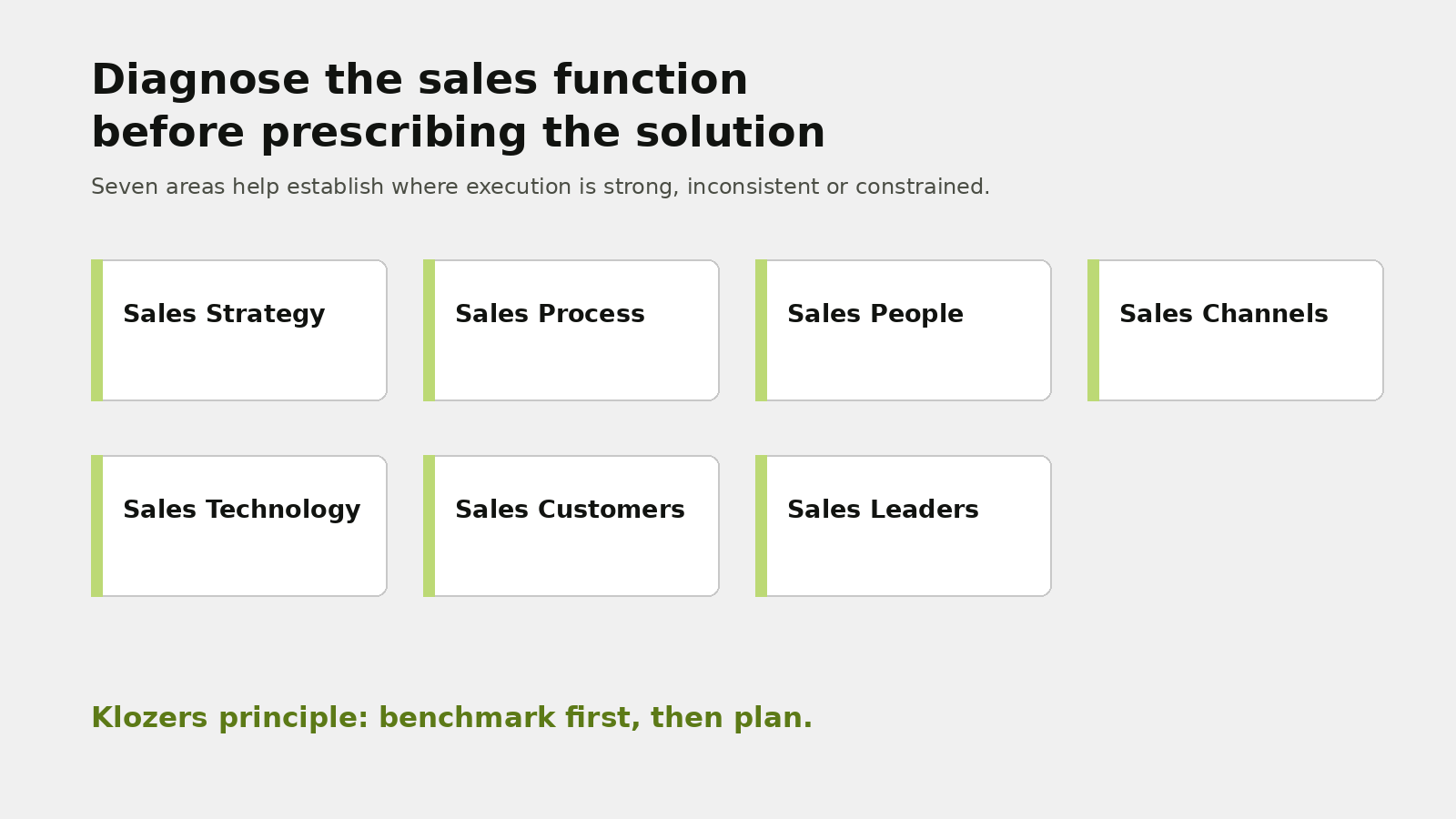
Seven areas provide a structured view of the sales function before an improvement plan is agreed.
Good sales consulting reduces the risk of investing in the wrong solution. Diagnose the sales function first, establish the gap between current and required performance, then decide what intervention is justified.
- Diagnosis should come before sales training, coaching, technology or methodology decisions.
- A sales problem can originate in strategy, process, people, channels, technology, customers or leadership.
- Benchmarking creates a more objective basis for an improvement plan.
- The intervention should follow the cause rather than the consultant’s preferred service.
- Agreed sales execution standards make implementation and inspection more objective.
Sales consulting services should help a leadership team establish what is preventing the sales function from performing as required before recommending what to change. The useful output is not a consultant’s preferred methodology. It is an evidence-based view of the current position, the priority gaps and the actions that will improve sales execution.
What are sales consulting services?
Sales consulting services provide external expertise to diagnose and improve the way a sales function operates. That can include sales strategy, process, people, channels, technology, customer management and sales leadership. The important point is sequence: diagnosis should come before prescription.
A business may approach a consultant because pipeline is weak, forecasts are unreliable, conversion has fallen or salespeople are inconsistent. Those symptoms do not automatically identify the cause. A pipeline problem may begin with qualification. A performance problem may reflect unclear standards. A CRM problem may actually be a sales process problem expressed through technology.
Why should diagnosis come before the solution?
Starting with a solution creates a simple risk: the business can invest time and money fixing the wrong problem. Sales training, coaching, a new methodology, CRM changes and lead generation can all be appropriate interventions. None should be assumed to be the answer before the sales function has been examined.
Klozers takes a methodology-first approach. We benchmark the current position, identify the gaps that matter, agree priorities with the relevant stakeholders and then determine the intervention. This changes the conversation from opinion to evidence.
It also separates symptoms from causes. If salespeople are failing to progress opportunities, more prospecting activity may create a larger pipeline without improving results. If managers do not have an agreed standard for qualification, coaching may remain subjective. If the sales process does not reflect how customers buy, technology can automate inconsistency rather than remove it.
What should a sales consultant examine?
Klozers examines the sales function across seven areas. Together they provide a structured way to establish where execution is strong, where it is inconsistent and where improvement is required.
- Sales Strategy. The choices that define where the business will compete, who it will sell to and how it intends to win.
- Sales Process. The way opportunities move from first engagement to a customer decision, including the standards used to govern progression.
- Sales People. Recruitment, development, capability and objective performance management.
- Sales Channels. The routes used to reach customers and whether those routes are properly supported and managed
- Sales Technology. Whether technology and data improve the customer experience while producing useful management information and accountability.
- Sales Customers. How customer relationships are segmented, managed and measured.
- Sales Leaders. Whether leaders create a positive, supportive environment that rewards and encourages success, and whether the team receives the leadership and management it requires.
This is broader than asking whether individual salespeople need more skills. It examines the system around the salesperson as well as the salesperson.
What does benchmark first, then plan mean?
A sales improvement plan is more useful when it starts with an agreed benchmark. Without that baseline, priorities can be driven by the loudest opinion in the room or by the solution a supplier happens to sell.
The Klozers principle is simple: benchmark first, then plan. Assess the sales unit, identify the gaps, decide which gaps have the greatest commercial consequence and build the improvement plan from that evidence.
The benchmark is not the end of the work. It provides a common starting point for the Economic Buyer, Economic Owner and other stakeholders. It also makes later measurement more meaningful because the business knows what it was trying to change.
What should a sales consulting engagement produce?
A useful engagement should create more than recommendations. The leadership team should leave with a clear view of the current state, the required state, the priority gaps, who owns each action and how progress will be inspected.
Benchmark.
Establish the current position across the relevant parts of the sales function.
Diagnose.
Separate visible symptoms from the underlying causes.
Prioritise.
Decide which gaps have the greatest effect on sales execution and commercial performance.
Plan.
Convert the diagnosis into a practical improvement plan with ownership and measures.
Implement.
Apply the required changes, which may include standards, process changes, leadership support, training, coaching or technology.
Measure.
Inspect whether the agreed behaviours and outcomes are changing.
The intervention follows the diagnosis. That is important because different causes require different responses.
How is sales consulting different from sales training and sales coaching?
Sales consulting diagnoses and improves the sales function. Bespoke sales training develops the knowledge, skills and behaviours required by a team. Sales coaching reinforces application and helps people improve through practice, feedback and manager support.
They can work together, but they are not interchangeable. Training should not be used to compensate for an unclear sales process. Coaching cannot create an agreed organisational standard if leadership has never defined one. Consulting should not continue indefinitely when the required change is capability development.
For this reason, Klozers does not begin with an assumption that every sales problem requires a training programme. The correct intervention depends on the diagnosis.
How do sales execution standards change the consulting conversation?
Consulting becomes more objective when the business has an agreed definition of good sales execution. Without that definition, managers and salespeople can hold different views of what a qualified opportunity looks like, when a deal should progress or what evidence is required before a forecast changes.
Gold Selling Standards provide a route from diagnosis to consistent execution. They allow a business to make important sales behaviours explicit, inspect whether they are being applied and coach against a shared standard rather than personal preference.
This matters because the aim of sales consulting is not simply to produce a report. The aim is to help the organisation improve how sales work is executed after the consultant has left.
How should you choose a sales consultant?
Start by asking how the consultant diagnoses the problem. A credible answer should explain how evidence is gathered, how different parts of the sales function are assessed and how the consultant avoids recommending a solution before the cause is clear.
Then examine implementation. Recommendations that cannot be translated into standards, behaviours, ownership and inspection are difficult to sustain. Ask who needs to be involved, what will be measured and how the organisation will know whether the intervention has worked.
Finally, establish whether the consultant is prepared to say that their usual service is not the answer. A diagnosis has limited value if every route leads to the same product.
What are the warning signs that diagnosis is too narrow?
A narrow diagnosis often appears when the problem has been defined in the same terms as the proposed solution. If the starting assumption is that the team needs training, every performance issue can begin to look like a skills gap. If the starting assumption is that CRM adoption is poor, every inconsistency can appear to be a technology problem.
Senior leaders should expect the diagnosis to test alternative explanations. Are salespeople clear about the strategy? Does the sales process describe how customers actually make decisions? Are managers inspecting the same behaviours? Does the technology support the process, or has the process been shaped around the technology? Are customer relationships being managed consistently? These questions help establish whether the visible problem belongs to one area or is the result of several connected gaps.
This is also why stakeholder involvement matters. The Economic Buyer may see the commercial consequence, while the Economic Owner is closer to implementation. Sales leaders, managers and salespeople can each hold different evidence about the same problem. The consultant’s role is to bring that evidence together without confusing opinion with an agreed benchmark.
What should happen after the consulting work?
The value of the diagnosis depends on what happens next. Priorities need owners, standards need to be clear enough to inspect, and managers need a practical way to reinforce the required behaviours. Where training is justified, it should be built around the gaps the diagnosis identified rather than delivered as a separate event.
For Klozers, this is where consulting connects to execution. The organisation should be able to state what good looks like, observe whether it is happening and decide what support is required when it is not. That may involve a change to process, leadership behaviour, coaching, capability or technology. The important point is that the action is traceable to the diagnosed gap.
When should you consider sales consulting services?
Sales consulting is most useful when the problem is important but the cause is uncertain, when different stakeholders have different explanations for performance, or when a business needs an external benchmark before committing to a wider change programme.
It can also be useful when growth has exposed inconsistencies that were manageable in a smaller team. The objective is not to add process for its own sake. It is to identify the standards, management disciplines and support required for consistent execution.
Before deciding what to buy, establish what needs to change.
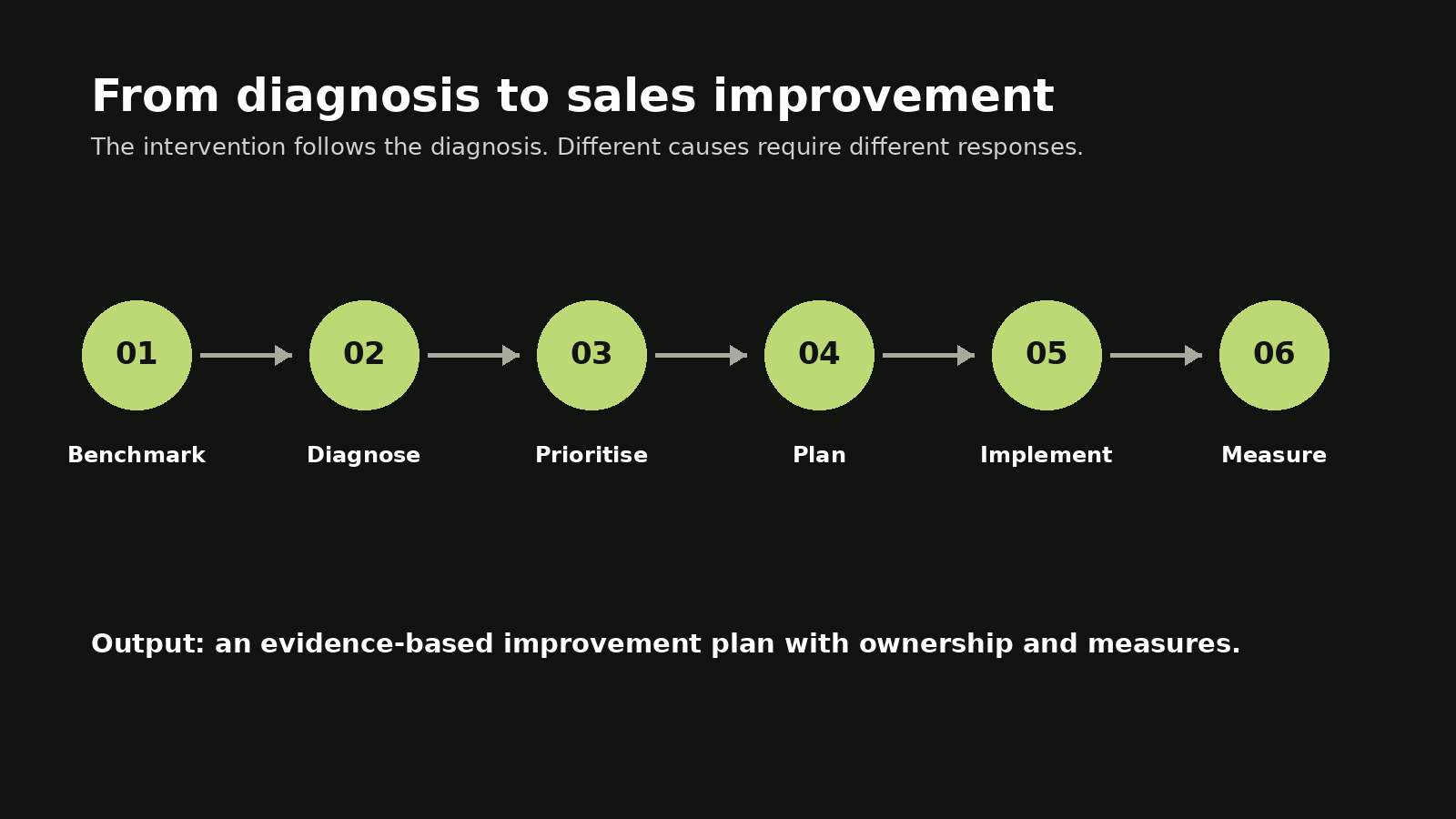
Consulting should move from evidence to diagnosis, priorities, implementation and measurement.
Sales consulting services FAQs
What does a sales consultant do?
A sales consultant diagnoses problems in the sales function, identifies priority gaps and helps the leadership team decide what changes are justified. The work can involve strategy, process, people, channels, technology, customers and leadership.
Is sales consulting the same as sales training?
No. Consulting diagnoses and improves the sales function. Training develops knowledge, skills and behaviours. A consulting diagnosis may identify training as part of the solution, but it should not assume training is required.
What should a sales consulting engagement deliver?
It should deliver an evidence-based view of the current position, agreed priorities, an improvement plan, ownership and measures that allow the business to inspect progress.
When should we use a sales consultant?
Consider sales consulting when the commercial problem matters but its cause is uncertain, when stakeholders disagree about what is wrong, or when an external benchmark is needed before a larger change programme.
Establish what needs to change before deciding what to buy.
We can help you benchmark the sales function, identify the priority gaps and determine the right route to improvement.