Coaching for Sales Leaders – how coaching drives growth

Sales coaching and embedding

Coaching for Sales Leaders

A sales leader’s coaching job is not to coach the salespeople. It is to coach the managers who coach them, so every deal is inspected against the same written standard.

By Iain Swanston, Founder, Klozers

7 minute read
Chart from a Klozers survey of 40 B2B sales leaders across 15 countries, July 2024 to February 2025, with one dot per respondent. 77.5%, or 31 of 40, rate forecasting as highly critical. 20%, or 8 of 40, report full confidence in its accuracy.
Most sales leaders depend on their forecast. Few trust it. The gap is what coaching managers to one standard is designed to close.
In short

Coaching for sales leaders means coaching the managers who lead sales teams, so they coach and inspect every deal against the same written standard. The leader agrees what good looks like, sets KPIs each manager can influence, and checks deal reviews for evidence rather than opinion. A deal moves forward when the buyer’s actions show it has.

On this page

Key takeaways

  1. A sales leader coaches the managers, and the managers coach the salespeople.
  2. Write down what good looks like before you coach anyone against it.
  3. In every deal review, ask what evidence moves the deal forward, not how the salesperson feels about it.
  4. Give each manager KPIs they can influence, and coach where execution falls short of them.
  5. Build the business case for coaching from the gap between your top and average performers, using your own figures.

What is coaching for sales leaders?

Coaching for sales leaders has two meanings. It can mean the coaching a sales leader receives, from an outside coach, on how they lead. Or it can mean the coaching a sales leader gives to the managers who report to them.

This guide covers the second. If you are a sales director, head of sales or chief revenue officer looking for a coach for yourself, see exec sales coaching.

For a leader who runs managers, coaching is the main way the standard spreads through the team. You cannot attend every deal review. Your managers can, and the way they run them decides how the whole team sells.

How do you coach a sales manager?

Agree the sales strategy and the standard in writing, then agree a plan with KPIs the manager can influence. Coach the manager where their team’s execution falls short of those KPIs.

Coach how the manager runs their team, not their deals. Most sales managers were promoted because they sold well. When a deal is at risk, their instinct is to take it over. That may save one deal, but it teaches the salesperson nothing and leaves the manager no time to coach anyone else.

Instead, sit in on the manager’s one-to-ones and deal reviews. Afterwards, ask what they inspected, what evidence they asked for and what action the salesperson agreed. Then agree one change for the next review. That is the coaching.

Why do sales leaders need a written standard?

Because without one, every manager coaches to their own idea of what good looks like. One manager asks about activity. Another asks whether the salesperson has met the person who signs. A third asks when the deal will close. The salesperson learns to satisfy each manager, and the forecast is built on whichever question was asked last.

The result shows in the forecast. In a Klozers survey of 40 B2B sales leaders across 15 countries, carried out between July 2024 and February 2025, 77.5% rated forecasting as highly critical. Only 20% reported full confidence in its accuracy. The sample is small, and 42.5% of respondents work in companies of ten people or fewer. Even so, the gap between how much leaders depend on the forecast and how much they trust it is wide.

A written standard closes that gap. It replaces “how do you feel about this deal?” with “what evidence admits it?”. Every manager asks the same questions, so every salesperson is coached to the same standard.

Gold Selling Standards
Training teaches skills. It does not control how deals are run.

Gold Selling Standards are six operating rules for how deals are qualified, evidenced and admitted to the forecast. Your managers inspect every deal against them.

Qualification Criteria, defined on evidence

Evidence Requirements at every stage

Progression Integrity in the pipeline

Forecast Admission on evidence, not sentiment

Trusted by teams at Microsoft, Panasonic, TikTok, Bizerba, Marangoni and Lathams.

What should managers inspect in a deal review?

Evidence. Progression has to be earned, not asserted. A pipeline stage is a claim about what the buyer has done, not a record of what the salesperson did.

The Klozers Gold Selling Standards give managers six domains to inspect. Each one becomes a question in the deal review:

The six Gold Selling Standards domains as deal review questions. Qualification Criteria: does this deal meet our written definition of qualified? Evidence Requirements: what proof do we have that this deal has reached this stage? Value Articulation: has the buyer stated the value in terms their senior leaders use? Stakeholder Alignment: who in the buying group have we met, and who decides? Progression Integrity: what did the buyer do to move this stage? Forecast Admission: what evidence admits this deal to the forecast?
The same six questions, asked by every manager, about every deal.

The question that matters most is the second. For each stage, agree what proof is expected before a deal can move. A meeting the buyer accepted, a figure the buyer gave or a date the buyer agreed is evidence. “They seemed keen” is not.

Coach managers to ask for that proof every time, and to move the deal back a stage when it is missing. The first few reviews feel uncomfortable. After a few weeks, salespeople bring the evidence without being asked, because they know the question is coming. For a fuller view of the framework, read what CROs need to know about Gold Selling Standards.

How do you build the business case for coaching?

Use your own figures, not an industry average. Four steps:

  1. Take the annual revenue of your top performers and of your average performers.
  2. Calculate the difference for one person.
  3. Multiply it by the number of average performers you have, and decide how much of the gap coaching could realistically close.
  4. Compare that figure with the cost of coaching your managers, and agree both numbers with finance before you start.

The figure finance agrees with is the one you will be measured against. Do not inflate it. A modest number that the business accepts is worth more than a large one that nobody believes.

Who should managers coach first?

Coachability matters more than current results. Coaching needs a person who wants to improve and accepts that they have something to learn.

Most teams have three groups. Top performers already sell well, and what they do is the best material you have. Record how they work, including their weekly activity and how they run each stage, and use it as the baseline for everyone else. The middle group gains the most from coaching, because a small change in behaviour moves a large share of the team’s results. Some salespeople do not want to improve. For them, the manager should hold a direct conversation about performance, not continue coaching.

Do not ignore the last group. Leaving a low performer alone tells the rest of the team that the standard is optional.

What makes sales manager coaching work?

  • It is based on data. Start from the KPIs and the pipeline, not from impressions.
  • It is regular. A fixed time each week or fortnight, not only when a problem appears.
  • It has a structure. Many managers use GROW: Goal, Reality, Options and Will. Any structure works if it is used every time.
  • It focuses on lead indicators. Coach the behaviours that produce results, such as stage conversion and agreed next steps, not only the result itself.
  • Each KPI is inside the person’s control. If someone cannot influence whether they hit it, it measures the market, not the person.
  • It is written down. The salesperson writes their own action after each session, and the manager holds them accountable to their own words at the next one.

Rolling 30, 60 and 90 day targets help too. Quarterly targets alone leave two months in which nothing is measurable. Rolling targets let the manager see a problem while the quarter can still be recovered.

How do you coach a newly promoted manager?

Start earlier than you think. A new manager is usually the best salesperson the team had, and they still measure themselves by their own sales. In the first months, agree what they will stop doing as well as what they will start. They will no longer run the largest deals themselves, and they will spend more time in other people’s calls.

Sit in on their first deal reviews and their first difficult performance conversation. Give them the written standard before they need it, so they coach to it from the start instead of to their own habits.

What gets in the way of coaching?

Two problems come up most often. The first is productivity: whether salespeople do enough of the right work, such as contacting new accounts every week. The second is performance: whether that work turns into progress, measured by conversion from one stage to the next. Each needs different coaching, so agree which problem you are coaching before you start.

Motivation is the third. Salespeople work harder for a goal they care about than for a target they were given. Ask each person what they want to achieve this year and why, and connect their plan to it.

The biggest threat to motivation is an empty pipeline. A salesperson with too few opportunities loses confidence quickly, and confidence affects every call. If confidence falls, check the pipeline before you coach anything else.

How do you know the coaching worked?

Look at what the managers do, then at what the team does. Are deal reviews asking for evidence? Are deals moving back a stage when the evidence is missing? Then look at the results: forecast accuracy, conversion between stages and the number of deals with an agreed next step in the customer’s diary.

On a Klozers programme, each manager receives a Manager Embed Plan, with follow-up calls at 30, 60 and 90 days. Those checkpoints show whether the standard is holding. For how this connects to training across the whole team, read about coaching managers to reinforce standards.

Do this on Monday
Sit in on one deal review this week.

You need one manager, one of their deal reviews and thirty minutes afterwards.

  1. During the review, write down every question the manager asks about each deal.
  2. Afterwards, mark each question as asking for evidence or asking for an opinion.
  3. Agree with the manager one evidence question to ask about every deal at the next review.
  4. Sit in again in two weeks and count how many deals had the evidence ready.

Common questions about coaching for sales leaders

What is the difference between coaching a salesperson and coaching a sales manager?

Coaching a salesperson works on their own deals and behaviours. Coaching a sales manager works on how they coach and inspect their team, so the standard holds across every salesperson they manage.

A fixed session every week or fortnight suits most leaders, plus time in the manager’s own deal reviews. Regular, short sessions work better than occasional long ones.

Ask what evidence supports the deal’s current stage, not how the salesperson feels about it. The six Gold Selling Standards domains give a manager one question for each part of the deal.

Occasionally, to see how the team works. Most of a leader’s coaching time should go to the managers, because the managers coach the salespeople every week.

Klozers offers Exec Sales Coaching: one-to-one coaching for sales directors, heads of sales and chief revenue officers, built on a benchmark of the sales unit.

Founder & Lead Trainer Klozers · London, Dortmund, Austin, Melbourne

Iain has trained and coached B2B sales teams since 2008. He was Lead Trainer and Coach at Microsoft Scotland. Before that he sold capital equipment and managed sales teams in the UK and North America. He served as an Associate at Strathclyde University Business School, where he delivered the sales content for the Masters in Entrepreneurship from 2015 to 2019.

Connect with Iain on LinkedIn

Bespoke sales training
You are not buying a day of training.

You are buying a change in how your team sells, and the proof that it worked. A short call to agree your four topics and a date that works.

Sales Training and Consulting for B2B Companies

sales training and consulting

Why invest in Sales Training and Consulting?

There are normally two reasons companies invest in our Sales Training and Consulting services. Firstly, they are often in a hurry to find sales growth and are looking for a short cut, a growth hack. 

Often these companies would eventually find the right strategies and tactics themselves, but they may be keen to capitalise on their first mover advantage or satisfy the needs of external investors. 

For these companies we provide a shortcut, we help them avoid the pitfalls and roadblocks that every growing  business experiences. 

When you engage with Klozers your team has access to over 70 years experience in B2B sales and marketing. 

Our sales training can help you get the best out of your team, alongside our consultancy services that will help you deploy the changes identified by our consultancy

Let’s take a closer look at why it makes so much sense to use sales training and consulting services together.

1. Why sales consulting compliments your sales training?

Many companies make the mistake of rushing into training as the solution to improving sales performance. 

Indeed, training may be part of the solution, but it is never the whole solution.  Before any training takes place it’s important to understand the root causes of the challenges within the sales department and only when we truly understand the problems can we prescribe the best possible solution. 

By rushing into training we would be assuming that everything else that affects sales is 100% perfect, and that is simply never the case. 

As with anything, the greater the investment upfront in terms of the diagnosis, the more effective the training will be. 

This is because the training can then be customised to meet the exact needs of the business which makes it much more impactful.

Sales Training and consulting companies

2. Why is Sales Training so effective?

Sales training builds both skills and confidence, and those are simply unbeatable in front of a customer.   

The best salespeople are like athletes and they are hungry to learn more and stay at the top of their game. 

The reason they are so good is that they are constantly looking for an edge, an advantage, and this keeps driving them forward. 

These are small but important things that make the difference and gets more deals over the line.  Our training is designed to keep your team at the top of their game and help them benefit from the very latest insights and industry best practice.

Our sales trainers work hard to keep your team engaged and motivated during training sessions, using a range of mediums to maintain their attention and inspire them.

Your sales trainer will help your team sell more effectively whether that be over the phone, in-person or online.

They can help them improve their lead generation, closing and account management skills, and provide indispensable mentoring services.

3. What happens before training takes place?

Before your training sessions begin, it’s important to identify what you want to get from them. As a sales training provider we offer bespoke services that are based on your specific needs and challenges.

We can provide a full sales consultancy service in advance of any training.  This would typically include an evaluation of your current sales unit in relation to sales maturity and best practice.

We can also provide full training needs analysis so you can gain a better understanding of your requirements before staring any training course.

For sales training to be effective, they need to be delivered in a way that maintains your teams’ attention, which means your sessions will include a great deal of interactivity.

Our sales training sessions include a range of demonstrations, exercises, games and roleplay.

Sales Consulting Services

4. What is the aim of Sales Training

Our goal as a provider is not to deliver sales training, but to deliver results. 

Therefore we believe the goal of Sales training is to help you meet a range of sales goals faster than you would if you were to continue without any intervention.

Not every company’s needs are the same, but businesses often invest in sales training because they want to improve their staff’s sales skills, close more deals, create more conversions, make their staff feel more supported, improve morale and boost the average value of their sales.

However, ultimately all of these lead to one overall benefit – an improvement in results. Some companies invest in training because they have identified a particular problem that needs addressing which is being caused by a skills gaps within their businesses.

Training may also benefit your team if they seem to be lacking direction, or are feeling unmotivated. A lack of motivation can often occur because staff are unclear on what their roles are, or because the current strategies they are using are not working.

In many occasions this is why Sales consultancy is a perfect fit alongside sales training as it can also help you identify and deal with additional challenges.

5. How can a Sales Consultant help our business?

A sales consultant will help your business by taking a close look at your current situation, identifying strengths and weaknesses, and helping you make positive changes to drive revenue growth.

If you are not currently meeting your sales targets, our sales consultants can help you find out why this is happening and develop strategies to address the issues.

Our experienced consultants can help with optimising your sales processes and ensuring you get the maximum conversion ratios from the leads you are generating.

With our years of experience in B2B sales our sales consultants can introduce you to specific resources that will support your business.

These can include lead generation, marketing, sales tracking, and training programmes and software that will give you a better insight into how your sales team are performing.

Sales Consulting System

6. Adding Sales Experience to your Leadership Team

When you are immersed in the day-to-day running of your company, it can be hard to assess your situation objectively.

It’s often impossible to find anyone around you who is not objective as your team all have a role which in some way will make them subjective. 

Our sales consultants aren’t just there to identify problems that you weren’t previously aware of, we are completely hands on and happy to work alongside your team to implement any solutions.

Where applicable we will highlight your strengths and help you make the most of the resources that you currently have. In most cases this revolves around the creation of a sales plan, which we work with you to develop and if required are happy to help with executing against the plan. 

Our consultants will work with you to help you improve relationships between departments and colleagues. For instance, we are often called upon for detailed advice on aligning sales and marketing departments so you’re delivering coherent messages to your customers.

Indeed aligning sales and marketing is one of our most popular services.

7. Which Companies benefit the most from Consulting Services

We typically have two types of customers of our consulting services.  The first are larger organisations who already have a Sales Plan in place. 

They need help executing and delivering against the plan as they simply lack the internal resources to do this themselves.

The second group are those looking for external and objective advice.  In some cases they have seen a substantial decline in sales recently or aren’t meeting their targets they need to reach and hence are reaching out for support.

These businesses hire us because we have a track record of turning companies around. Alternately you may need external support if you have experienced changes in your industry and you’re struggling to keep up with your competitors.

Companies also may hire us because they feel missed sales targets are starting to affect morale and staff retention rates.

By investing in training and consultancy services, you can show your team you’re determined to improve and start achieving more.

8. Build a Selling System

It’s also common for companies to invest in sales consultancy services because their sales processes are confused and unclear, with team members pulling in different directions.

We are a huge advocate of having a selling system. Finance has a system, operations have a system so why not sales. Building a repeatable scalable selling system is simply a must for any business.

By mapping this out we can help your salespeople to understand how and where they can influence buyers and sell to people on different parts of their journey, helping you secure more sales.

Our consultants can also help you gain a richer understanding of the data available to you, from both your marketing automation and CRM platforms. 

In many cases our clients either don’t have enough data or they are overwhelmed by data, and miss out on the most important parts.  Either way we can help.  

In Conclusion

Sales is an ever changing environment and more and more businesses are improving their performance, staff retention rates and workplace morale. 

For most of use this means competition is tough and by investing in our sales training and consultancy services we can give you that edge you need to not just compete, but win.  

Sales consultants and trainers can provide invaluable mentorship, help you identify and eradicate weaknesses, and help you make the changes that you need to not only survive but prosper.

Our team can breathe new life into your organisation and inspire people throughout your company. Whether you’ve been missing your targets or are simply ready to build upon recent success and take your business to the next level, there are many great reasons for hiring sales training and consultancy professionals.

If you are ready to hire a sales trainer, sales consultant or both, come and talk with us.


Sales and Service Training Courses

If your business is typical, up to 80% of next years revenues will come from this years customers.  Despite this many organisations give little or no thought to customer service, viewing it merely as a cost to the business. 

In many cases customer service is a cost to the business, however, survey after survey shows customer service as a core component of your brand.  In certain cases some brands who understand the commercial value of great customer service, use it as an opportunity to cross sell and upsell, thus driving additional revenue into the business.

There are so many great statistics for investing in sales and service training once you look into it, it’s difficult to ignore. As an example studies show that 82% of customers leave because of a poor experience and of those 73% leave because of a reaction to rude staff. 

Structured and well supported training can help your team meet your customers expectations and even exceed them. The right sales and service training can make your team more adept at winning customers’ trust, whilst boosting your teams confidence.

The best sales and service training programmes are designed to help companies move away from customer service and towards customer experiences.


How can Sales and Service Training help my team?

Often the biggest challenge in business is winning new customers.  Given that’s the case it surely makes sense to do everything possible to not only keep those customers, but to maximise the revenue from them. 

Most service issues have a simple root problem, for example, 55% of customers are leaving because of delays in resolving a dispute and 51% are leaving because of poor staff training.  What’s possibly most important to note, is that all these problems can be easily remedied.

Sales and service training can give your team a system to measure, track and consistently improve your customer service and sales.  This will help change the mindset of your team, enabling them to make a real impact by being able to identify what matters most and take action to improve. 

When done correctly training can enhance your workplace culture substantially and provide your sales team with additional skills that can benefit them personally throughout their careers.


Why Sales and Service Training is Important


Sales and Service Training

Close More Deals and Learn New Skills

Most companies are unaware of the potential sales opportunities they have with existing customers. With repeat customer spending up to 67% more, sales and service training is more than just handling complaints and returns. 

A big part of resolving customers problems should be finding new solutions to the problems customers encounter.   In most cases the problems that customers experience are actually the best opportunities for cross selling and upselling.

Training can introduce your team to new strategies and tactics that they may simply never come across before. In addition to external input, there are often great lessons that can be shared internally, and these should be captured and documented for the benefit of others. 

Training will help your team become more familiar with your own company’s best practices. In a well structured sales and service training programme, your staff will not only learn new techniques, but also find out why they are so effective and which situations they should be deployed in.


Benefit from External Sales Specialists

Often a key benefit of sales and service training is that it gives your team a chance to take onboard new ideas and strategies from outside the business.  In many cases they are more open to learning from external facilitators with an in-depth knowledge than from internal colleagues.

Sales and service specialists can give your team more than just the skills they need to engage potential customers in meaningful conversations.  They can help you explain on your customers terms why your products and service may be a good fit for them.

Sales and service training will help your team use the product knowledge and information that they have about your products and services, and turn this into powerful questions that make the buyer want to buy rather than them having to sell to them.    


Retain the Best Staff

Many companies are now switched on to the fact that it’s easier to retain quality staff when you invest in training courses for them.

If your team members feel you aren’t investing in them, there’s a high possibility that they will move to a company that will. Investing in training shows your employees that you are eager to help them improve.

When staff receive quality training, they tend to feel more supported, which in turn boosts their confidence. Recruitment costs to replace team members can be incredibly expensive and take up an inordinate amount of management time.  

It’s therefore important to try and keep hold of the employees that you have already invested in and continue to develop them.

benefits of sales and service training


Sales and Service Training

Should Managers attend Sales and Service Training?

Sales Managers are responsible for the day to day activities and performance of those activities for members in their team. 

Your Managers set the bar in terms of what is acceptable performance and what is not.  With this in mind, it’s important that sales managers attend every sales and service training along with their staff so they can hear the information first-hand.

When managers know exactly what’s covered and agreed during training, they can ensure their staff apply this knowledge to real-life scenarios and coach them if they are struggling.

Sales training often includes an element of goal-setting, which is yet another reason why it’s so important for managers to attend. It’s important for the managers to set realistic, yet achievable goals, rather than targets that are out of your team’s reach. 

Failure to do this will simply harm the confidence of the team and demotivate them.


Increase your Customer Satisfaction Ratings

Training like everything else in your business needs to deliver a return on your investment.  Whilst not everything should be judged by customer service scores, any service training should ultimately  improve your customer satisfaction ratings.

Customer expectations are arguably higher than they have ever been and today’s customers expect to receive high-quality service more than ever before.

If they have a bad experience with a member of your team, they’re likely to make their opinions public and Social Media can amplify bad news like never before. 

Customer Service training will not only teach your team to deliver the best customer experiences possible, but also turn your happy customers into advocates for your brand, thus generating new business referrals.


Omnichannel Customer Support

Modern customer service training often starts before your customers have even made a purchase.  In most cases your customers first interaction with your brand is either your website or social media pages. 

It’s important to include these as part of your wider customer experience strategy. This is supported by many statistics for example, using three channels instead of one for marketing campaigns results in a 287% higher purchase rate. 

Providing Omnichannel customer support helps your team keep your clients happy across a range of channels and mediums. It can help them communicate with your customers better not only over traditional channels like the phone, but also via live chat, email, social media, SMS and other platforms.

The most successful customer service teams around today adopt an omnichannel approach with research showing that companies with an omnichannel approach experience a 23 fold increase in customer satisfaction.

We believe it’s really  important to include these areas in your service programme. Many companies are failing to meet their customers’ expectations which makes it easier for you and your team to stand out from the crowd and win business from them.  


Sales and Service Training Course


Sales and Service Training

Build Expert Product Knowledge

No matter the industry customers want to deal with experts and not agents who are simply following a call centre script.

Sales and service training encourages your team to get to know your products inside out so they can answer any and every relevant question they might be faced with.

If sales reps don’t have the knowledge that they require, they are more likely to leave customers feeling frustrated, with the customer going on to air their feedback publicly.

The more your reps know about your products and services, the better they can address customer pain points and explain why your solutions are the answer to their problems. 


Enhance Customer Loyalty

Repeated studies show that customers tend to be much more loyal to companies that offer outstanding customer service. Many of today’s customers say that customer service is more important than price when they’re deciding who to do business with.

By investing in sales and service training, you can attract and retain more customers and gain a real edge over your competitors.  Part of your overall programme should include how you plan to collect and share customer reviews. 

With 70% of people taking action based on customer reviews this is an essential component of every sales and customer service training.


Resolve Disputes Quickly

Delays when resolving complaints can often be the straw that breaks the camels back with 55% of people leaving a brand because of delays in resolution.

Sales and service training can help your reps resolve complaints quickly which is important when dealing with angry and frustrated customers.

Training can help them show tactical empathy when they are dealing with an angry customer and enable them to steer the conversation in the right direction, no matter which medium they are communicating on.

Understanding active listening skills can turn your team into better, more helpful listeners that pay close attention to what your customers have to say and then use the skills and information they have to deliver the best outcome possible.


Customer Service Training

Unlike traditional customer service training courses, Klozers provides the latest in business simulation software, that allows your team to experience a 2 year customer experience transformation program in 1 day.  

Our state of the art business simulation goes way beyond basic communication skills and helps your sales team understand customer expectations, sales process, and what truly drives sales performance across the organisation. 

Designed specifically as a holistic cross departmental our customer service courses are designed to engage everyone from your front line sales team, product and services teams and company management.  

The customer service training includes two options as follows:

Enterprise Customer Service Training

SaaS Customer Success Training

Please contact us for further information.  

customer service training courses

In Summary

How important is retaining your existing customers? 

How valuable would the extra revenue be if your customer service team were actively cross selling and upselling throughout their day?  

Investing in sales and service training will make your staff and customers much happier. If you look after your staff they will in turn look after your customers. 

If you feel you need to make improvements in these areas, please give us a call. We would love to work with you and make the sales and service goals you have in mind a reality.

Sales Negotiation Training

Key Negotiation Skills – Introduction

There is a common misconception that sales negotiation skills are only required towards the end of the sales process.  The part in every sales process where costs and terms are agreed.  Whilst this is undoubtedly true, it’s also true that the best salespeople are negotiating all the way through the sales process.  In fact every Professional salesperson negotiates, every single day which is why it’s an important part of any training programme. 

From negotiating with their children on what to have for breakfast, to negotiating with a Partner on where to go for dinner.  In between times they will negotiate workloads with their line managers, negotiate meeting times with co-workers, negotiate dates & times for appointments with prospects and lastly negotiating sales contracts, project delivery and aftercare contracts.  In short, Negotiation is actually unavoidable, and the ability to Negotiate is a core skill for every Salesperson.

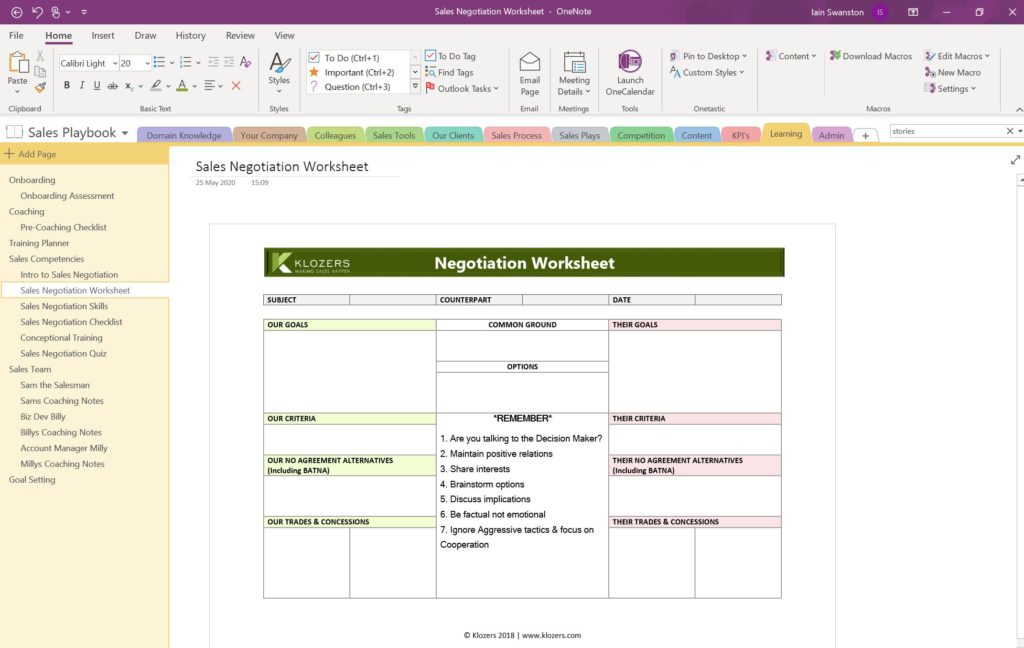
Planning for Sales Negotiations

Like most things in life when it comes to Negotiation knowledge is power.  The more information you have and better prepared you are then the more likely you will achieve a successful negotiation. Follow the information below to discover how to research and plan your next negotiation.

Sales Negotiation Goals

These are the needs, wants and desires of the parties involved in the negotiation.  In business this can be complicated as not only may both sides have differing goals, but parties within each side may have differing and even conflicting Goals.

Goals can be subjective for example “We need to increase the confidence of our people.” or they can be more objective like “We need to reduce our overheads by 10 this quarter”.  Either way it’s important to know both your own Goals and that of the other side.  Important questions you must ask are:

  • Have we identified all the Goals?
  • What are the Prioritised Goals?
  • What are the Business Goals?
  • What are the Personal Goals?
  • Are there conflicting Goals?
Business Goals Examples Personal Goals Examples
Strategic Security
Change Satisfaction
Growth Peer Pressure
Improvement Financial Gain

Please note Goals are NOT the same as outcomes.

Example:

Goals – George is 65 years old and would like to retire (Goal).  In order to fund his retirement he needs to sell his business but no one wants to invest a large sum of capital.  Mike would like to buy a business (Goal) but does not have any capital to invest. 

The Outcome is the Negotiated agreement that they come to.

Negotiation Options

These are all the possible solutions that satisfy the goals of both parties.  They are all possibilities that both parties agree or say Yes to.

By investing time to explore all the Options then you are more likely to find:

  • Alternative solutions
  • Enable both parties to achieve their goals
  • Reach the Best Possible Agreement (BPA)

Example:

Goals – George is 65 years old and would like to retire (Goal).  In order to fund his retirement he needs to sell his business but no one wants to invest a large sum of capital.  Mike would like to buy a business (Goal) but does not have any capital to invest. 

Option – George can sell his business to Mike but rather than invest a lump sum he agrees to pay George on a Monthly basis from the profits for the next 5 years and hence fund his retirement. 

Criteria for Negotiation

Criteria are the “terms” of any possible Option

Example:

Goals – George is 65 years old and would like to retire (Goal).  In order to fund his retirement he needs to sell his business but no one wants to invest a large sum of capital.  Mike would like to buy a business (Goal) but does not have any capital to invest. 

Option – George can sell his business to Mike but rather than invest a lump sum he agrees to pay George on a Monthly basis from the profits for the next 5 years and hence fund his retirement. 

Criteria – George needs to guarantee a minimum payment every month regardless of the profitability of that month.  Mike needs to ensure ensure he will not be liable for any warranty, liability or compensations claims from the period before he take responsibility/ownership of the business.

Get expert Sales Negotiation Training from our Sales Coaches

CNA – Cost of No Agreement

Not all Negotiations end in an agreement, it is therefore vital before entering into any Negotiation that you first work out what the Cost of No Agreement is for both parties.  The costs of no agreement can be both Objective and Subjective.

Example:

Goals – George is 65 years old and would like to retire (Goal).  In order to fund his retirement he needs to sell his business but no one wants to invest a large sum of capital.  Mike would like to buy a business (Goal) but does not have any capital to invest. 

Option – George can sell his business to Mike but rather than invest a lump sum he agrees to pay George on a Monthly basis from the profits for the next 5 years and hence fund his retirement. 

Criteria – George needs to guarantee a minimum payment every month regardless of the profitability of that month.  Mike needs to ensure ensure he will not be liable for any warranty, liability or compensations claims from the period before he take responsibility/ownership of the business.

CNA – George does not have the financial resources to retire (Objective) however he has been trying unsuccessfully to sell his business for three years and is now desperate (Subjective) for a solution.  Mike is keen to buy a business (Objective) but knows there are hundreds of businesses for sale and he is pretty relaxed (Subjective) if this deal doesn’t go through another one will come along.

The Subjective Cost of No Agreement can be more powerful than the Objective ones as people make decisions emotionally and then justify their position intellectually afterwards. 

BATNA – Best Alternative to No Agreement

Not all Negotiations end in an Agreement, it is therefore vital before entering into any Negotiations that you first work out what the Best Alternative to No Agreement is.  In some cases you may well experience that the other party is so entrenched in their position that they have no desire to Negotiate.  BATNA is typically but not always, an alternative course of action that can be taken if no agreement is reached.

BATNA helps you prepare for a Negotiation by:

  • Helps prevent you from agreeing to something you will regret
  • Defining your Minimum Possible Agreement (MPA)
  • Provides you with a Plan B
  • Helps prevent you from over or underestimating the your own and the other party’s position
  • Helps you understand where the leverage is
  • Identifying alternative Options

Example:

Goals – George is 65 years old and would like to retire (Goal).  In order to fund his retirement he needs to sell his business but no one wants to invest a large sum of capital.  Mike would like to buy a business (Goal) but does not have any capital to invest. 

Option – George can sell his business to Mike but rather than invest a lump sum he agrees to pay George on a Monthly basis from the profits for the next 5 years and hence fund his retirement. 

Criteria – George needs to guarantee a minimum payment every month regardless of the profitability of that month.  Mike needs to ensure ensure he will not be liable for any warranty, liability or compensations claims from the period before he take responsibility/ownership of the business.

CNA – George does not have the financial resources to retire (CNA) and has been trying unsuccessfully to sell his business for three years and is now desperate for a solution.  Mike is keen to buy a business and has spent £3,000 with Solicitors and Accountants thus far completing his due diligence on the company. 

BATNA – George is in discussion with his Lawyers to explore the possibilities of a Management Buyout for the business.  Mike knows there are hundreds of businesses for sale and he is pretty relaxed if this deal doesn’t go through another one will come along.

Concessions for Negotiation

A concession is something given to the other party in furtherance of the agreement.  These concessions should be identified in advance and segmented for both parties in terms of:

High Value – High Cost

High Value – Low Cost

Remember – Never give anything away without receiving something of equal or greater value in return.

Example:

Goals – George is 65 years old and would like to retire (Goal).  In order to fund his retirement he needs to sell his business but no one wants to invest a large sum of capital.  Mike would like to buy a business (Goal) but does not have any capital to invest. 

Option – George can sell his business to Mike but rather than invest a lump sum he agrees to pay George on a Monthly basis from the profits for the next 5 years and hence fund his retirement. 

Criteria – George needs to guarantee a minimum payment every month regardless of the profitability of that month.  Mike needs to ensure ensure he will not be liable for any warranty, liability or compensations claims from the period before he take responsibility/ownership of the business.

CNA – George does not have the financial resources to retire (CNA) and has been trying unsuccessfully to sell his business for three years and is now desperate for a solution.  Mike is keen to buy a business and has spent £3,000 with Solicitors and Accountants thus far completing his due diligence on the company. 

BATNA – George is in discussion with his Lawyers to explore the possibilities of a Management Buyout for the business.  Mike knows there are hundreds of businesses for sale and he is pretty relaxed if this deal doesn’t go through another one will come along.

Concessions – George is prepared to spend 3 months of his time ensuring during the handover period which is Low Cost to him as he will be retired but High Value to Mike as he is new to the industry and recognises the benefit of George’s experience.

Mike is prepared to move quickly which has no cost to him however this is High Value to George as the last thing he wants is a long protracted sale.

Negotiation Strategies

Aggressive Tactics

  • Shoot the hostage
    • This strategy is extremely aggressive as it involves an immediate offer to walk away with no deal which is designed to throw and unsettle the other party.  This is often delivered in a reluctant tone “we don’t want to do this but…”,
  • Delaying tactics
    • When time is clearly on one parties side the process can often be deliberately slowed which is extremely effective when there are cost implications if talks over run.  This tactic also applies if the other party has another meeting or needs to leave.  The negotiator deliberately talks around the subject to delay the real conversation and then uses time to put pressure on the other party to come to an agreement.
  • Poor Me
    • This strategy is used to play the false victim that needs rescued by the other party.
  • Last Minute.com
    • As the name suggests this strategy involves the Negotiator agreeing to a solution right up until they are required to sign and then withdrawing.  The withdrawal is usually followed up quickly with a counter offer at dramatically reduced terms.
  • Misleading/lying
    • Often Negotiators will make exaggerated claims or even lie so without hard data to support them you should discount these.  They may also issue warnings and threats or make matters personal to unbalance you.
  • Missing People
    • Everyone knows the importance of having all the Decision Makers in the room but Negotiators may even turn up with complete strangers.  In sales some companies will remove Sales People from the final negotiations.  If the Sales People have a relationship with the other party they could be more empathetic and weaker negotiators.  Turning up without warning with complete strangers also unbalances the other party.

Co-operative Tactics

  • Agree on the Process
    • Spend time up front agreeing the process and format of the Negotiations including what’s in scope and what’s not.
  • Win Win Agreements
    • Most professional Negotiators accept that any final agreement must be fair and sustainable for the life of the time period.  In most business scenarios it should never be win at all costs as this destroys relationships.
  • Matching Rights
    • Offer the other party the right to match any solution that you receive.  For example if one of two business partners decides to sell their shares to another party they may have the agreement that the other party gets first refusal if they match the offer.
  • Contingent Agreements
    • These are simply agreements based on future events.  Financial Bonus may be tied to Performance.  Football transfer fees can be include Contingent Agreements that provides the selling club additional revenue if a player is sold on and or if a player is capped by their country or simply makes a certain number of appearances.
  • Multiple Offers
    • When multiple offers are placed on the table this allows both parties to indicate preferences and encourages creativity as a winning hybrid offer can be formed.  Placing one offer on the table often leads to a refusal and a stall in the process.

Sales Negotiation Checklist

1.  Be prepared to walk away.  Sales Negotiation is 70% Mindset and 30% Strategy and unless you are prepared to walk away, no strategy will help you.

2.  It’s not what you charge it’s what your worth.  Thoroughly research the market and discuss with the buyer the Value you bring to the table?

3. Take council from colleagues and external advisors and agree a pre-meeting strategy for the negotiations then PRACTICE.

4. Never give anything away without receiving something of equal or greater value in return.

5. Never enter a Negotiation without first providing your price and outline terms in advance, to anchor the prospect to a higher number and terms.

6. Where possible in high value deals do not include your sales people in Negotiations, as they will be emotionally involved in the sale and not objective.

7. Ensure everyone in your team have agreed in advance your trade-offs, your concessions, and your best alternative to a negotiated settlement.

8. You must be comfortable with silence and at most only talk 30% of the time, as the more you talk the more information you are giving away.

9. If it’s not Win Win then you run the danger of the prospect backing out or failing to implement your agreement, then the lawyers are the only winners.

10.  Negotiation is between human beings, you must therefore be familiar with Human Psychology, DiSC, Neuro Linguistic and Programming.