
Sales Simulation O.S.
Pilots do not learn to fly in a classroom. Sales Simulation O.S. gives established B2B sales teams realistic decisions to make, so leaders can see how consistently agreed sales practices are applied.
By Iain Swanston, Founder, Klozers
- Updated 3 September 2026

A sales simulation is a facilitated, realistic exercise that shows how a sales team applies what it knows when decisions have consequences. Klozers configures the simulation around the client’s market, buyers and sales environment, then uses the decisions made during the exercise as evidence for a structured debrief and reinforcement plan.
- Sales training develops capability. Sales simulation makes application observable.
- The simulation is configured around the client’s buyers, market and commercial environment.
- Facilitators observe decisions on qualification, value, stakeholders and opportunity progression.
- Sales Simulation O.S. can support multilingual teams, including German-language delivery.
- The output is evidence for a leadership debrief and focused reinforcement, not another attendance record.
What does a sales simulation show that training cannot?
Training can teach a framework, explain a method and create structured practice. It cannot, by itself, show you how consistently the team will apply that knowledge when information is incomplete and competing priorities appear at the same time.
Sales Simulation O.S. compresses realistic sales situations into a facilitated environment. Participants make choices, receive new information and decide what to do next. Those decisions give the facilitator and leadership team something concrete to discuss in the debrief.

Who this is for
Sales Simulation O.S. is designed for established B2B teams where leaders want evidence of how sales practices are applied, not another explanation of what those practices are.
Sales Directors and CROs
Use the simulation to observe where execution is consistent and where the team needs clearer reinforcement.
HR and L&D leaders
Use a realistic application exercise when attendance and feedback forms are not enough evidence of transfer.
Sales Enablement
Test whether agreed practices are showing up in the decisions participants make across a complex sales situation.
International sales teams
Configure scenarios for different markets and working languages while keeping the same underlying commercial standards.
If you already know what good should look like, the next question is whether it appears consistently in real decisions. We can discuss the commercial situations you want the simulation to test.
How is Sales Simulation O.S. delivered?
The service is facilitated. Technology supports the room, the timing and the decision record, but clients are not buying a software licence. Klozers researches the sales environment, configures the scenarios and facilitates the exercise.
- Research the sales environmentWe speak with relevant leaders and top performers and identify the buyer context, sales situations and execution priorities the simulation needs to represent.
- Configure the scenarioThe simulation is built around realistic accounts, decision points and information. The level of detail reflects the client environment rather than a generic case study.
- Run the simulationTeams work through timed decisions. The facilitator releases information, observes the discussion and records the choices made.
- Debrief the evidenceThe debrief connects each decision to the agreed sales practices and identifies patterns that need reinforcement.
- Agree the next actionsLeadership receives priorities for reinforcement and participants can leave with focused actions rather than a generic list of learning points.
The interface and scenario content can be configured for multilingual use cases. The Bizerba Deutschland example below is deliberately shown in German because the working language is part of the implementation.

Organisations we have worked with.


What evidence do clients have after the simulation?
The simulation produces observed decisions and a structured debrief. The figures below are first-party outcomes already published by Klozers from individual engagements. They are not guarantees of what another client will achieve.
Reported within 90 days of the engagement.
Increase in deal value.
Reported within 90 days of the engagement.
Increase in qualified deals.
Reported from the engagement.
Reduction in early-stage discounting.
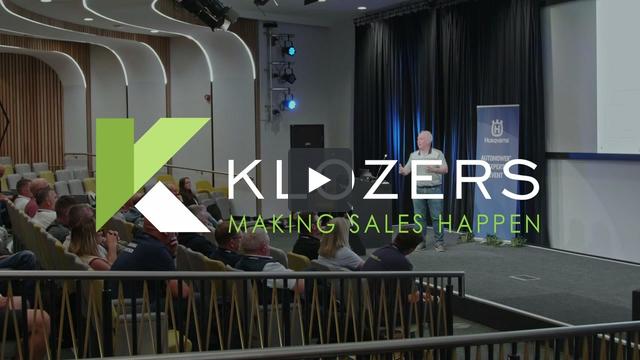
The approved Husqvarna video testimonial belongs here as supporting client evidence. The video is intentionally contained rather than presented as a full-width feature, so it supports the proof section without taking over the page.
Is this right for your team?
| Designed for | Not designed for |
|---|---|
| Established B2B sales teams with agreed sales practices. | Individual learners looking for a public course. |
| Complex sales environments where judgement matters. | Teams that first need foundational sales skills training. |
| Leaders who want observable evidence of application. | Buyers looking for a standalone software licence. |
| Teams that need a shared debrief and reinforcement priorities. |
Qualifying the format matters. A simulation is useful when the team has something meaningful to apply. Where the first requirement is capability development, bespoke sales training is usually the better starting point.
Investment
The current published Klozers price is a range because team size and customisation requirements change the scope.
| What | From |
|---|---|
| Sales Simulation O.S. Research, configuration, facilitated simulation and leadership debrief. | £12,000 Current published range: £12,000 to £70,000. |
- Team size and number of participants.
- Depth of research and scenario customisation.
- Languages required.
- Locations, facilitation requirements and travel.
GBP is shown because no approved current EUR, USD or AUD equivalents were found in the governing project material. No currency conversions have been invented.
What is included
- Research into the commercial environment and agreed execution priorities.
- Client-specific scenario configuration.
- Facilitated simulation delivery.
- Structured debrief and execution-gap analysis.
- Participant action priorities and leadership recommendations.
The evidence can be used by sales leadership, enablement or L&D to decide what needs reinforcement. Where additional support is required, Klozers can scope manager reinforcement, coaching or live-opportunity work separately.
Frequently asked questions
Is Sales Simulation O.S. software?
No. It is a facilitated service. Technology supports the exercise, but the commercial offer includes research, configuration, facilitation and debrief rather than a software licence.
Is the sales simulation customised?
Yes. The scenarios are configured around the client’s market, buyer context, commercial environment and agreed execution priorities.
Can the simulation be delivered in other languages?
Yes. The Bizerba Deutschland example on this page shows a German-language implementation. Klozers has also published an engagement involving 96 salespeople working across seven languages.
How long does the simulation take?
The current Klozers format uses a one-day facilitated simulation after research and configuration. The preparation period varies with the depth of the client-specific scenario.
What do leaders receive afterwards?
The service includes a structured debrief and execution-gap analysis so leadership can see the patterns observed during the simulation and decide what to reinforce next.
Why is application more useful than another knowledge test?
A knowledge test can tell you whether someone remembers a definition, a framework or a sequence. That may be useful when the objective is recall. It is a weaker test when the commercial question is whether a seller can choose what to do when the information is incomplete, multiple stakeholders matter and the next action affects the quality of the opportunity.
Sales Simulation O.S. therefore uses decisions rather than recall as the evidence source. Participants need to decide what information matters, what they still need to learn and what they should do next. The facilitator can then compare the reasoning and the action with the agreed sales practice.
This does not prove that the same decision will be made in every live opportunity. A simulation is still a controlled exercise. What it does provide is a more relevant discussion about application than a test that asks participants to repeat what they were taught.
How does the pilot and classroom metaphor apply?
Pilots do not learn to fly in a classroom alone. They learn concepts, procedures and systems, then they practise application in controlled environments before those decisions need to be made in a live situation. The comparison is useful because sales training has the same gap between knowing and doing, even though the commercial consequences and professional standards are different.
Klozers retains the metaphor for one reason: it makes the purpose of the simulation clear. The simulation is not there to entertain the team or to add another workshop format. It exists to create a realistic place to apply what the team is expected to know.
The metaphor should not be stretched beyond that. A sales simulation is not an aviation simulator and it does not make sales behaviour risk-free. It gives leaders a controlled view of decision-making that is difficult to obtain from classroom discussion alone.
What should leaders observe during a sales simulation?
The useful observations are not whether someone speaks confidently or appears competitive. They are the sales decisions that shape opportunity quality. Qualification is one example: what evidence does the team require before it invests more time? Value is another: does the team connect the buyer’s problem to a commercial outcome before describing the solution?
Stakeholder navigation matters because complex B2B sales involve different roles. The Economic Buyer releases the money. The Economic Owner owns the pain of the problem and the outcome the purchase must deliver. A simulation can expose whether the team treats those roles as separate and whether it has evidence that both have been engaged appropriately.
Progression is equally important. A team that moves an opportunity forward because activity happened is making a different decision from a team that requires specific evidence. The debrief can make those differences visible without pretending that one isolated exercise proves future performance.
How does multilingual delivery change the simulation?
Language changes more than the interface labels. Buyer information, commercial wording and team discussion need to be usable in the language in which the participants actually sell. A translated shell around an English scenario would not provide the same level of realism.
The Bizerba Deutschland implementation on this page shows the principle in practice. The simulation is presented in German so the participants can work with the buyer context and commercial decisions in their working language. The purpose is not to create a different methodology for each country. It is to remove avoidable language friction from the application exercise.
For international programmes, the design question is therefore what should remain common and what needs localisation. The commercial standards can remain consistent while the scenario language, account context and local market detail are adapted.
What should happen after the simulation?
The debrief should not finish with a generic list of strengths and weaknesses. Leaders need to decide which observed patterns matter commercially, which can be addressed through reinforcement and which indicate a deeper capability or process issue.
That distinction prevents the simulation becoming an isolated event. A pattern such as early discounting may require managers to reinforce value conversations. Weak stakeholder coverage may require clearer opportunity-review standards. Inconsistent qualification may indicate that the team has not agreed what evidence is required before an opportunity progresses.
This is where workplace learning transfer is relevant. CIPD describes learning transfer as applying newly acquired knowledge and skills to real-life workplace situations. That source is adjacent workplace L&D evidence and did not study sales simulations specifically. Read the CIPD discussion of learning transfer.
We can discuss the sales situations, buyer context and execution priorities your simulation needs to represent. The first step is to decide what you actually need to observe.