
Sales Coaching
Sales coaching is how a manager keeps training in use on live deals. Coached against one agreed standard, the same sessions also produce the evidence that behaviour changed.
By Iain Swanston, Founder, Klozers
- Updated 11 November 2026
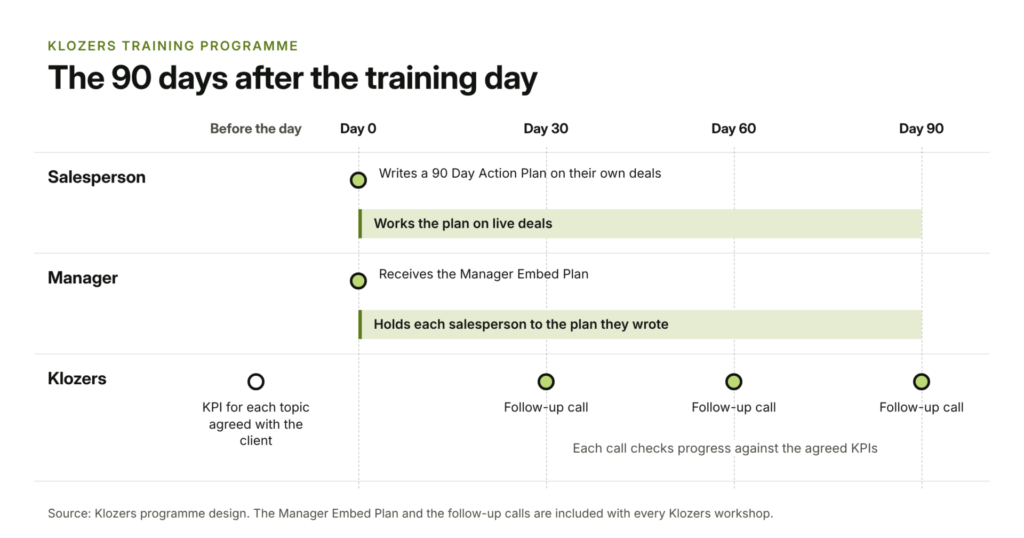
Sales coaching is regular one-to-one work between a manager and a salesperson on the salesperson’s own live deals. It keeps what was taught in training in use. It works best against a written standard, agreed before the training and assessed by the manager at day 30, 60 and 90. With certification, those same coaching sessions produce the evidence that behaviour changed.
Key takeaways
- Training gives people knowledge. Coaching makes sure they use it on live deals.
- Coach the salespeople who want to improve. With the others, hold a direct conversation about performance.
- Coach against one agreed, written standard, not against each manager’s personal preference.
- Write each requirement so a manager can see it in a live account and assess it without interpretation.
- Certification turns the coaching sessions at day 30, 60 and 90 into checkpoints, and gives the manager a certification of their own.
What is sales coaching?
Sales coaching is the work a manager, or an external coach, does with a salesperson to improve how they sell. It takes place one to one, on the salesperson’s own accounts, over weeks and months rather than in a single session.
It is different from sales training. Training gives a group of people new knowledge and practice in a short time. Coaching is what happens afterwards, when the salesperson is busy again and the pressure of the quarter returns. Most of what people learn in training is used only if somebody checks that they use it. In most sales teams, that person is the sales manager.
This guide covers when to coach and when not to, which coaching model to use and how to run a coaching session. It also covers how to coach a remote team and who coaches the managers. Finally, it covers the part most coaching guides leave out: how you know the coaching worked.
Why invest in sales coaching?
Because training without coaching is rarely used for long. The clearest evidence comes from outside sales. Olivero, Bane and Kopelman (1997) studied 31 managers and supervisors in a public health agency, not salespeople. A three-day training programme increased their productivity by 22.4%. When eight weeks of one-to-one coaching followed the training, the increase was 88.0%.
The study has limits, and the authors state them. There was no randomly assigned control group, the sample was small, and the participants were managers rather than salespeople. It shows that training followed by coaching was associated with a much larger gain than training alone. It does not prove that coaching will produce the same gain in your sales team.
Cost is the most common reason companies give for not investing in coaching. Yet a team that is missing its targets usually needs coaching more than a team that is meeting them. The real question is whether the coaching can be shown to work. Klozers changed its own coaching for that reason. Every engagement now starts with KPIs agreed with the client, so the change in the pipeline can be measured against them.
What is the difference between sales training and sales coaching?
Sales training transfers knowledge and skills. Sales coaching makes sure they are applied. Each fails without the other. Training without coaching is forgotten. Coaching without training has no shared content to coach against, so each manager coaches what they personally believe.
| Sales training | Sales coaching | |
|---|---|---|
| Purpose | New knowledge and skills | Applying them on live deals |
| Who leads it | A trainer, internal or external | Usually the salesperson’s own manager |
| Format | A group, in one or more sessions | One to one, repeated over weeks |
| Material | Concepts, practice and examples | The salesperson’s own accounts |
| Evidence that it worked | Assessment at the end of the session | Behaviour observed in live accounts over time |
The two work best as one programme. In a Klozers workshop, every topic is applied to the team’s own live deals during the session. Each participant writes their own 90 Day Action Plan before they leave. That plan is what the manager coaches against afterwards. For more on what happens when nobody coaches after training, read why sales training fails.
When should you coach, and when should you not?
Not every salesperson can be coached. Coaching needs a person who wants to improve and accepts that they have something to learn. Some salespeople resist. Some believe they already know more than the coach. Others are comfortable with their current results and see no reason to change.
Top performers often resist for a fair reason. They are being asked to change something that already works for them. Klozers interviews a team’s top performers one to one before designing a programme, and builds the programme from what they already do. Coaching then reinforces their approach instead of replacing it.
For a salesperson who does not want to improve, coaching is usually a poor use of a manager’s time. Unless there is a specific reason to continue, the manager has two choices. They can accept the effect that person has on the team’s results, or hold a direct conversation about performance. That conversation is a management task, not a coaching task, and it should be treated as one.
Coaching is most useful in four situations:
- After training, when the team needs to apply something new on live deals.
- When a salesperson is new to the role, the product or the market.
- When one stage of the sales process is weak across the whole team.
- When a large deal is at risk and the salesperson needs help to plan the next step.
Every workshop is built from a blank page around your team’s own live deals. No slides. Every topic carries a KPI you agree up front, then track and prove afterwards.
Pre and post assessment, so you see the change
Worked on your real deals, in the room
Manager Embed Plan and calls at 30, 60 and 90 days
Delivered in person by a practitioner, not a presenter
Trusted by teams at Microsoft, Panasonic, TikTok, Bizerba, Marangoni and Lathams.
Which sales coaching model should you use?
Many sales managers use GROW, which stands for Goal, Reality, Options and Will. It is a general coaching model, not one written for sales, and Klozers coaches use it too. The coach asks the salesperson to state the goal and describe the current situation. The salesperson then lists the options and commits to what they will do.
Sales coaching differs from executive coaching in one important way. In executive coaching, the coach asks questions and the person finds their own answer. In sales, a deal has a value and a date, and both matter to the business. A good sales coach starts with questions. When a deal is at risk and the salesperson cannot see the problem, the coach becomes more directive and says what they would do.
Coaching one deal with GROW
Here is how a short GROW session on one deal might run. The goal: the salesperson wants a decision on the proposal this month. The reality: they have spoken to one contact, who says the budget is approved. Nobody else in the customer’s business has confirmed it.
The options: ask the contact to introduce the person who owns the problem, ask for a meeting with finance, or wait. The will: the salesperson writes that they will ask for the introduction on Thursday’s call and record the answer. At the next session, the manager asks what happened.
If the salesperson cannot see why one contact is a risk, the manager says so directly. Information counts when it came from the buyer, not when one contact passed it on. This is the point where sales coaching becomes more directive than executive coaching.
The model matters less than what the coaching is measured against. Two managers can use GROW well and still coach a salesperson towards two different results. Each has a different idea of what good looks like. The section on certification below explains how to remove that difference.
What can a manager coach?
- Activity. What the salesperson does each week, and whether it is the right work.
- Accountability. Whether they did what they committed to in the last session.
- Finding new customers. Which accounts they choose, and the reason they contact each one.
- Pipeline and qualification. Whether each deal meets the team’s definition of qualified.
- Deal coaching. Planning the next step on one important opportunity.
- Field coaching. Observing a live call or meeting, then reviewing it together.
- Call planning. Agreeing the purpose of a call and the outcome the salesperson wants from it.
- Call review. Comparing what happened with the plan, soon after the call.
- Customer stories. Explaining another customer’s result in terms the buyer can relate to their own business.
What should a sales coaching session look like?
A coaching session is short, regular and specific. It works on one live deal or one behaviour, not on the salesperson’s whole job. The salesperson should do most of the talking.
Coach one to one
Team meetings are useful for shared information. Coaching works best one to one, because the salesperson can talk about their weaknesses without an audience. A fixed time each week or each fortnight is better than coaching only when a problem appears.
Work on a live deal
Role play has a place in training. In coaching, the salesperson’s own open opportunities are better material, because any improvement affects a real result. Ask the salesperson to bring one deal and the question they need answered.
Agree one action, written by the salesperson
End each session with one action, a date and a measure. The salesperson writes it, not the manager. A plan someone wrote themselves is a plan they will defend. At the next session, the manager holds them accountable to their own words. That is a different conversation from accountability to a course, and it removes the argument about whether the standard is fair.
Give specific praise and specific criticism
Feedback is useful only when it describes what the salesperson did. “Good call” teaches nothing. “You asked what the delay is costing them, and they gave you a number” tells the salesperson what to repeat. Criticism works the same way. Describe the moment in the call and what to do differently next time.
Coach after product training
New products and services create a specific coaching need. Salespeople learn the product, then return to describing its features. After product training, coach how the salesperson connects the product to a problem the customer has stated, in the customer’s own words.
Use your CRM to choose what to coach
Pipeline data shows where a deal stands. It does not show how the salesperson ran the last conversation. Use the CRM to choose which deal to coach, then coach the conversation. For more practical guidance on running sessions, read about structured coaching after training.
How does certification change sales coaching?
Most sales coaching has no agreed end point. The manager coaches, the salesperson improves or does not, and nobody can say with evidence what changed. Klozers runs coaching and certification as one process, the Sales Certification Programme. The coaching sessions at day 30, 60 and 90 are also where the evidence for certification is assessed.
One definition of good
Ask six managers to review the same deal and you may hear six different questions. One asks how many calls were made. Another asks whether the salesperson has met the person who signs. A third asks when the deal will close. Others ask about the proposal, whether the buyer likes the salesperson, and whether the deal is in the forecast. Each question reflects what that manager believes matters.
The salesperson then learns to satisfy each manager, instead of learning to sell better. Certification removes that problem. Managers stop coaching to personal preference and start coaching to an agreed standard.
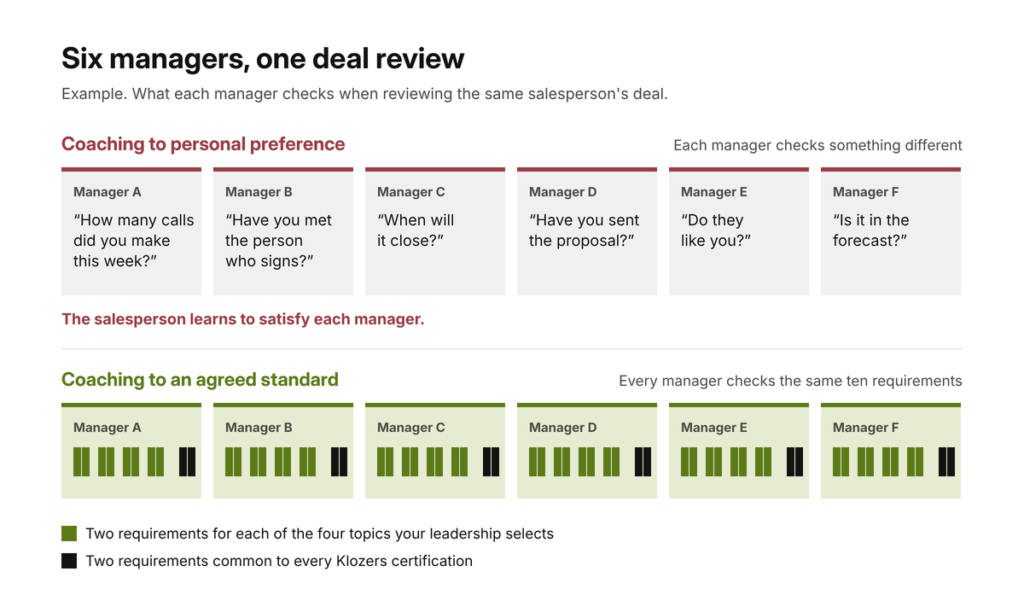
The standard is not generic. Every Klozers programme is built around four execution topics your leadership selects, because your market, your deal sizes and your buyers are your own. The certification is written in the same way. It has two requirements for each of the four topics, plus two requirements common to every Klozers certification. That gives ten requirements, and every manager coaches against the same ten.
Requirements a manager can assess
A requirement is useful for coaching only if a manager can see it. Each Klozers requirement must be observable, tied to a checkpoint, evidenced on a live account and assessable by a manager without interpretation.
Compare two ways of writing the same requirement. “Built senior relationships” cannot be assessed. A relationship is an opinion, there is nothing in the account to point to, and two managers could reach two different answers. “Engaged the Economic Owner and recorded the outcome they are measured on” can be assessed. The Economic Owner is the person who owns the problem and the outcome, not the Economic Buyer who releases the money. Either the salesperson engaged that person and recorded the outcome in the account, or they did not.
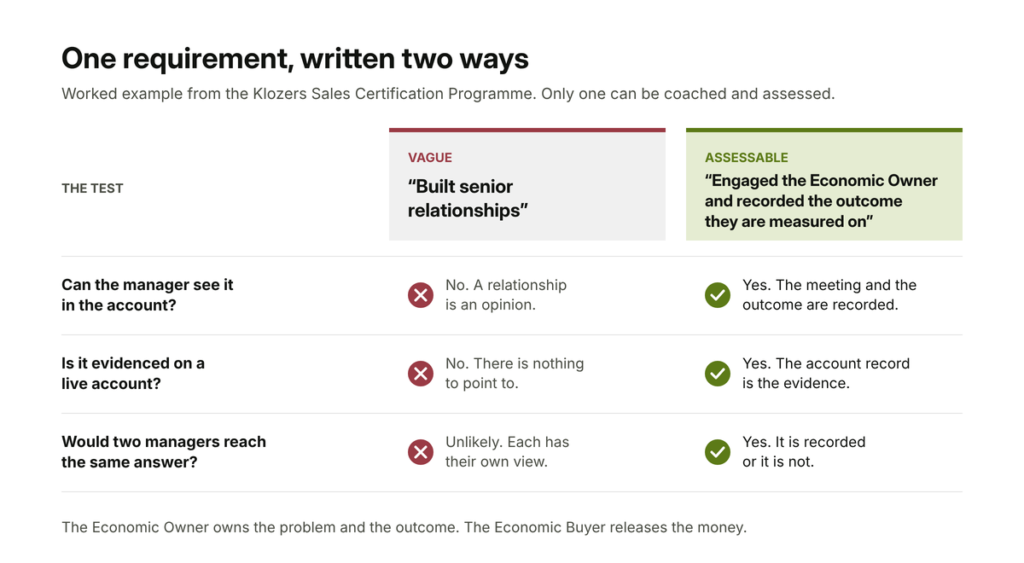
A requirement written this way also improves the coaching conversation. The manager does not need to argue about whether the salesperson is good at senior relationships. They look at the account together and agree what is missing.
Coaching sessions at day 30, 60 and 90
After a Klozers programme, each manager receives a Manager Embed Plan. It sets out how to reinforce the behaviour, with follow-up calls at 30, 60 and 90 days. On a certification programme, those calls are also the checkpoints. At each one, the manager reviews the evidence in the salesperson’s live accounts and assesses each requirement.
Klozers designs the standard and issues the certification, but never marks a requirement as evidenced. Your manager assesses. We issue. The person with direct visibility signs, so no one assesses their own performance.
The checkpoints also help the manager. If a salesperson has stopped using what they learned, it shows at day 30 rather than in the quarterly forecast. The standard carries the difficult conversation instead of the manager. The manager also holds dated evidence for reviews and promotion decisions.
A certificate that expires
There are two certification statuses. Candidate is awarded at day 2. It confirms that the participant completed the programme and built an account plan to full depth. It lapses at day 90.
Certified is awarded at day 90, on ten requirements evidenced on live accounts and signed by the participant’s own manager. It is valid for twelve months and is renewed on evidence, not on another programme. Behaviour deteriorates under pressure, which is the reason coaching exists. A certificate that never expired would contradict that argument.
Each certificate carries a QR code linking to its own verification page, which shows the holder, status, scope and validity.
Certified Coach: a certification for the manager
In Certified Coach, “coach” means the manager who coaches. It is different from the Coach in a buying group, who is the person in a customer’s business who gives a salesperson access.
Klozers issues three certifications. Certified Practitioner is for the salesperson. Certified Organisation is awarded when certified coverage across a sales team passes and holds a defined threshold. Certified Coach is for the manager.
A manager earns Certified Coach by running a full cohort properly. That means checkpoints held, evidence assessed, honest assessment and a sample audit passed. It makes the manager’s coaching visible, not only their team’s results. For an HR or L&D leader, it answers a question that is usually hard to answer: which of our managers coach well?
How do you coach a remote sales team?
Remote selling changed what salespeople do each day, and the coaching has to change with it. The principles stay the same: one to one, on live deals, against an agreed standard. Four things differ.
- Cameras on for the whole session. A manager cannot coach what they cannot see, and coaching relies on seeing how the salesperson responds.
- Shorter, more frequent sessions. One topic a week has the least effect on a salesperson’s normal selling time, and it gives them time to practise between sessions.
- Field coaching on video calls. With the buyer’s agreement, the manager joins a video call and reviews it with the salesperson afterwards.
- A shared sales language. When people rarely meet, a written standard keeps everyone working to the same definition of good. Without one, each person develops their own.
Klozers delivers training live online as well as in person. Online, the standard one-day workshop of four 90-minute modules is split into separate sessions, delivered one or two a week. The coaching between sessions follows the same pattern.
Who coaches the sales managers?
Sales managers are the people most often left out of coaching programmes, yet they are usually the team’s coach. Most were promoted because they sold well. Few have been trained to manage a sales team, and fewer have been trained to coach.
A manager who has not been coached will coach the way they sell. That works for salespeople who sell the same way, and fails for everyone else. Before managers coach a team against a new standard, they need to understand the standard themselves and practise assessing it on real accounts.
On a Klozers programme, each manager has their own Manager Embed Plan. The Certified Coach assessment checks whether they held the checkpoints and assessed honestly. Some teams need coaching without a workshop. Sales Performance Coaching can be bought on its own and runs for a minimum of three months. The format depends on what your team needs. KPIs are agreed with you before coaching starts, and each salesperson’s manager is involved.
If your managers need a full programme built around your own team, see bespoke sales training.
What should HR and L&D leaders ask before buying sales coaching?
Sales coaching is often bought by HR or L&D on behalf of a sales team. Five questions separate coaching that can be evidenced from coaching that cannot.
- What standard will the coaching be measured against, and who agrees it?
- Will the coaching work on the team’s own live deals, or on case studies?
- Who assesses whether the behaviour changed: the coach, or the salesperson’s own manager?
- Which KPIs will be agreed before coaching starts, and how will they be tracked?
- Are the managers coached as well, and is their own coaching assessed?
The third question matters most. A provider who assesses its own coaching is asking you to accept its own view of its own work. The salesperson’s manager sees the accounts every week and should be the person who assesses.
How do you measure sales coaching?
Measure behaviour first and results second. Results take longer to show, and they depend on the market and the length of your sales cycle. Behaviour shows within weeks.
Agree one KPI for each topic before the coaching starts, and make sure each KPI is something the salesperson can influence. Satisfaction scores are not evidence. Depending on what the coaching covers, the KPIs might include:
- Activity on the accounts the team agreed to work on.
- Conversion from one pipeline stage to the next.
- Average deal value, where the coaching covers value and price.
- New customers won, where the coaching covers finding new business.
- Forecast accuracy, where the coaching covers qualification.
- Time for a new hire to reach the expected level.
Coaching cannot guarantee any of these results. What it can do is make sure the salesperson uses what they learned, so you can see whether the training made a difference. Morale and confidence also tend to improve when salespeople know what is expected of them. They are harder to measure, so do not use them as the main evidence.
You need one behaviour your team is working on and twenty minutes with two managers.
- Choose one behaviour you want to see more often in live deals.
- Write it as one sentence that describes what a salesperson does and records in an account.
- Give both managers the same three live accounts and ask each to assess the requirement separately.
- If they reach different answers, rewrite the sentence until they agree. That sentence is the start of your coaching standard.
Common questions about sales coaching
What is the difference between sales coaching and sales mentoring?
Mentoring is guidance from a more experienced person about a career or a role, often from someone outside the reporting line. Sales coaching works on specific behaviours in live deals. It is usually done by the salesperson’s own manager, against an agreed standard.
How often should a sales manager coach each salesperson?
There is no single right number. A fixed session each week or each fortnight suits most teams, with extra time on large deals. On a Klozers certification programme, the checkpoints at day 30, 60 and 90 are fixed, and the manager coaches between them.
Should sales coaching be done by managers or by external coaches?
Both have a place. An external coach brings experience the team may not have. The manager sees the salesperson’s accounts every week, so the manager should assess them. That is why the manager signs each certification requirement, and Klozers does not.
Can sales coaching be done online?
Yes. Keep cameras on for the whole session and keep sessions short and frequent. Coach against a written standard, so remote salespeople and managers work to the same definition of good.
What does sales coaching certification prove?
A Klozers certification proves that a salesperson met ten agreed requirements on live accounts, assessed by their own manager at day 30, 60 and 90. Certified Coach proves that the manager held the checkpoints and assessed the evidence honestly.

Iain has trained and coached B2B sales teams since 2008. He was Lead Trainer and Coach at Microsoft Scotland. Before that he sold capital equipment and managed sales teams in the UK and North America. He served as an Associate at Strathclyde University Business School, where he delivered the sales content for the Masters in Entrepreneurship from 2015 to 2019.
You are buying a change in how your team sells, and the proof that it worked. A short call to agree your four topics and a date that works.