
Sales Team Motivation Starts with the Culture You Create
Before investing in incentives or another motivational event, examine the leadership, management and working conditions that shape your sales team’s behaviour.
By Iain Swanston, Founder, Klozers
- Updated 15 October 2026
What really motivates a sales team?
Sales team motivation is influenced by more than an individual’s attitude or desire to earn commission. Leadership, management, clear expectations, confidence, useful coaching and opportunities to succeed all affect whether salespeople can sustain the behaviours required for performance. Before prescribing a motivational intervention, assess the environment in which the team works.
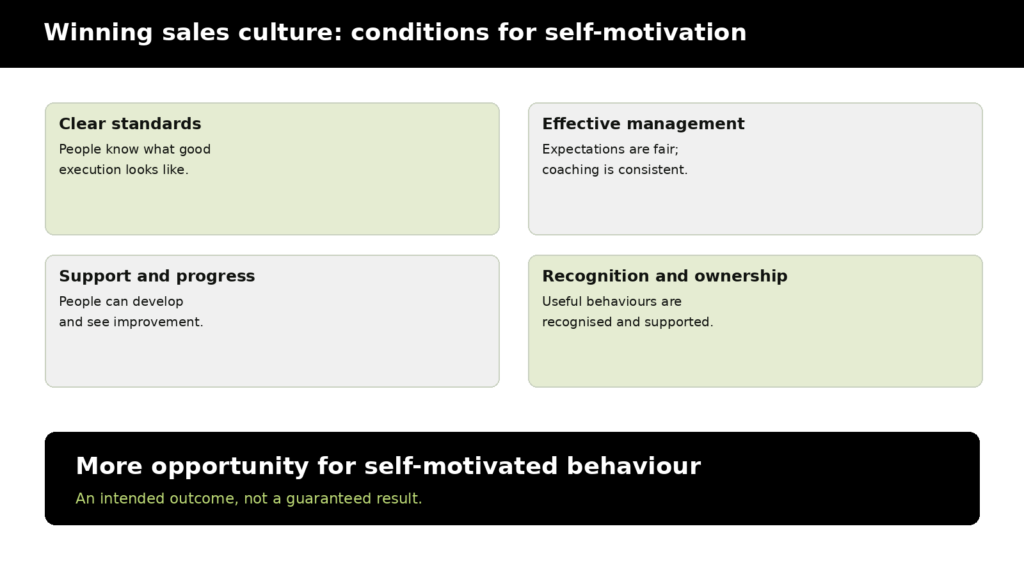
The Klozers position: a winning sales culture reduces the need for managers to continually motivate their teams because it creates better conditions for salespeople to motivate themselves.
Why another motivation initiative may not solve the problem
When activity falls or morale declines, it is understandable to look for a direct intervention. A competition, revised incentive, motivational speaker or training event can appear easier to organise than a review of the sales environment. These activities may have a place, but none establishes why the team has become disengaged.
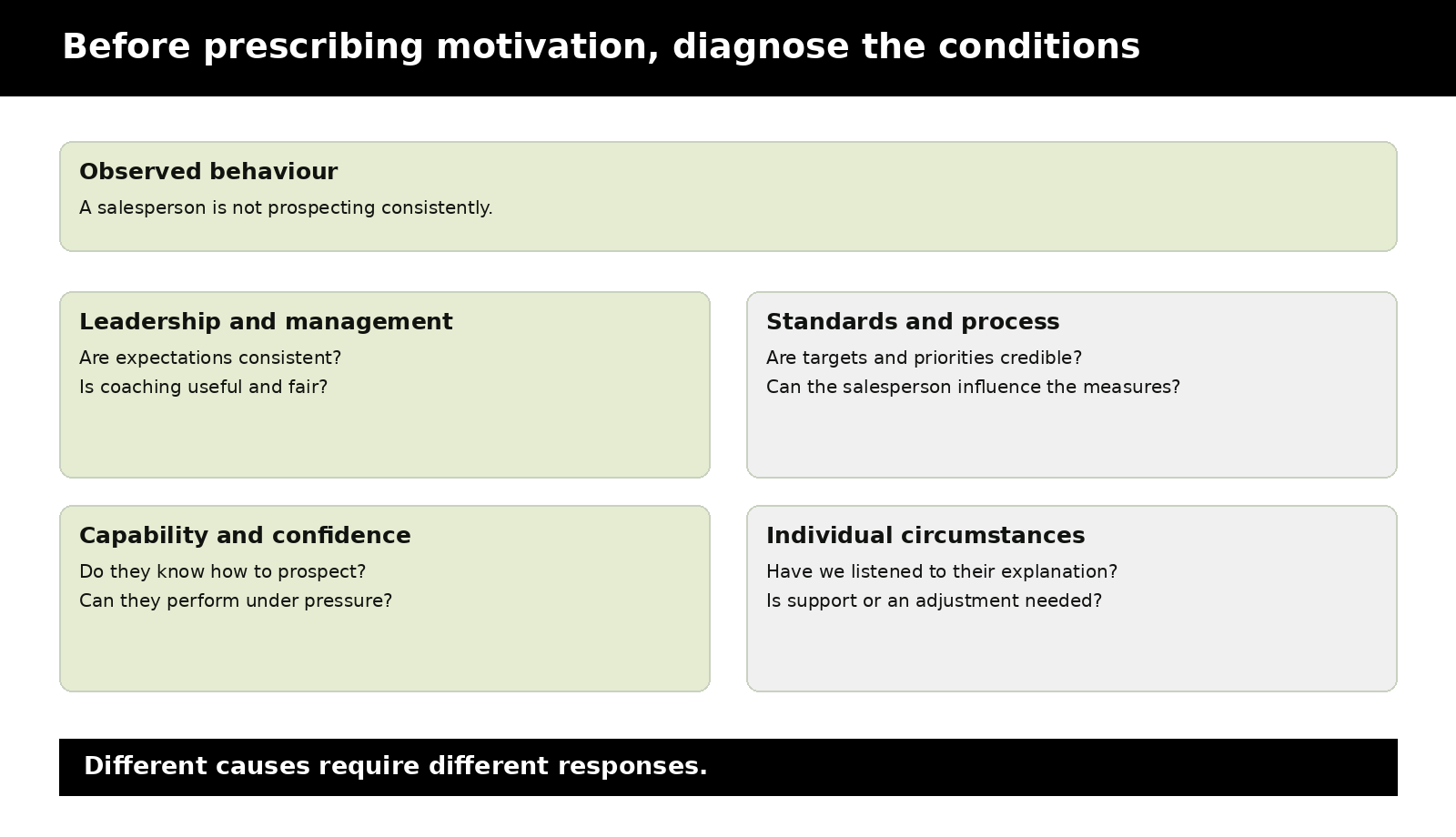
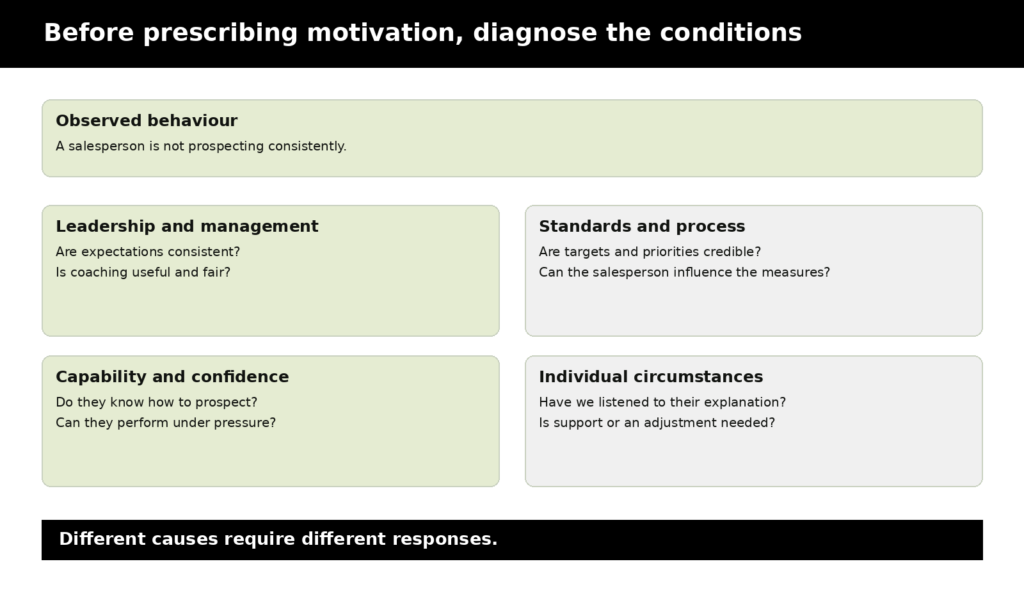
Consider a salesperson who previously prospected consistently but now avoids calling. It may be tempting to attribute the change to attitude. The salesperson may instead be receiving contradictory priorities, working with an unrealistic territory plan, receiving little coaching or struggling to see progress. They may have the required technical skill but lack the confidence to use it under pressure.
The appropriate response depends on the cause. More pressure will not correct an unclear process. A new reward will not necessarily repair trust. Another skills workshop will not address management practices that discourage the very behaviours the workshop teaches.
This is not an argument that every performance problem originates with management. Individuals remain accountable for agreed standards. It is an argument for examining the conditions around the individual before deciding what intervention is justified.
What a winning sales culture looks like in practice
A winning sales culture is not a team that feels enthusiastic every day. It is an environment where people understand what good sales execution requires, believe they have a reasonable opportunity to succeed and receive the support and accountability needed to improve. Results matter, but the organisation also examines the behaviours that precede results.
Clear and credible standards
Salespeople need to know what is expected of them beyond a revenue target. Standards might describe qualification discipline, access to the Economic Owner, the quality of next steps or evidence that a deal is progressing. These are observable behaviours managers can inspect and coach. Targets should be explained, and measures of individual execution should be within the person’s influence wherever possible.
Coaching that improves capability
Good coaching identifies a specific behaviour, explores the reason for the gap and agrees an improvement that can be observed. It is not simply another forecast review. Managers also need to distinguish functional ability, knowing how to perform a task, from conceptual ability, being able to envisage performing it successfully in a difficult situation. A person can understand a prospecting technique yet struggle to use it when facing rejection.
Recognition, fairness and progress
Recognition should acknowledge the behaviours the organisation wants repeated, not only the largest closed deal. Fair and consistent standards reduce uncertainty. Useful feedback helps people see what is improving even when a long sales cycle delays revenue. Progress should be evidenced rather than asserted.
Responsibility without unnecessary control
Accountability and autonomy are not opposites. A salesperson can own their activity and decisions while working within agreed standards. Managers can explain the objective, inspect the evidence and allow appropriate discretion in execution. That is different from controlling every conversation.
Workplace research on self-determination theory examines how autonomy, competence and relatedness influence motivation and wellbeing. This is relevant adjacent research, but it does not directly test the Klozers sales-culture approach.
Diagnose the environment before the individual
Imagine two salespeople whose prospecting activity has declined. One is avoiding calls because they lack confidence handling objections. The other is receiving frequent changes to target accounts and has stopped trusting the prospecting plan. Both show the same activity result. They need different management responses.
A useful leadership review starts with the team-level evidence. Are expectations stable? Are managers using the same standards? Is coaching happening? Are salespeople able to describe what good execution looks like? Are people rewarded for the behaviours management says it values? Then examine individual capability, confidence, circumstances and accountability.
It is important to listen directly to salespeople rather than diagnose their motives from a dashboard. Reduced activity is observable. Its cause is not. The explanation should be tested against evidence and discussed with the person concerned.
This is also why a sales training programme should not be the automatic first response. Training can improve capability, but its effect may be limited if managers do not reinforce the new behaviours. A culture that rewards shortcuts or tolerates inconsistent standards can undermine what people learn.
How motivation connects to sales management
Motivation is not separate from the management of sales execution. It is affected by the system people work within. Our sales management guide explains the broader management responsibilities, while selling skills explores the distinction between knowing what to do and being able to perform under pressure.
For sales leaders, the next step is to establish whether agreed standards exist, whether managers coach against them and whether the team has a consistent way to assess performance. The Gold Selling Standards provide the relevant commercial destination for a conversation about sales execution, rather than treating motivation as an isolated training topic.
There is a useful distinction between an individual who is unwilling to meet fair standards and a team whose working conditions make those standards difficult to meet. The first may require an individual performance response. The second requires leadership attention. Confusing the two can lead to unnecessary expenditure and unresolved problems.
Questions sales leaders should ask first
Before approving a motivation programme, establish what has changed. Has performance declined across the whole team or only in particular roles? Have priorities, management routines, territories or incentives changed? Do salespeople understand the standards and believe those standards are applied fairly? Can managers demonstrate coaching and improvement rather than only reporting results?
Ask what the team experiences in practice. Do people receive useful feedback? Can they raise concerns without being dismissed? Are good sales behaviours recognised when deals do not close immediately? Can people identify the actions that are within their control? These questions are prompts for discussion, not a scored proprietary assessment.
Where the evidence identifies a genuine capability gap, targeted training may be appropriate. Where it identifies weak management routines, changing those routines should take priority. Where both are present, the improvement plan must address both.
Frequently asked questions
How do you motivate a sales team?
Start by understanding why motivation is low. Review leadership, management practices, standards, coaching, confidence and working conditions before choosing incentives or training. Different causes require different interventions.
Can poor management demotivate salespeople?
Yes. Inconsistent expectations, weak coaching, unfair accountability and a lack of recognition can make sustained effort harder. Research across workplaces associates manager effectiveness with employee engagement, although it does not establish a universal ranking of causes for sales teams.
Do sales incentives still matter?
They can matter, particularly when they are clear and aligned with the desired behaviours. They should not be expected to compensate for unclear standards, ineffective management or an environment in which salespeople cannot see a credible route to success.
What is a winning sales culture?
It is an environment with clear expectations, consistent management, useful coaching, fair accountability, opportunities to improve and recognition of effective sales behaviours. Its purpose is to support sustained execution and make self-motivation more likely.

Iain has trained and coached B2B sales teams since 2008. He was Lead Trainer and Coach at Microsoft Scotland. Before that he sold capital equipment and managed sales teams in the UK and North America. He served as an Associate at Strathclyde University Business School, where he delivered the sales content for the Masters in Entrepreneurship from 2015 to 2019.
Before investing in another motivation initiative, establish what your team needs to execute well and what may be preventing it.