
AI sales training how it works
AI tools can listen to sales calls and give feedback while your team works. They help most where you have already defined what good selling looks like, and least where the deal depends on trust between people.
By Iain Swanston, Founder, Klozers
- Updated 11 November 2026
AI sales training, and how it works: software records what salespeople do on calls, in emails and in the CRM. It compares that with a model of good selling and gives feedback as they work. It helps new salespeople most, and it helps most when the business has defined what good looks like. It supports the conversations that win complex B2B deals. It does not replace them.
Key takeaways
- AI sales training compares what salespeople do with a model of good selling and gives feedback while they work.
- In the largest study of AI assistance at work, new and less skilled people gained most. Experienced people gained little.
- The tool can only reinforce a standard. Define what good looks like in your business first.
- Most companies have used AI to send more messages. Buyers avoid suppliers who send them messages that are not relevant.
- In complex B2B sales, people still buy from people. AI supports that work. It does not replace it.
What is AI sales training?
AI sales training uses software to support how salespeople learn and improve while they work. It does not replace people with machines. It gives each salesperson feedback that would otherwise need a manager to listen to every call.
The tools fall into three types. Call recording and analysis tools transcribe calls and point out what was missed. CRM-based coaching tools read deal activity and suggest the next step. Practice tools let salespeople rehearse a conversation before they have it with a customer.
How does AI sales training work?
AI sales training works in four steps:
- Record. The tool captures calls, emails and CRM activity from the systems your team already uses.
- Compare. It compares what each salesperson did with a model of good selling. That might be a list of questions to ask, the stages of your sales process, or patterns from your most successful calls.
- Feed back. It shows the salesperson what they missed and suggests what to do next, during or after the call.
- Reinforce. It repeats the point over the following weeks, through prompts, reminders and short practice tasks.
Each salesperson gets feedback on their own weaknesses. If one struggles with discovery and another with agreeing next steps, each receives different feedback.
Reinforcement is where AI adds most to training. What people learn fades unless something brings it back into their work. A workshop gives the team the skill. A manager, and now a tool, keeps it in use over the following weeks.
What does the research show about who gains most?
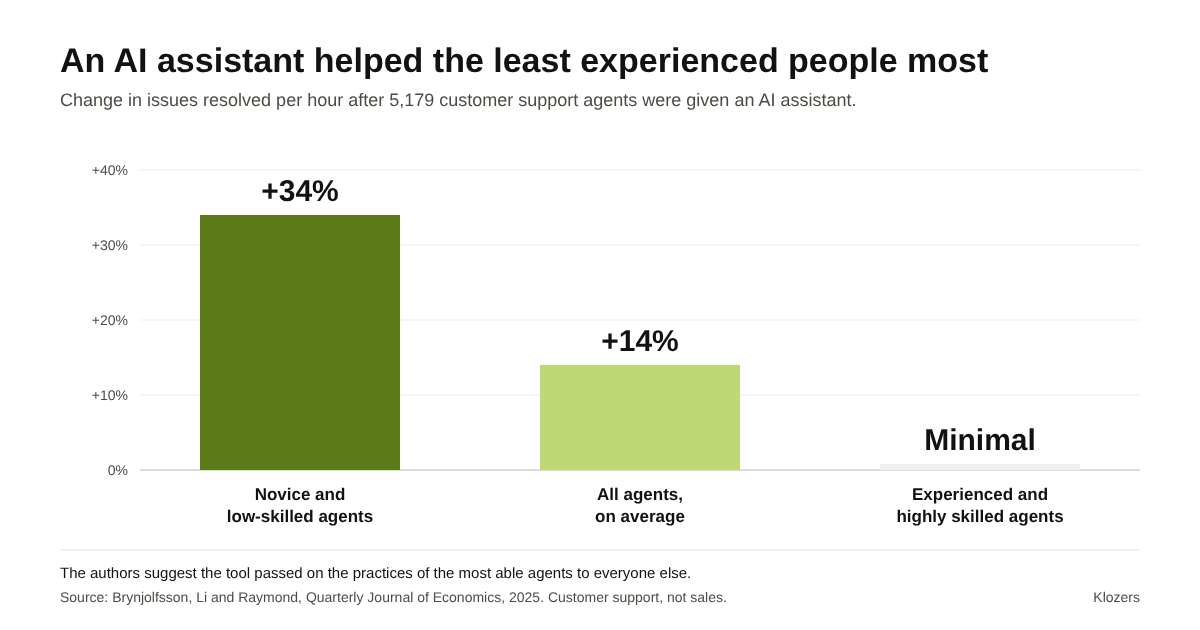
The strongest evidence so far comes from customer support, not sales. Brynjolfsson, Li and Raymond studied 5,179 customer support agents who were given an AI assistant. Issues resolved per hour rose by 14% on average, and by 34% for novice and low-skilled agents. The effect on experienced and highly skilled agents was minimal. The study was published in the Quarterly Journal of Economics in 2025.
The authors also suggest why it worked. The tool passed on the practices of the most able agents to everyone else. That is a useful finding for any sales leader. It means the value of the tool depends on what it has learned from your best people. The people who gain most are the newest.
Every workshop is built from a blank page around your team’s own live deals. No slides. Every topic carries a KPI you agree up front, then track and prove afterwards.
Pre and post assessment, so you see the change
Worked on your real deals, in the room
Manager Embed Plan and calls at 30, 60 and 90 days
Delivered in person by a practitioner, not a presenter
Trusted by teams at Microsoft, Panasonic, TikTok, Bizerba, Marangoni and Lathams.
What does AI sales training need from you first?
A clear standard. An AI coach compares calls with a model of good selling. If nobody has defined what good looks like in your business, the tool coaches everyone towards a general standard written for someone else’s buyers.
So the work comes before the tool. Find out what your best people already do, through one-to-one interviews, not a survey. Write it down as a standard the whole team can follow. Where no one does it well yet, write the standard first, then train the team to meet it. The tool then reinforces your standard, not a generic one.
This is how Klozers builds every programme: we interview your top performers before we design anything. We also use AI within Gold Selling Standards and Sales Simulation O.S. For a programme built around your team’s own deals, see bespoke training built from your best people.
How do you add AI to your sales process?
Start where the tool can make the most difference, then expand.
- Begin with the CRM. Many CRM-based tools can read activity records, flag deals that have stopped moving and suggest follow-ups.
- Analyse calls and emails. Call analysis tools find the objections that come up most often and show how salespeople answer them.
- Prioritise which customers to contact. Scoring tools rank accounts using your own past deals and how well each account fits your ideal customer.
- Coach during the work. Feedback during a call or while updating the CRM makes training part of the working day, not a separate event.
- Review the data. Check regularly what is working and where deals stop moving, and use it to adjust the standard and the training.
Has AI made B2B selling better?
For most companies, no. The most common use of AI in sales so far has been to send more messages, not better ones. Tools that write and send emails and connection requests in thousands have made unwanted contact cheaper to produce than ever.
Buyers and email providers have responded. Gmail now requires anyone sending more than 5,000 messages a day to its users to authenticate their email and offer one-click unsubscribe. Google says its defences block nearly 15 billion unwanted emails every day. In a Gartner survey of 632 B2B buyers, 73% said they actively avoid suppliers who send irrelevant outreach. The same survey found that 61% prefer to buy without a salesperson overall.
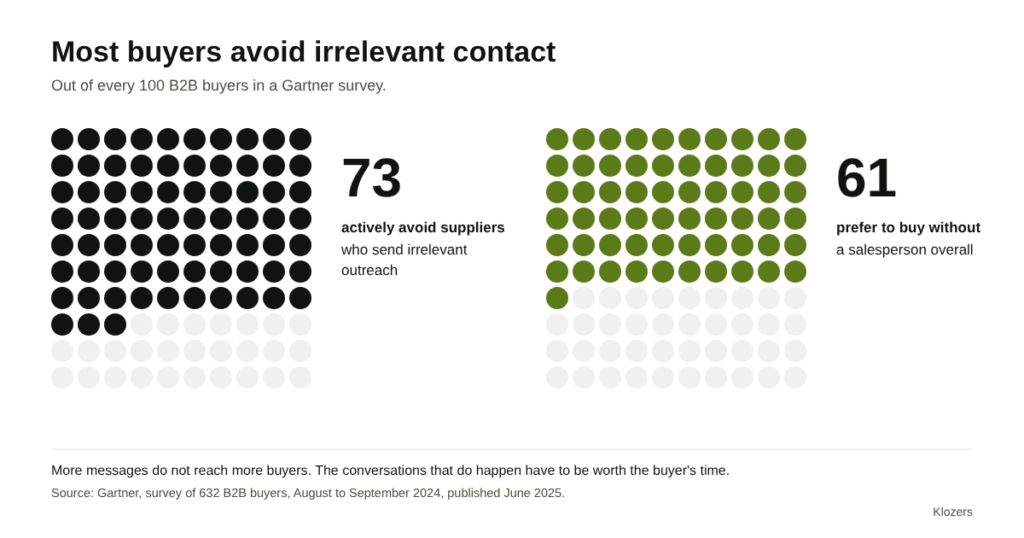
That does not mean buyers no longer want people. It means they do not want to be contacted without a reason, and they want to do as much as they can without a salesperson. So the conversations that do happen carry more weight, and they have to be worth the buyer’s time.
In complex B2B sales, people buy from people. A purchase that involves several people, real risk and a decision the buyer must defend to their own board is made with someone they trust. We see no sign that AI plays any part in that beyond what is already happening: preparing, recording and reviewing. The research above points the same way. The assistant made little difference to the most experienced and skilled people.
How do you get started with AI sales training?
- Start small, then expand. Try a tool with a few salespeople and one clear goal, such as better discovery calls or fewer deals that stop moving. See what works before rolling it out.
- Track a few measures. Choose two or three that matter to your business, such as time to first deal or how often next steps are agreed. Use them to guide both training and coaching.
- Keep the people part. Your team still needs a manager who holds them to the standard and coaches their judgement. Use AI to reduce the routine work, so managers have more time for that.
Four tasks, one week, no supplier needed.
- Choose one type of call that matters most, such as a first discovery call.
- Ask your two best salespeople, separately, what they always do on that call.
- Write what they agree on as five or six points a call should cover.
- Listen to three recent calls by newer salespeople and mark which points they covered.
Common questions about AI sales training
How does AI sales coaching work in practice?
The tool connects to the systems your team already uses, such as call recording, email and the CRM. It analyses calls, emails and deal activity, then suggests what to do next, points out missed opportunities and reinforces the standard you have agreed.
Can AI sales training replace sales managers?
No. AI can analyse activity and suggest improvements. Managers are still needed to hold people to the standard, coach judgement on complex deals, and build the trust that a team runs on.
Is AI sales training suitable for small businesses?
Yes. Many tools can be tried with a few salespeople at low cost. The limit for a small business is rarely the tool. It is whether anyone has written down what a good call or a good deal looks like.
How does AI help with onboarding new salespeople?
It gives new salespeople feedback on their own calls from the first week, instead of waiting for a manager to listen in. In the study described above, the least experienced people gained the most.
Will AI replace salespeople in complex B2B sales?
We see no sign of it. Complex purchases involve several people, real risk and a decision the buyer has to defend. Buyers still make those decisions with people they trust.

Iain has trained and coached B2B sales teams since 2008. He was Lead Trainer and Coach at Microsoft Scotland. Before that he sold capital equipment and managed sales teams in the UK and North America. He served as an Associate at Strathclyde University Business School, where he delivered the sales content for the Masters in Entrepreneurship from 2015 to 2019.
You are buying a change in how your team sells, and the proof that it worked. A short call to agree what your team needs and a date that works.