
How to build an outbound sales team: hire, equip and measure it
By Iain Swanston, Founder, Klozers
- Updated 11 November 2026
Key takeaways
- Hire for mindset and values. Selling skills and product knowledge can be taught after the person joins.
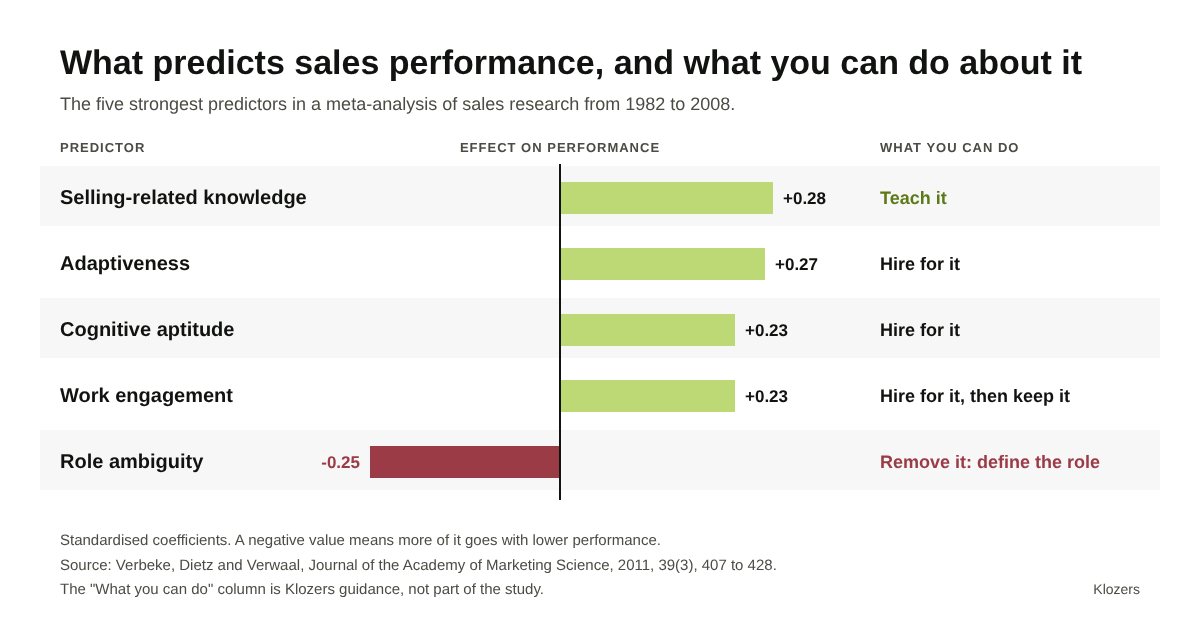
- Give every new hire a clear role. Research across studies from 1982 to 2008 links an unclear role with lower sales performance.
- Build the playbook from your best people if you have them, and from a written standard if you do not.
- Measure outbound salespeople on what is inside their control, not on revenue they cannot yet influence.
How to build an outbound sales team: what comes first?
Four things come before the first hire: a confirmed reason to buy, the right words, a clear role and a capable manager. An outbound team contacts companies that have not contacted you. Inbound depends on marketing to bring enquiries in. Outbound depends on the team to start the conversation.
- A reason to buy that customers have confirmed. Ask existing customers why they bought. If they cannot say it in their own words, a new team will not be able to explain it.
- The words. The first sentence of a call or a letter decides whether the buyer keeps listening. Write it and test it before the team grows.
- The role. Decide what the outbound team does and where its work ends. Usually that is research, first contact, testing the need and booking the next step.
- A manager who can lead the team. A top salesperson does not automatically make a good outbound manager. Managing a team takes different skills from selling.
Who should you hire for an outbound sales team?
Hire for mindset and values. Selling skills can be taught after the person joins. Mindset and values are what they bring with them.
The research supports teaching the skills. A meta-analysis by Verbeke, Dietz and Verwaal was published in a peer-reviewed marketing journal in 2011. It reviewed sales performance studies from 1982 to 2008. Selling-related knowledge was the strongest predictor of performance, and knowledge can be taught. Adaptiveness and work engagement were close behind. An unclear role was linked with lower performance by almost as much.
Look for these qualities of mindset:
- Resilience. They keep calling after a run of refusals, and they do not take a refusal personally.
- Curiosity. They want to understand the buyer's business before they talk about the product.
- Adaptiveness.They change their approach when it is not working.
- Ownership. They hold themselves to their own numbers without being chased.
And these values: honesty with buyers, including saying “this is not right for you” when it is true, and respect for the buyer’s time. No need, no meeting.
To test for them, ask each candidate to make a short first call to a colleague playing the buyer. Give feedback, then ask them to make the call again. The second attempt tells you more than the first. Ask about the longest run of refusals they have had and what they did next. Record what you see against the same criteria for every candidate, so the decision rests on evidence rather than a general impression.
Trusted by teams at Microsoft, Panasonic, TikTok, Bizerba, Marangoni and Lathams.
Should you build the team in-house or outsource it?
What does an outbound salesperson do?
- Research target accounts and the people in them.
- Make first contact by phone, letter, email or LinkedIn, within the rules of each country.
- Test whether the buyer has a need, and book the next step when there is one.
- Follow up on proposals and record every contact in the CRM.
Where does an outbound team's playbook come from?
From your best people if you have them, and from a written standard if you do not.
- If someone already wins new customers, interview them. Write down who they call, what they say in the first minute and the questions they ask. That becomes the first version of the playbook.
- If nobody has done it yet, start from a written standard based on outside expertise. It sets who to call first, the reason for calling and the question to ask. Change it based on what the team learns in the first 90 days.
How should you measure an outbound sales team?
Measure each salesperson on what is inside their control. In the first months, a new salesperson controls their research, first contacts and conversations. They also control the needs they find and the next steps they agree. Revenue depends on the buyer’s timing and comes later.
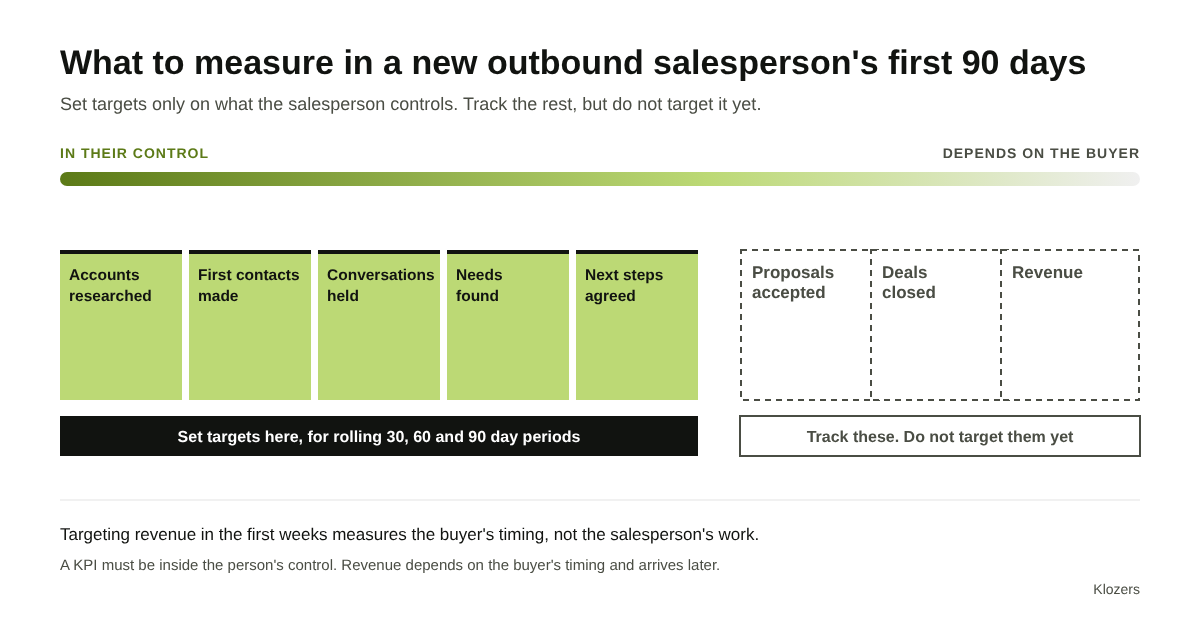
Chart: set targets on the measures a new salesperson controls, and track the rest without targets in the first 90 days.
Set targets for rolling 30, 60 and 90 day periods as well as the quarter. A slow first month is then visible while there is still time to correct it. In a 2024 engagement with CAEM, a team working 102 target accounts had 19 additional enterprise accounts in active conversation within 90 days. It won £167,000 from three new customers in the same period.
If the team needs support while it settles in, see our outbound sales coaching for your team.
Four tasks, one week, no supplier needed.
- Write one paragraph describing the outbound role, including where its work ends.
- Ask three customers why they bought from you, and write down their words.
- List the mindset and values you will hire for, and one interview task that tests each.
- Choose three measures each salesperson controls, and set a 30 day target for each.
Common questions about building an outbound sales team
How long before an outbound team produces results?
It depends on your sales cycle. Conversations and needs found should be visible within the first 30 days. New customers usually take longer. In the CAEM engagement described above, the first new customers came within 90 days.
Should outbound salespeople use scripts?
Can existing salespeople do outbound alongside account management?

Iain has trained and coached B2B sales teams since 2008. He was Lead Trainer and Coach at Microsoft Scotland. Before that he sold capital equipment and managed sales teams in the UK and North America. He served as an Associate at Strathclyde University Business School, where he delivered the sales content for the Masters in Entrepreneurship from 2015 to 2019.
You are buying a change in how your team sells, and the proof that it worked. A short call to agree what your team needs and a date that works.