
Sales Fundamentals Course
Build a consistent foundation in the essential behaviours used across the sales cycle. The programme starts with how your team already sells, retains effective internal practice and develops the gaps that need attention.
By Iain Swanston, Founder, Klozers
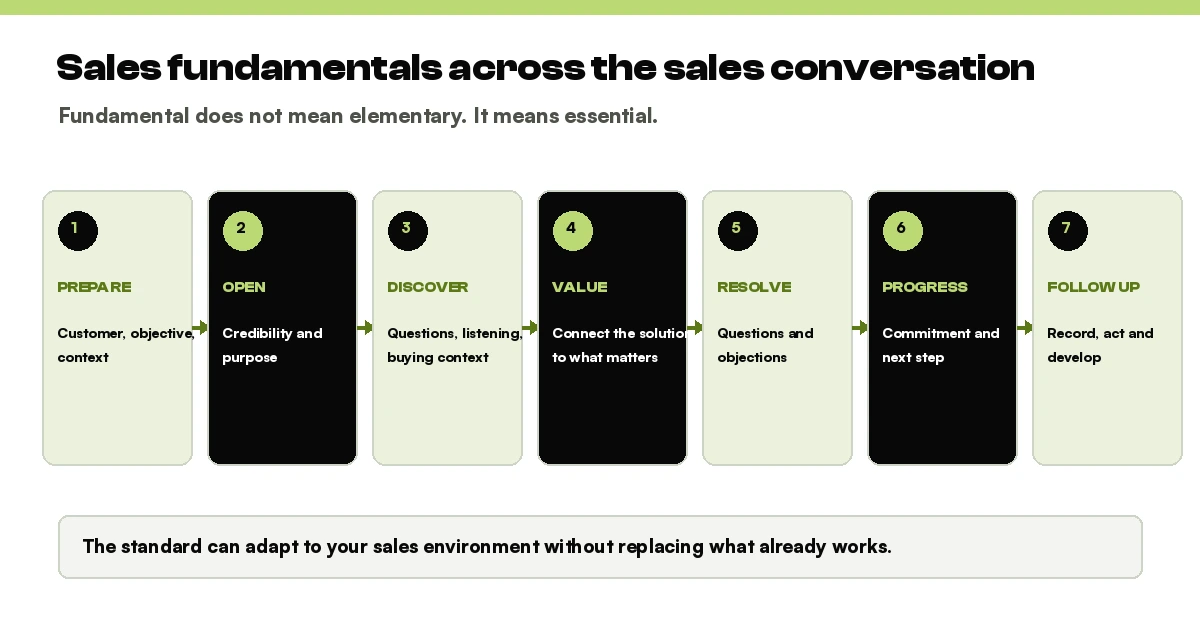
Sales fundamentals provide a practical standard across the sales conversation without requiring every salesperson to use the same script.
A sales fundamentals course develops the essential behaviours salespeople need to prepare, start customer conversations, discover needs, communicate value, handle questions and objections, progress the sale and follow up effectively. Good fundamentals apply to experienced salespeople as well as people who are new to sales.
- Fundamental does not mean elementary. It means essential.
- Sales fundamentals should create a consistent standard without replacing effective internal practice.
- The course covers the core sales conversation from preparation through to an agreed next step and follow-up.
- New and experienced salespeople can both benefit when execution of the basics is inconsistent.
- Application in live work matters more than attendance alone.
What should sales fundamentals training actually develop?
Sales fundamentals are the core behaviours a salesperson needs throughout their career. Experience changes how those behaviours are executed, but it does not remove the need to prepare properly, understand the customer, ask useful questions, listen, communicate value and agree what happens next.
Fundamental does not mean elementary. It means essential.
The purpose of this course is not to turn every participant into the same type of salesperson. Klozers starts with the client’s sales environment and the practices that already work. Those internal strengths are retained, while training is added where the team needs a clearer or more consistent standard.
This matters for mixed-experience teams. A new salesperson may need a complete foundation. An experienced salesperson may need to strengthen one part of the conversation or align with the standard expected across the team. The programme can address both without treating experience as a problem.
Who is the Sales Fundamentals Course for?
The course is designed for organisations that need a practical and consistent foundation in B2B selling.
New salespeople
People who need a structured foundation for preparing, conducting and progressing customer conversations.
Technical specialists moving into sales
People with strong product or domain knowledge who now need to develop commercial conversation skills.
Established sales teams
Teams where the basic approach varies significantly between individuals or has developed informally over time.
Customer-facing teams with sales responsibility
People whose role now includes identifying needs, communicating value or progressing commercial opportunities.
What does the Sales Fundamentals Course cover?
The final programme is built around your market, sales motion and existing internal best practice. The following modules define the capability areas for the refreshed course.
Module 1: Understand your customer and sales environment
Clarify who the organisation sells to, how customers buy, what the salesperson is responsible for and how individual sales activity supports the wider commercial strategy.
Module 2: Prepare for sales conversations
Research the customer, set an objective and decide what the salesperson needs to learn. Preparation should improve the quality of the conversation rather than become a substitute for speaking to the customer.
Module 3: Start the conversation
Establish credibility, create an appropriate opening and make the purpose of the conversation clear. Participants practise ways to begin without relying on a long company or product introduction.
Module 4: Discover needs and buying context
Use questioning and listening to understand the customer’s situation, problems, priorities, stakeholders and buying context. The focus is on learning enough to decide what is relevant rather than working through a fixed questionnaire.
Module 5: Communicate value
Connect the proposed solution to what the customer has said matters. Participants learn to move beyond generic features and benefits and explain value in the context of the customer’s priorities.
Module 6: Handle questions and objections
Understand what sits behind resistance before responding. The objective is to clarify the issue and decide how to address it rather than treating every objection as something to overcome immediately.
Module 7: Progress and close the sale
Agree appropriate commitments, decisions and next actions. Participants learn to progress the sale through clear mutual commitments rather than depend on closing techniques at the end of the conversation.
Module 8: Progress and close the sale
Record commitments, complete agreed actions, maintain the customer conversation and identify the behaviours that need continued practice after the training.
Build the fundamentals around how your team sells
We identify what already works in your sales environment before adding new content. The result is a programme that strengthens capability without discarding effective internal practice.
How is the Sales Fundamentals Course delivered?
The programme is delivered privately for your organisation. Current Klozers course delivery supports one or two-day workshops or a series of shorter live online sessions, with the final format agreed around the capability requirement and the team’s availability.
Identify
Establish the sales behaviours that need to improve and capture effective internal practice.
Practise
Apply the agreed principles to relevant customer conversations and sales situations.
Apply
Transfer the behaviours into live work and reinforce the standard after the session.
Delivery options
Current Klozers course pages state a maximum group size of 12 participants so people have time to ask questions and apply the material to their own sales situations.
How Klozers certification works
Where certification is included in the programme, participants are assessed on evidence that the agreed sales behaviours have been applied in live work rather than on attendance alone.
Candidate
Awarded after the programme · expires Day 90
Confirms completion of the agreed training and the initial application plan.
Certified
Awarded Day 90 · valid 12 months
Confirms that agreed requirements have been evidenced in live work and assessed through the defined process.What gets certified is your standard, not ours
The evidence requirements can be written against the sales behaviours selected during scoping, including preparation, discovery, value communication, next-step discipline and follow-up.

Certification provides a defined period for applying and evidencing the agreed behaviours after training.
What does workplace learning research tell us?
CIPD workplace learning guidance
Knowledge and skills create value when people can apply them in real work after the learning event.
Apply
Transfer into the workplace should be treated as part of the learning process, not as an assumption after training.
CIPD Learning at Work 2023
Effective L&D starts by understanding the performance issue before prescribing training.
57%
of surveyed L&D professionals reported proactively understanding a performance issue before recommending a solution, up from 32% in 2021.
CIPD Learning at Work 2023
Capability gaps remain a major organisational learning priority.
29%
identified addressing skills gaps as their top L&D priority in the CIPD survey.
This is adjacent workplace learning research. It did not study sales fundamentals training or outcomes from this Klozers course.
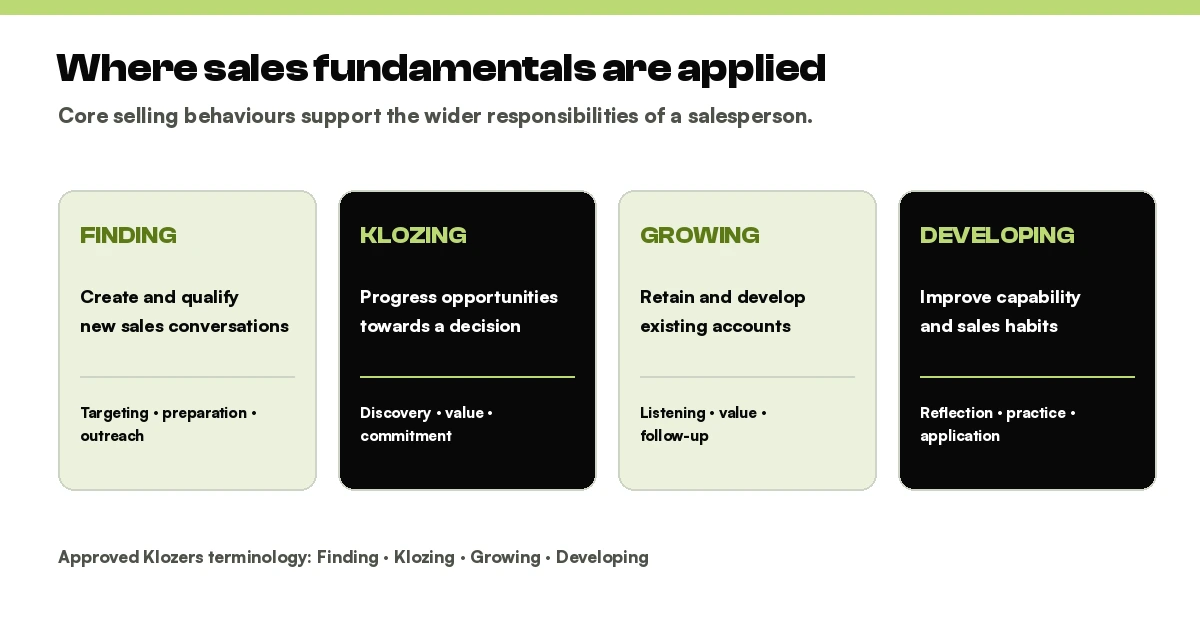
Fundamental selling behaviours support the wider responsibilities of Finding, Klozing, Growing and Developing.
Is the Sales Fundamentals Course right for your team?
Designed for
- Organisations that need a consistent foundation in B2B selling.
- New salespeople who need a practical standard for customer conversations.
- Experienced teams where execution of core behaviours is inconsistent.
- Technical or customer-facing people taking on greater commercial responsibility.
Not designed for
- Teams that only need one advanced specialist skill such as negotiation.
- Organisations whose main issue is sales management rather than salesperson capability.
- Teams seeking a fixed external methodology to replace effective internal practice.
- Businesses that need outsourced selling rather than capability development.
How much does the Sales Fundamentals Course cost?
Price per person
Private organisational delivery. Final scope depends on team size, customisation and delivery requirements.
From £720
€880 · US $990 · AUS $1445
What moves the price
- Number of participants and sessions required.
- Depth of discovery and customisation.
- Delivery location and format.
- Certification and post-training reinforcement where included.
- Number of participants and sessions required.
- Depth of discovery and customisation.
- Delivery location and format.
- Certification and post-training reinforcement where included.
All prices exclude applicable taxes.
What is included
- Discovery to understand the sales environment and capability requirement.
- Programme design around existing internal practice and identified gaps.
- Practical exercises using relevant customer and sales situations.
- Application planning so participants know which behaviours to use in live work.
What happens after the course?
Participants apply the agreed behaviours in live sales work. Where reinforcement or certification forms part of the scope, progress can be reviewed against the standard and evidence agreed for the programme.
Frequently asked questions
What are sales fundamentals?
Sales fundamentals are the essential behaviours used to prepare for customer conversations, understand needs, communicate value, respond to questions, progress the sale and follow up effectively.
Is Sales Fundamentals only for new salespeople?
No. New salespeople may need a complete foundation, while experienced salespeople can use the programme to strengthen inconsistent behaviours or align around a common team standard.
Can the course be customised?
Yes. Klozers starts with the client’s sales environment and existing internal best practice, then develops the areas where additional capability is required.
How long is the Sales Fundamentals Course?
The programme can be delivered as one or two-day workshops or as a series of shorter live online sessions. The final format is agreed during scoping.
How many people can attend?
Current Klozers course delivery is designed for groups of up to 12 participants so there is time for questions, practice and application.
Why do experienced salespeople still need sales fundamentals?
Experience and consistency are not the same thing. An experienced salesperson can have strong commercial judgement and customer relationships while still preparing inconsistently, moving too quickly into a presentation or failing to agree a clear next step. A fundamentals programme creates a way to inspect those behaviours without treating experienced people as beginners.
The starting point should be the behaviour required by the sales environment. If a team already has an effective way to conduct discovery, there is little value in replacing it simply because a trainer prefers another framework. Klozers therefore identifies internal best practice first and uses it as part of the programme.
This also helps sales leaders define what good looks like. When the expected behaviours are explicit, managers can coach against a common standard while allowing individuals to retain an appropriate personal style. The objective is consistency in the quality of execution, not identical scripts.
For mixed-experience teams, the same principle allows the programme to create a shared foundation without ignoring differences in capability. Newer participants can build the complete sequence while experienced participants focus on the parts that require improvement.
A useful standard should also be observable. Terms such as “be consultative” or “build relationships” are difficult to coach unless the team can describe the behaviour expected in a real customer conversation. Preparation might mean entering a meeting with a clear objective and relevant account context. Good discovery might mean understanding the customer’s priority, impact, stakeholders and decision process before proposing a solution. Progression might mean leaving with an agreed action owned by both parties.
That level of clarity gives experienced salespeople room to use judgement while giving managers something concrete to inspect and coach. It also prevents a fundamentals programme becoming a collection of generic tips that participants recognise but do not use differently after the training.
What is the difference between sales fundamentals and a sales methodology?
Sales fundamentals describe the essential work a salesperson needs to perform. A methodology is a more specific system for how parts of that work should be executed. The two can overlap, but they are not the same thing.
A salesperson needs to prepare, discover, communicate value and progress an opportunity regardless of whether the organisation uses a named methodology. Where a client already has a methodology, the fundamentals programme should support it rather than introduce competing terminology unnecessarily.
This is why the course starts with the client’s existing sales environment. The training can capture language, questions, standards and practices already used successfully by the team. Additional tools are then introduced only where there is a genuine capability gap.
For organisations without a formal methodology, the course still provides a practical structure for the customer conversation. The aim is to make the essential behaviours explicit and usable without creating a large implementation project around a methodology the organisation does not need.
This distinction is also important when several departments interact with customers. Marketing, presales, customer success and account management may use different language from the sales team. A fundamentals programme should not force every function into sales terminology. It should make the commercial hand-offs and expected sales behaviours clear enough that people understand what information is needed, who owns the next action and when an opportunity should progress.
How should sales fundamentals be practised?
Knowing a sales principle is different from applying it in a live conversation. Participants therefore need opportunities to practise the behaviour in situations that resemble their real work. That can include preparing for an account, opening a conversation, asking discovery questions, responding to resistance or agreeing the next step.
The practice should use the client’s own market and customer context wherever possible. Generic exercises can demonstrate a principle, but they require an additional translation step before the salesperson can use them at work. Relevant scenarios reduce that gap.
CIPD guidance on learning transfer states that knowledge and skills acquired through learning and development only create value when they can be applied in real workplace situations. Its Learning at Work 2023 research found that 57% of L&D professionals reported proactively understanding a performance issue before recommending a solution in 2023, compared with 32% in 2021. This research concerns workplace learning generally, not sales training specifically. The practical implication for this course is to diagnose the sales behaviour first and design practice around the work participants actually need to perform.
Managers can then reinforce the same behaviours after the training. This gives participants a clearer connection between what was practised in the session and what is expected when they return to live opportunities.
Practice also needs feedback. The purpose is not to reward a polished role play. It is to identify whether the salesperson made the right decisions during the conversation: what they prepared, what they asked, what they heard, how they connected value and whether the next step made commercial sense. Repeating a short section after feedback can be more useful than completing a long simulation without correction.
How do Finding, Klozing, Growing and Developing relate to sales fundamentals?
Klozers uses Finding, Klozing, Growing and Developing to describe four high-value areas of a salesperson’s work. They provide useful context for where fundamental selling behaviours are applied, but they are not being used here as a substitute for the course curriculum.
Finding includes the work required to create new sales conversations. Fundamentals such as targeting, preparation, relevance and communication affect the quality of that work.
Klozing covers progressing new prospects and opportunities. Discovery, value communication, handling resistance and agreeing commitments all contribute to that part of the salesperson’s role.
Growing applies many of the same fundamentals to existing customers. Listening, understanding changing needs, communicating value and following through on commitments remain important after the first sale.
Developing recognises that sales capability itself needs attention. Reflection, practice, coaching and continued application help salespeople improve how they perform the other three areas. The four terms therefore show the wider context in which the fundamentals are used rather than creating four separate course modules.
The balance between these areas will vary by role. An SDR may spend more time Finding, an account manager more time Growing, and an account executive more time Klozing. Developing applies to all of them. The fundamentals course provides the common behaviours beneath those different role priorities rather than assuming every salesperson should spend the same amount of time on each area.
How should organisations measure whether the training is being applied?
Attendance confirms that someone was present. It does not confirm that the sales behaviour changed. Measurement should therefore begin with the behaviours the organisation expects participants to use after the programme.
Those behaviours can be observed through normal sales management activity. Managers might inspect the quality of call preparation, the questions being asked, the information captured from discovery, whether value is connected to customer priorities, or whether opportunities have a clear agreed next step.
Where suitable, existing CRM data and sales measures can support the assessment. The important point is to avoid creating a separate reporting system simply to prove that training occurred. Measures should help managers understand whether the required behaviour is being used and where further coaching is needed.
CIPD’s Learning at Work 2023 research reports that addressing skills gaps was the top priority for 29% of L&D professionals in its survey, while its learning-transfer guidance treats workplace application as part of the L&D process. That research did not study sales teams, so it does not establish a sales performance effect.
For this course, the practical measurement question is therefore: are the agreed behaviours appearing more consistently in live work? Revenue, win rate and pipeline value may matter commercially, but many factors influence them. Behavioural evidence gives managers an earlier view of whether the training is being applied and where further coaching is required.
When should a team choose specialist sales training instead?
Sales Fundamentals is appropriate when the requirement spans the core sales conversation or when the organisation needs a consistent baseline across a team. A more specialist course is appropriate when the capability gap is narrower.
If the problem is primarily creating new conversations, a prospecting or B2B lead generation programme can go deeper into targeting and outreach. If the team already creates opportunities but needs stronger discovery and customer-focused conversations, consultative selling may be the better focus.
Negotiation training is more appropriate when the problem appears at the commercial agreement stage. Key account management is relevant where the priority is retaining and developing strategic customers. Sales management training addresses the manager’s ability to set standards, inspect execution, coach and create accountability rather than the salesperson’s customer conversation.
Where several capabilities need to improve together, the individual subjects can be combined into a broader programme. The selection should follow the performance requirement rather than a predetermined catalogue of courses.
Build a consistent foundation for your sales team
Tell us which sales behaviours need to improve. We will scope the programme around your market, customers, existing good practice and the capability gaps that matter.