
LinkedIn Training Course
LinkedIn sales training for B2B teams that need to identify the right buyers, research what matters to them and create relevant reasons to start sales conversations. The programme is built around your market, your sales process and the prospecting practices that already work inside your team.
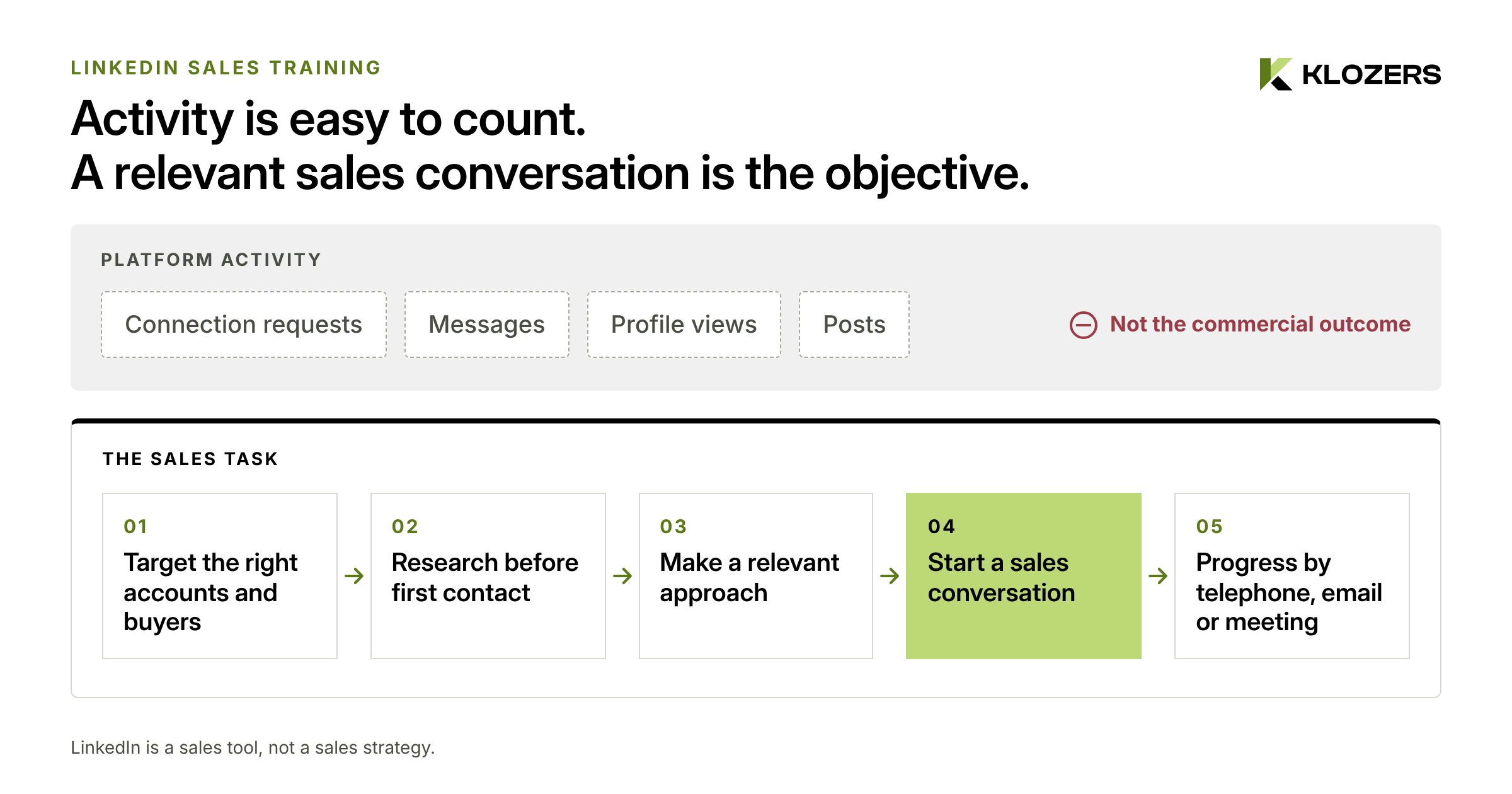
LinkedIn activity only has commercial value when it helps salespeople reach the right buyer with a relevant reason to engage.
LinkedIn sales training should teach salespeople how to identify the right buyers, research what matters to them, find credible routes into accounts and create relevant reasons to start a sales conversation. Knowing how to use LinkedIn is not the same as knowing how to sell with it.
- LinkedIn is a sales tool, not a sales strategy.
- The commercial objective is a relevant sales conversation, not more connections or profile activity.
- Research should improve who the salesperson contacts, why the approach is relevant and how the conversation starts.
- Sales Navigator can support targeting, account research, relationship mapping and timely outreach, but it is not required for the training.
- Klozers captures the client’s strongest existing prospecting practices before adding external techniques.
What should LinkedIn contribute to B2B sales?
LinkedIn gives salespeople access to professional information, relationships and signals that can make prospecting more informed. The commercial value does not come from using more features. It comes from using the information to improve the route to a buyer and the relevance of the conversation.
Knowing how to use LinkedIn is not the same as knowing how to sell with it.
A team can increase connection activity without improving pipeline. It can publish more content without reaching the accounts that matter. It can also buy Sales Navigator without changing the quality of its outreach. Before prescribing training, Klozers establishes whether the problem is sales capability or whether weak targeting, positioning, data or proposition needs to be addressed first.
Who this is for
The programme is for B2B teams that use LinkedIn as part of prospecting, account development or preparation for sales conversations.
Salespeople and account executives
Use LinkedIn to research buyers, prepare relevant approaches and support active opportunities.
SDRs and BDRs
Improve targeting, research and the quality of first contact rather than relying on high-volume generic outreach.
Sales managers and directors
Create a consistent commercial standard for how LinkedIn supports prospecting and account development.
Business development teams
Find the right people, identify routes into target accounts and move digital engagement towards a sales conversation.
What the LinkedIn Training Course covers
The final programme is customised after discovery. The modules below define the core behaviours rather than a fixed platform tutorial.
Target the right accounts and buyers
Translate the sales strategy into practical account and buyer criteria. Salespeople learn to use LinkedIn search, and Sales Navigator where available, to find people who fit the commercial target rather than building large unqualified lists.
Build a credible professional profile
Make the salesperson’s profile clear and relevant to the buyers they need to engage. The objective is commercial credibility when a prospect checks who has contacted them, not personal-brand activity for its own sake.
Research before outreach
Use company, role, activity and relationship information to understand the prospect’s context. Research should produce a better reason for contact and better questions, not simply more facts to insert into a message.
Map the people around an account
Identify relevant stakeholders and potential routes into the account. Sales Navigator users can also apply Relationship Maps, Relationship Explorer and shared-network information to support multi-threaded account development.
Connect with relevance
Create approaches based on the buyer and commercial context rather than generic connection requests. Participants learn when a connection request is useful and when another channel may be more appropriate.
Engage without substituting activity for selling
Use appropriate interaction with buyer and account content where it creates context or supports a relationship. Posting, commenting and reacting are supporting activities, not the commercial outcome.
Start a sales conversation
Move from LinkedIn interaction to a genuine business conversation. Participants practise personalised messaging, openings and questions that connect what they have researched with a relevant reason to talk.
Progress beyond LinkedIn
Use LinkedIn alongside telephone, email, meetings and the existing sales process. The platform should support the route into an opportunity rather than become a separate sales process.
Build LinkedIn into the way your team already sells
We start with your target market, sales process and the practices already producing results inside your team. External techniques are added where they improve that approach.
How it is delivered
The LinkedIn Training Course is delivered privately in person or live online. Participants work on the accounts, buyers and sales situations relevant to their role, so the programme is based on application rather than a feature demonstration.
Establish the sales task
Define the accounts, buyers and commercial conversations LinkedIn needs to support.
Apply it live
Participants research and work on relevant real-world sales situations during the training.
Capture the approach
Record the searches, research practices, messaging principles and next actions the team will use after the session.
Delivery options
Organisations we have worked with.


What does buyer research say about relevant outreach?
Relevance
Buyers unlikely to engage when a seller approaches with information irrelevant to their job.
68%
Business understanding
Buyers more likely to consider a solution when the seller understands their business needs.
51%
Role and personalisation
Buyer responses supporting understanding the person’s decision role and personalised communication.
47%
Source: LinkedIn Sales Solutions buyer research. These are surveyed buyer responses, not measured sales outcomes.
LinkedIn’s buyer research supports preparation and relevance before outreach. It does not prove that LinkedIn training causes a particular sales result.
Is this right for your team?
Designed for
- B2B teams using LinkedIn for prospecting or account development.
- Teams that need better targeting, research and relevance before outreach.
- Salespeople using standard LinkedIn or Sales Navigator.
- Organisations that want LinkedIn integrated with their wider sales process.
Not designed for
- Teams seeking LinkedIn advertising training.
- Organisations whose primary requirement is social-media marketing or influencer development.
- Teams expecting platform activity alone to correct weak targeting or positioning.
The programme is a sales programme. LinkedIn is the tool used to support the sales task.
What does LinkedIn Training cost?
Price per person
Current published page price verified before this refresh.
From £720, €880, US $990, CAN$1390, AUS$1390
Per person
The live page exposes a currency selector, but the retrievable published page only exposes the US dollar value. Other currency values have therefore not been inferred in this build.
What moves the price
- Participant numbers.
- In-person or live online delivery.
- Depth of discovery and customisation.
- Travel requirements for in-person delivery.
Frequently asked questions
Do participants need Sales Navigator?
No. The programme can be delivered for teams using standard LinkedIn. Where Sales Navigator is available, relevant search, account, relationship and buyer-signal features can be incorporated.
Is this a LinkedIn marketing course?
No. The commercial purpose is B2B selling. Profile credibility and content can support that purpose, but the programme is centred on targeting, research, relationships and sales conversations rather than social-media marketing.
Does the course cover LinkedIn advertising?
No. LinkedIn advertising is outside the scope of this sales training.
Can the training be customised?
Yes. Klozers reviews the client’s sales context and existing best practice before finalising the programme.
Can LinkedIn Training be delivered online?
Yes. Delivery can be in person or live online.
Why should LinkedIn activity start with the sales strategy?
LinkedIn provides tools for finding people, researching accounts, following activity and communicating. None of those features decides which market the company should pursue, which accounts deserve sales effort or why a buyer should consider changing. Those decisions belong to the sales strategy.
This distinction matters because platform activity is easy to count. A team can measure connection requests, messages, profile views and posts while still failing to create enough qualified sales conversations. Activity becomes useful only when it serves an agreed commercial target.
Klozers therefore starts with the people and accounts the organisation needs to reach. The training then shows participants how LinkedIn can improve targeting, preparation, access and engagement with those buyers. This is consistent with Klozers’ existing training material, which treats LinkedIn as a tool that can execute a strategy rather than as a strategy itself.
The result is a clearer standard for salespeople. They know which accounts matter, which roles are relevant, what information to research and what a useful next step looks like.
How should salespeople research buyers before outreach?
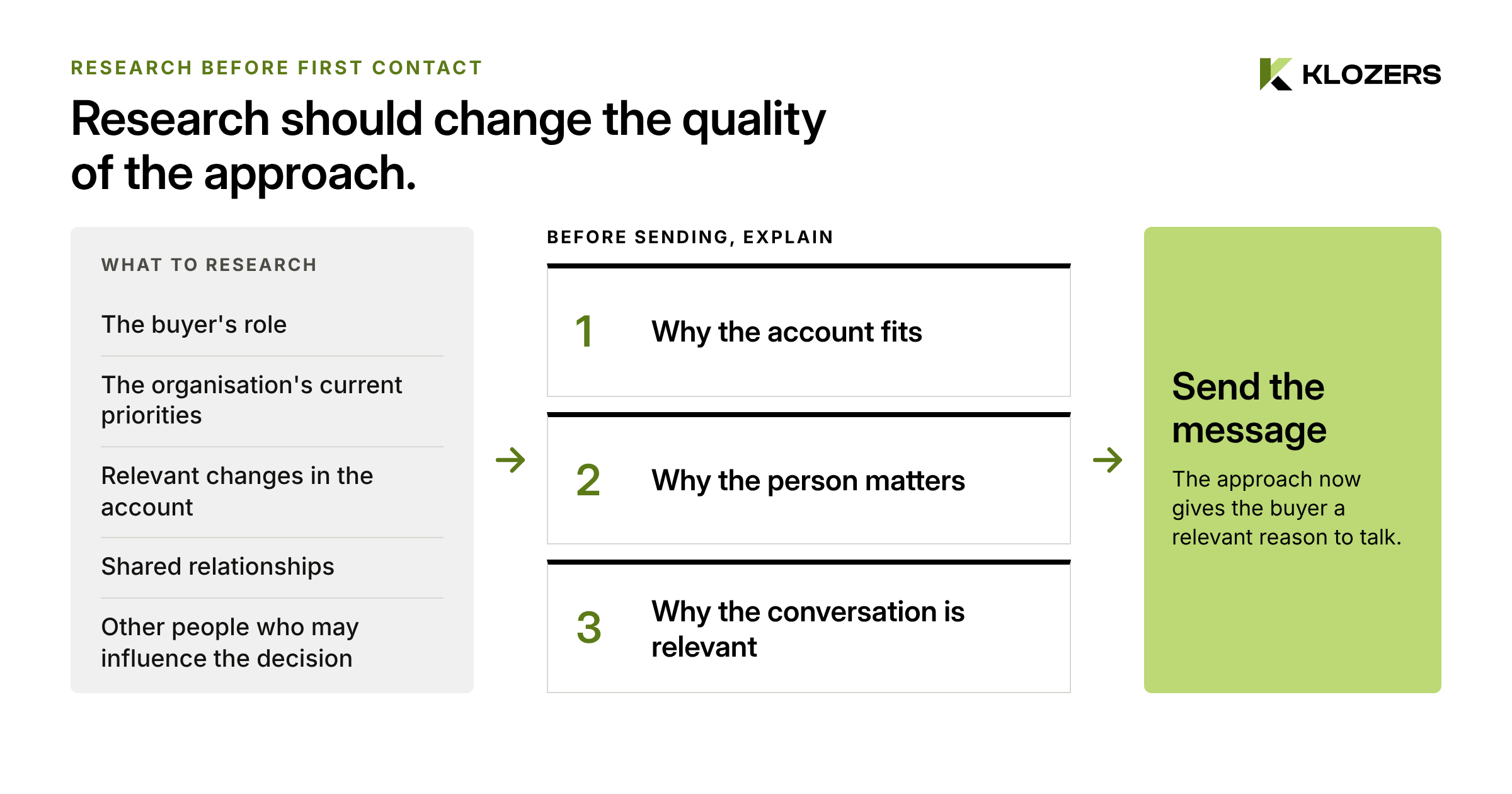
Research should change the quality of the approach. Collecting information that never changes the message, question or timing adds work without improving the conversation.
Useful research can include the buyer’s role, the organisation’s current priorities, relevant changes in the account, shared relationships and other people who may influence the decision. LinkedIn Sales Navigator currently supports lead and account search, alerts, Relationship Explorer, Relationship Maps and buyer-intent signals. These features can help a salesperson decide who to contact and provide context for a more relevant approach.
The evidence supports the emphasis on relevance. LinkedIn reports that 68% of surveyed buyers were unlikely to engage with a seller who approached them with information irrelevant to their job. The same research reports higher consideration when sellers understand business needs, understand the buyer’s role in the decision and personalise communication.
The training turns that principle into a repeatable preparation standard. Participants should be able to explain why the account fits, why the person matters and why the proposed conversation is relevant before sending the message.
How should LinkedIn support multi-threaded account development?
B2B decisions frequently involve more than one person. LinkedIn can help salespeople identify relevant roles around an account and understand existing relationships before deciding how to approach them.
For Sales Navigator users, LinkedIn’s Relationship Explorer can surface relevant leads, potential allies and routes into an account. Relationship Maps provide a place to organise saved leads and identify gaps in the buying group. TeamLink can expose colleagues who already have connections with people the salesperson needs to reach.
The training should not turn those features into a mechanical instruction to contact more people. The salesperson still needs a commercial reason for each relationship. A finance stakeholder, technical evaluator and operational user may care about different aspects of the same decision.
LinkedIn is useful here because it can make the account more visible before contact. The sales skill is deciding which relationships matter and how each conversation should contribute to progressing the opportunity.
When should a LinkedIn interaction become a sales conversation?
Engagement on LinkedIn can create context, but it should not become an indefinite substitute for selling. The salesperson needs to recognise when there is a credible reason to move from a connection, comment or message into a business conversation.
There is no universal number of interactions that makes somebody ready to talk. The appropriate point depends on the account, buyer, existing relationship and reason for contact. That is why the programme teaches judgement rather than a fixed sequence of automated touches.
A useful transition explains why a conversation may be worthwhile and gives the buyer a clear choice. Where another channel is more appropriate, the salesperson should use it. LinkedIn can support telephone, email and meetings rather than requiring the entire sale to remain inside the platform.
The commercial measure is therefore not whether the salesperson stayed active on LinkedIn. It is whether the platform helped create or progress a relevant sales conversation with a buyer the organisation wants to reach.
How does Klozers customise LinkedIn sales training?
Klozers does not begin by replacing the client’s existing approach with a generic LinkedIn methodology. The programme starts with discovery, including what the organisation sells, who it needs to reach, how its sales process works and what its strongest performers already do successfully.
That best-practice-first approach is important because sales teams often already contain behaviours worth standardising. One salesperson may have developed effective account searches. Another may be strong at researching stakeholders or moving online contact into a meeting. Capturing those practices creates internal relevance before external techniques are added.
The training is then built around the gaps. That may include target searches, profile credibility, account research, stakeholder mapping, messaging, Sales Navigator or integration with telephone and email prospecting.
The purpose is not to create a separate LinkedIn methodology. It is to improve the sales behaviours LinkedIn can support and make them practical enough for the team to use after the training.
Make LinkedIn support the sales conversation
Build the programme around your target buyers, your sales process and the practices that already work inside your team.