
Sales prospecting training course for B2B teams, built on your own accounts
Finding new customers depends on four decisions: which companies to target, when to call, who to call, and what to say in the first minute.
By Iain Swanston, Founder, Klozers
- Updated 5 November 2026
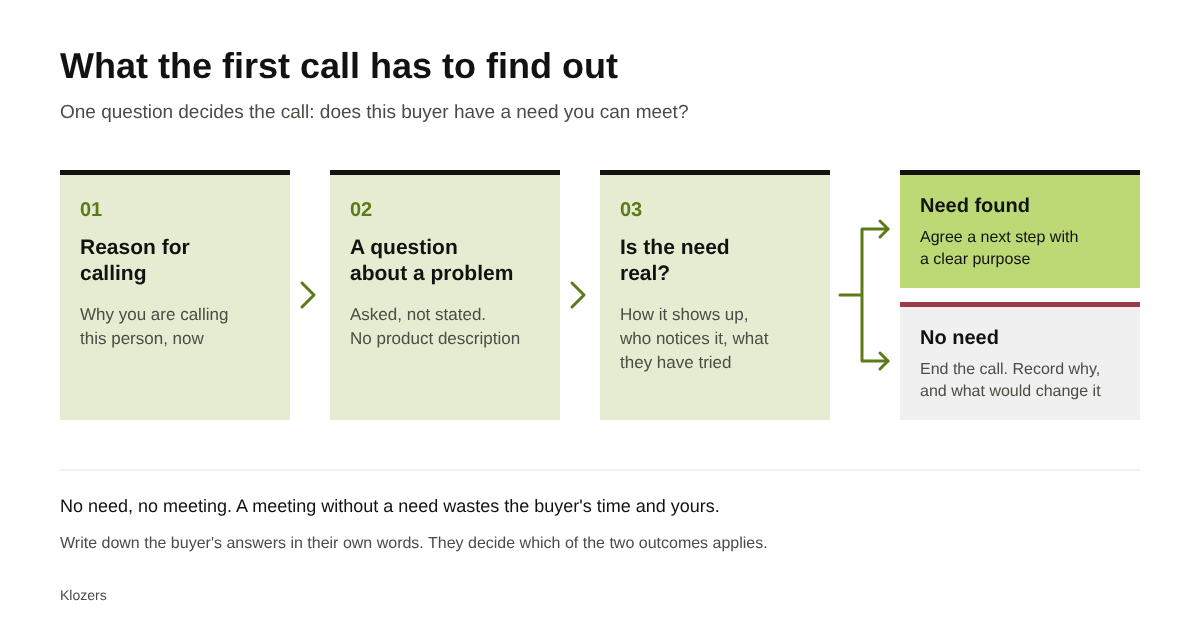
Diagram: a first meeting with a senior buyer needs four things in place before the request. The 17% figure is from a Gartner press release of 15 September 2020.
Key takeaways
- Build the target list from your ten best customers. The attributes they share define the lookalike accounts, and public triggers show which of them to call now.
- Call the people with the strongest reason to hear from you first: customers, people who contacted you, introductions, then lookalike accounts with a recent trigger.
- Write down why you are calling each person before you call. In Germany that record is also what makes a business call lawful.
- A senior buyer agrees to meet when there is a reason for calling, a problem they own, a small request and clear success criteria.
What should a sales prospecting training course cover?
How do you build a list of companies like your best customers?
Start from the customers you already have, not from a database filter. Take your ten best customers from the last three years. Best means they bought again, bought quickly or paid well, not only that they spent the most.
For each one, record facts anyone could check:
- Sector, and what the company sells.
- Size: the number of employees, and the size of the team you sell to.
- Where they sell: the home market only, or abroad as well.
- Ownership: family-owned, owned by an investor, or part of a group.
- What happened inside the company just before they bought from you.
- The job title of the person who first contacted you.
The attributes that most of the ten share are your ideal customer profile. A company with the same attributes that is not yet a customer is a lookalike account, and those accounts are your target list.
For a worked example, see our guide to a profile of your ideal customer. Public sources are enough to find the lookalike accounts. In the UK, Companies House lists registered companies with their officers and filing history. In Germany, the Handelsregister and the Bundesanzeiger publish the same kind of information. Trade association member lists and trade fair exhibitor lists add companies in your sector. Hannover Messe alone has about 3,000 exhibitors, according to its organisers.
Keep the list small enough to research properly. The CAEM team described below worked 102 named accounts, not several thousand.
How do triggers and buying cycles tell you when to call?
A trigger is an event that makes a change inside a company more likely, and with it a purchase. It tells you which accounts on your list to call now. Most companies on any list are not buying at a given moment. Professor John Dawes of the Ehrenberg-Bass Institute made an estimate in May 2021. If a business changes supplier about once every five years, only about 5% of buyers are in the market in any quarter. He describes this as a rule of thumb, not a precise measure.
Triggers are internal or external. Internal triggers happen inside the company:
- A new leader in the department you sell to. Trade press personnel news and LinkedIn job changes show these.
- Hiring in that department. Job boards show vacancies by function and city.
- Growth: a new site, a new product line or entry into a new country. Press releases and trade fair exhibitor lists show these.
- A change of owner or a merger. Company registers record these, for example Companies House filings in the UK and Handelsregister notices in Germany.
- A contract with their current supplier coming to an end. Your contacts at the account usually know the date.
- A new regulation or standard that the company must meet.
- A change in costs, prices or demand in its market.
- A move by one of its competitors, such as a new product or a lost contract.
- A change in technology that makes its current way of working out of date.
Which triggers matter depends on what you sell and who buys it. Your best customers show you. Look at what happened inside and around each company just before it bought from you. Those are the triggers to watch for across your lookalike accounts.
Buying cycles tell you how early to act. 6sense surveyed more than 4,000 buyers for its 2025 Buyer Experience Report. It found that 94% of buying groups had ranked their preferred suppliers before their first contact with a seller. The same report put the average buying cycle at about 10 months. So contact an account when the trigger happens, not when the tender is published.
Your own customers show the cycle in your market. Record when each customer first spoke to you, when they approved the budget and when they signed. The months that repeat tell you when to contact the lookalike accounts.
Who should your salespeople call first?
- Existing and past customers. Include other divisions and other country companies of the same group. They already know your work.
- People who contacted you. Enquiries, people who asked at an event to be called, and people who replied to a letter.
- Introductions. People a colleague, partner or customer has introduced, where the introducer has confirmed that the person wants the call.
- Lookalike accounts with a recent trigger. The trigger tells you why this company, and why now.
Before each call, write down four things: where the contact came from, the date, what shows their interest, and who the person is. If you cannot write the third item, you are not ready to call.
In Germany this record also matters legally. A call to a business is lawful only where specific facts, known before the call, show that this company would want it. Germany’s highest civil court, the BGH, has ruled that a general fit with your offer does not meet that test. This is not legal advice. Check the rules with a lawyer in each country where your team sells.
Trusted by teams at Microsoft, Panasonic, TikTok, Bizerba, Marangoni and Lathams.
What should a salesperson say on the first call?
Build the first minute on four things a senior buyer needs before agreeing to meet. Buyers have very little time for suppliers. Gartner research reported in September 2020 found that buyers typically spend only 17% of their time meeting potential suppliers when they consider a purchase.
- The reason for calling. Say why you are calling this person, now. For example: “Your colleague in Munich suggested I call you.” Or: “I read that you are opening a second site in Poland.”
- A problem they own. Name a problem the buyer already owns, in their terms, and ask about it. For example: “When a company opens a second site, [the problem your product solves] often becomes urgent in the first year. Is that happening for you?” Do not describe your product.
- A limited request. Ask for twenty minutes with a clear agenda, not a product demonstration. For example: “Would twenty minutes next week be useful? I would cover how two companies of a similar size dealt with it.”
- Their success criteria. Ask what would make the meeting worthwhile, and write down the answer in their words. For example: “What would you need to see in those twenty minutes for it to be worth your time?”
Which channels should the training cover?
The phone, letters, email and LinkedIn. The rules differ by country, so the training should follow the rules where your buyers are.
- The phone. The fastest way to find out whether there is interest, for the four groups above. Our page on cold calling and prospecting training covers the phone in more detail.
- Letters. A postal letter to a named senior person, with a simple way to reply. In Germany this is the main lawful first contact with a new account.
- Email. Use it with existing customers and with people who have agreed to hear from you. Under § 7 of the German unfair competition law (UWG), an advertising email to a new business contact needs their prior express consent.
- LinkedIn. Use it to research the buying group and to continue conversations with people you know. German legal commentary treats a promotional LinkedIn message like an email, so send an offer only when the person asks for one.
What results should you expect from the training?
Expect a measurable change in new conversations within 90 days, if the work continues after the training day. In a 2024 engagement with CAEM, a team working 102 target accounts had 19 additional enterprise accounts in active conversation within 90 days. It won £167,000 from three new customers in the same period. The full account is on our case studies page.
Each salesperson writes their own 90 day action plan during the session, and their manager reviews it at 30, 60 and 90 days. Where a team needs continued support, outbound lead generation coaching keeps the same plan in place week by week.
How do you practise first contact without risking your best accounts?
Practise on accounts you would like to win but would not miss. Use them to test new openings, and move a method to your priority accounts only after it has produced meetings. In the training, each salesperson writes and delivers the first call for a real account on their own list.
- Ask each salesperson to name ten accounts that match your best customers and have had a trigger in the last six months.
- For each account, write down the named person they will call and the reason for calling them now.
- For each person, write one sentence on why they would accept a meeting, in terms of a problem they own.
- Count the accounts that have all three. That number is your starting point.
Common questions about sales training for finding new customers
How long does the training take?
Is it suitable for new salespeople?
Yes. We teach the same approach at every level. New salespeople often adopt it faster, because they have fewer old habits. Experienced salespeople contribute real examples from their own accounts.
Do you run open courses with public dates?

Iain has trained and coached B2B sales teams since 2008. He was Lead Trainer and Coach at Microsoft Scotland. Before that he sold capital equipment and managed sales teams in the UK and North America. He served as an Associate at Strathclyde University Business School, where he delivered the sales content for the Masters in Entrepreneurship from 2015 to 2019.
You are buying a change in how your team sells, and the proof that it worked. A short call to agree what your team needs and a date that works.