
Exec Sales Coaching
Executive sales coaching for the person who runs the team. One to one, every two weeks, built on a benchmark of your sales unit and measured against KPIs you can influence.
By Iain Swanston, Founder, Klozers
- Updated 11 November 2026
Exec sales coaching is one-to-one coaching for sales leaders: sales directors, heads of sales, VPs of sales and chief revenue officers. Klozers starts with a benchmark of your sales unit against seven sales management areas. You then write a 90 day plan, and your coach works through it with you every two weeks, against KPIs you can influence.
Key takeaways
- Exec sales coaching is for the leader who runs the sales team, not for the individual salesperson.
- The coaching starts with a benchmark of your sales unit, so it works on the real gaps rather than on opinion.
- You write the 90 day plan. Your coach holds you accountable to your own plan.
- Every KPI must be something you can influence. A target the market decides measures the market, not you.
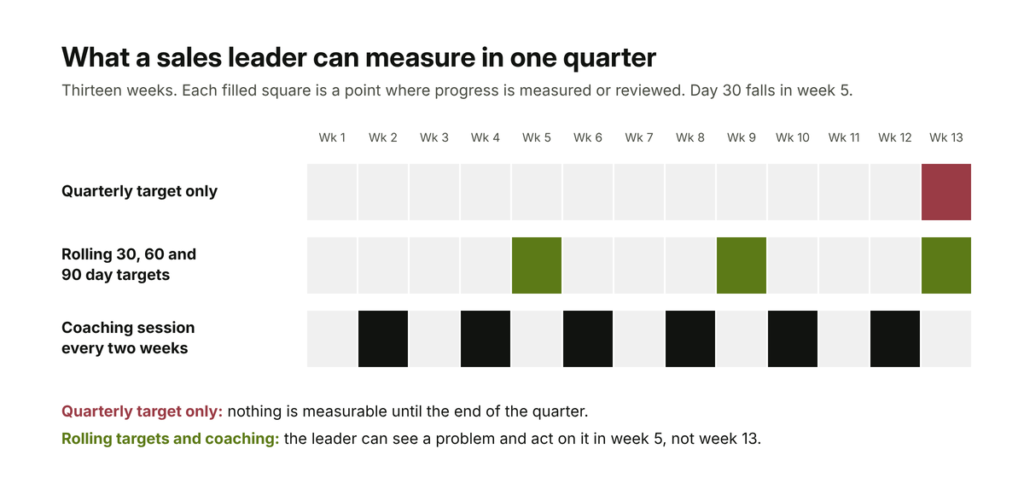
- Rolling 30, 60 and 90 day targets show a problem in week 5, not at the end of the quarter.
What is exec sales coaching?
Exec sales coaching, also called executive sales coaching, is one-to-one coaching for the person who leads a sales team. It works on how you lead the team, run the pipeline and hold people to a standard. It does not teach you to sell.
Most sales leaders were promoted because they sold well. Few were trained to lead a sales team. The skills that made you a strong salesperson are not the skills that make a team perform when you are not on the call.
The sharpest question for any sales leader is a simple one. Do you lead, or do you manage? Managing is checking activity and reporting the number. Leading is setting the standard, building the team that meets it and creating an environment that rewards the right behaviour. Exec sales coaching works on the second.
For coaching individual salespeople, see Sales Performance Coaching. For how coaching keeps training in use across a whole team, see sales coaching.
Who it is for
Leaders who are responsible for a sales number and the team that delivers it.
Sales directors and heads of sales
You run the team and own the forecast. You want an outside view of how you lead, from someone who has done the job.
VPs of sales and chief revenue officers
You lead managers, not salespeople. You need your managers to run the team to one standard when you are not there.
Newly promoted sales managers
You were the best salesperson. Now the number depends on other people, and nobody has shown you how to lead them.
What the coaching covers
Every business has the same seven sales management areas, whatever its size or sector. What varies is which ones are weak. The benchmark shows which, and the coaching works on those first.
| Sales Strategy | Whether the sales strategy matches the growth strategy of the business, and whether the team follows it. |
|---|---|
| Sales Process | Whether the team has a defined sales process, and whether everyone follows and records it. |
| Sales People | How you hire, develop and review your salespeople, and whether performance is recorded objectively. |
| Sales Channels | Whether you use the right routes to market, and whether each one is resourced and managed. |
| Sales Technology | Whether your CRM and data produce accurate reports, and whether people use them. |
| Sales Customers | How customer relationships are segmented and managed, and how success with them is measured. |
| Sales Leaders | Whether you create an environment that rewards the right behaviour, and whether you lead or only manage. |
A 30 minute call covers your team, your targets and what you want the coaching to change.
How it is delivered
One to one, on a video call, every two weeks. Coaching of this kind usually runs for three to nine months.
Benchmark your sales unit
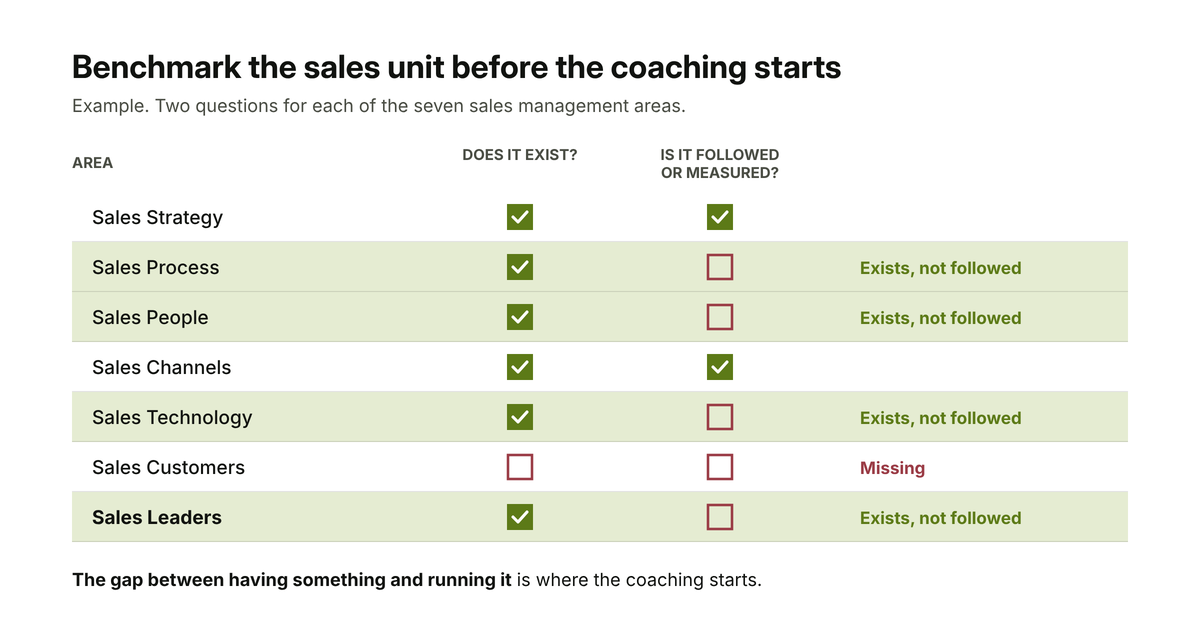
Your coach assesses the team against the seven areas, with two questions for each. Does it exist? Is it followed or measured? The result is an Improvement Plan, not an opinion.
Write your 90 day plan
You write the plan, with targets at 30, 60 and 90 days. It is reviewed and agreed with a colleague in your business, so it is not a private promise to your coach.
Coaching every two weeks
Each session works on the plan and on whatever is live: a deal at risk, a hire, a manager who is struggling. You leave each session with one written action.
Review at 30, 60 and 90 days
At each point you and your coach compare the KPIs with the plan. You then rewrite the next 30 days.
Organisations we have worked with.


What sales leaders told us
From a Klozers survey of 40 B2B sales leaders across 15 countries, July 2024 to February 2025. Read the full B2B Sales Landscape Report.
rate sales forecasting as highly critical to their business.
report full confidence in the accuracy of their forecast.
would rehire their entire current sales team.
42.5% of respondents work in companies of ten people or fewer, and 65% directly manage a sales team.
Designed for, and not designed for
| Designed for | Not designed for |
|---|---|
| Leaders responsible for a sales team and its number | Individual salespeople. See Sales Performance Coaching |
| Leaders prepared to agree KPIs and be measured against them | General life or career coaching with no sales number attached |
| Leaders who will write their own plan and share it with a colleague | Leaders who want someone to run the team for them |
| Newly promoted managers who want to lead, not only to sell | Anyone who does not want their progress measured |
Why this matters. Coaching without a measure turns into conversation. If you will not agree KPIs and a written plan, you will get more value from a book than from a coach.
Pricing
| What | From |
|---|---|
| Exec Sales Coaching | £1,250 per person, per month |
- Benchmark of your sales unit against the seven areas
- Your 90 day plan, with targets at 30, 60 and 90 days
- One-to-one coaching on a video call every two weeks
- Contact with your coach by email or phone between sessions
- The number of leaders coached
- The length of the engagement
- Work built for a larger organisation, such as coaching a whole leadership team to one standard
Cancel at any time. Your coaching continues until your next monthly payment date.
Questions about exec sales coaching
Who is exec sales coaching for?
Sales leaders: sales directors, heads of sales, VPs of sales, chief revenue officers and newly promoted sales managers. For coaching individual salespeople, Klozers offers Sales Performance Coaching, with the salesperson’s manager involved.
How many people does the coaching cover?
The price is per person, per month. Each leader has their own coach and their own sessions. For several leaders in one business, the coaching can be built as one programme, priced on request.
Will the coaching cover the topics that matter to me?
Yes. The agenda comes from the benchmark of your sales unit and the 90 day plan you write, not from a fixed syllabus. If a live deal or a team problem needs attention, the session works on that.
Which industries do you coach in?
Klozers coaches sales leaders in business-to-business companies across sectors, including technology, manufacturing and professional services. The seven sales management areas apply whatever you sell.
Is exec sales coaching delivered online?
Yes. Sessions are one to one on a video call, with cameras on. Online coaching suits leaders who manage teams across several locations and cannot set aside travel time.
Can I cancel?
Yes. You can cancel at any time, and your coaching continues until your next monthly payment date.
How does exec sales coaching work?
Exec sales coaching works by changing what the leader does each week, then measuring whether the team changes with it. The sections below explain the parts: what an executive sales coach does, how the coaching differs from general executive coaching, and how progress is measured.
What does an executive sales coach do?
An executive sales coach works with a sales leader on the leader’s own team, pipeline and targets. The coach has led sales teams, so the conversation is about real decisions. Which deal needs attention this week? Which manager is struggling? Which hire is not working?
The coach does not run the team. The coach asks questions, challenges assumptions and, when it helps, says plainly what they would do. The leader decides and acts.
How is it different from general executive coaching?
General executive coaching is mostly non-directive. The coach asks questions and the leader finds their own answer, which works well for leadership style, career choices and relationships at work.
A sales leader works to a number and a date. When the quarter is at risk, questions alone can be too slow. A good executive sales coach uses three styles and chooses between them:
- Directive. The coach says what they would do. Used when time is short and the leader cannot see the problem.
- Non-directive. The coach asks questions and the leader reaches the answer. Used for decisions the leader must own, such as how to structure the team.
- Collaborative. Coach and leader work through a problem together. Used for plans, such as the 90 day plan or a difficult conversation with a manager.
Klozers coaches also use GROW, a general coaching model: Goal, Reality, Options and Will. It gives each session a structure. The choice of style depends on the situation, not on the model.
Why benchmark before the coaching starts?
Because a plan built from a benchmark is a different conversation from a plan built from an opinion. Without one, the coaching works on whatever the leader thinks is wrong, and leaders often work on the wrong problem.
The Klozers benchmark uses seven sales management areas: Sales Strategy, Sales Process, Sales People, Sales Channels, Sales Technology, Sales Customers and Sales Leaders. Each has two questions. The first asks whether the thing exists. The second asks whether it is followed or measured.
The gap between those two answers is the pattern to look for. Many sales teams have a documented sales process that nobody follows, or a CRM that does not produce reports anyone trusts. For the Sales Leaders area, the two questions are these. Are you creating a positive and supportive environment that rewards and encourages success? Do you lead, or do you manage?
The benchmark produces an Improvement Plan. You share it with the other people in the business who need to support it, and it becomes the agenda for the coaching.
What does a sales leader work on in a session?
Each session has two parts. The first reviews the plan: what you committed to last time, what happened and what the KPIs show. The second works on whatever is live in your business that week.
Typical subjects include a forecast you do not trust or a manager whose team is behind. Others are a large deal that has stopped moving, or a hire you are unsure about. Others are a sales process the team does not follow, or a conversation with the board about the number. The session ends with one action, written by you, with a date.
Between sessions, you can contact your coach by email or phone when a decision cannot wait two weeks.
Why must every KPI be inside your control?
If you cannot influence whether you hit a KPI, it measures the market, not you. Revenue this quarter depends on deals that started months ago, on the market and on your buyers’ budgets. It is your goal, but it is a poor measure of whether the coaching is changing how you lead.
A goal and a KPI are not the same thing. The goal is the end result. A KPI is a step on the way to it. Good KPIs for a sales leader are things the leader’s own actions change. One example is the number of one-to-one sessions held with each manager. Another is the share of deals in the forecast that meet the team’s definition of qualified.
Klozers agrees the KPIs with you before the coaching starts. They are written into your 90 day plan, so both you and your coach know how progress will be judged.
Why use rolling 30, 60 and 90 day targets?
Quarterly targets alone leave two months in which nothing is measurable. By the time the quarter closes, it is too late to act. Rolling 30, 60 and 90 day targets, alongside the quarter, show whether the plan is working while there is still time to change it.
The coaching follows the same rhythm. Sessions every two weeks mean a problem in the plan is discussed within days, not at the next quarterly review.
Why write your own plan?
A plan you wrote yourself is a plan you will defend. A plan someone gave you is only a document. In each session your coach holds you accountable to your own words, which is a different conversation from accountability to a course or a framework.
The plan is also reviewed by a colleague in your business. That makes it a commitment to the business, not a private agreement with your coach.
The same principle applies when you coach your own managers. Ask them to write the plan, then hold them to it. Most leaders find that the habits they practise in their own coaching become the way they coach their team.
Does coaching work?
The research on workplace coaching is positive, with limits. A meta-analysis by Jones, Woods and Guillaume (2016) combined 17 studies of workplace coaching by internal or external coaches. It found a positive effect on organisational outcomes overall. The studies were not of sales leaders, so the result shows that coaching can work at work in general. It does not show what coaching will do for your team.
That is why the KPIs matter. Your own measures, agreed before the coaching starts, are better evidence for your business than any study.
Can exec sales coaching be done online?
Yes. In the same meta-analysis, coaching delivered face to face and coaching that combined face-to-face and online sessions showed no significant difference in effect. Klozers coaches sales leaders on video calls, with cameras on for the whole session. A coach cannot coach what they cannot see.
Online coaching suits most sales leaders. Many run teams across several offices or countries. An hour on a call every two weeks is easier to protect than half a day of travel.
How long does exec sales coaching take?
Sales coaching for a leader usually runs for three to nine months. Three months is enough to complete one 90 day plan and see whether the rolling targets move. Longer engagements suit leaders who are new to the role, or who are changing how a whole team works.
Mentoring is different. A mentor gives longer-term guidance on a career or a role, often over one to three years. Mentoring is not usually tied to a sales number. Exec sales coaching is tied to the plan and the KPIs from the start.
How do you choose an executive sales coach?
Ask four questions before you agree to work with anyone.
- Has the coach led a sales team, not only sold?
- Will the coaching start from a benchmark of your sales unit, or from a general programme?
- Which KPIs will you agree before the coaching starts, and who will see them?
- Who writes the plan: you or the coach?
A coach who cannot answer the third question is asking you to judge the coaching on how the sessions feel. That is not evidence.
What happens after the coaching?
Most leaders want the standard they have built to hold across the whole team. Klozers can extend the work to the managers who report to you, with coaching built around the same standard. For individual salespeople, Sales Performance Coaching runs for a minimum of three months, with each salesperson’s manager involved.

Iain has trained and coached B2B sales teams since 2008. He was Lead Trainer and Coach at Microsoft Scotland. Before that he sold capital equipment and managed sales teams in the UK and North America. He served as an Associate at Strathclyde University Business School, where he delivered the sales content for the Masters in Entrepreneurship from 2015 to 2019.
A 30 minute call covers your team, your targets and the KPIs you would want the coaching to change.