
Telesales Training Course
Develop telephone sales conversations around where the buyer is in their buying process. Outbound prospects may not yet recognise a need to act. Inbound buyers have already taken some action to investigate. Your salespeople need to recognise the difference and conduct the conversation accordingly.
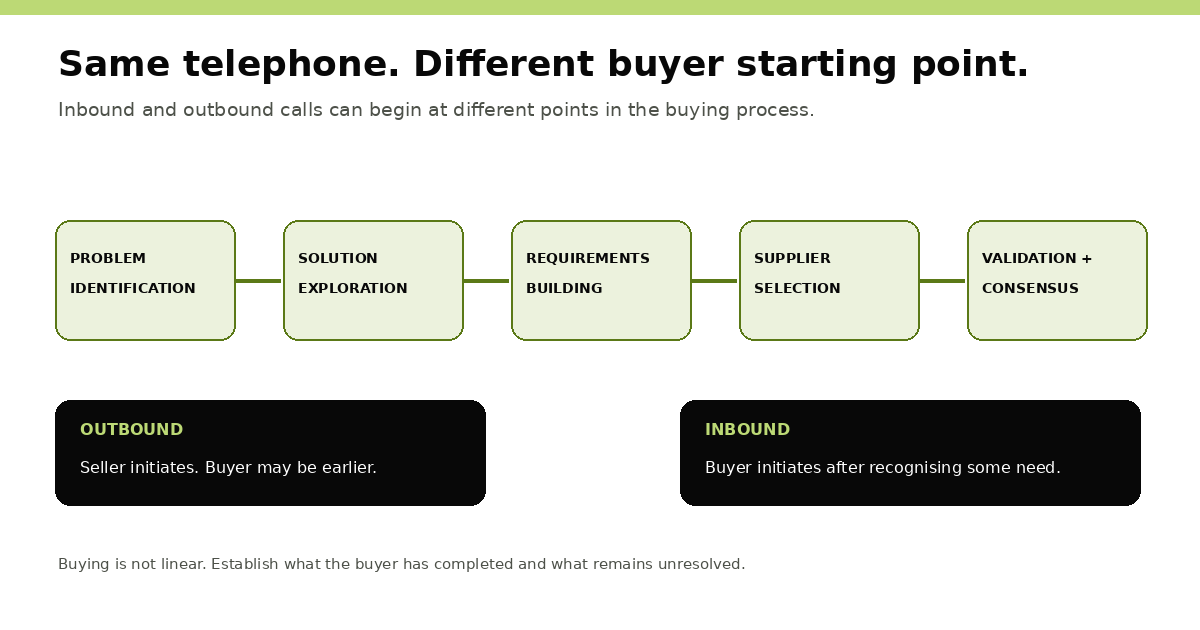
Inbound and outbound telephone conversations can start from different buyer positions. B2B buying itself is not linear.
Telesales training should teach salespeople to recognise where a buyer is in the buying process and adapt the telephone conversation accordingly. An outbound prospect may not yet recognise a reason to change. An inbound buyer has already taken some action to investigate. The salesperson’s task is to establish what the buyer knows, what remains unresolved and the appropriate next step.
- Telephone sales includes inbound and outbound calls.
- The main difference is often where the buyer starts in the buying process.
- Outbound salespeople may need to establish why a problem deserves attention before discussing a solution.
- Inbound salespeople should not assume an enquiry means the buyer has finished defining the problem or requirements.
- Effective telesales training develops judgement and conversation skills rather than dependence on a fixed script.
What changes between inbound and outbound telephone sales?
The telephone is the channel. The buyer’s position determines the conversation.
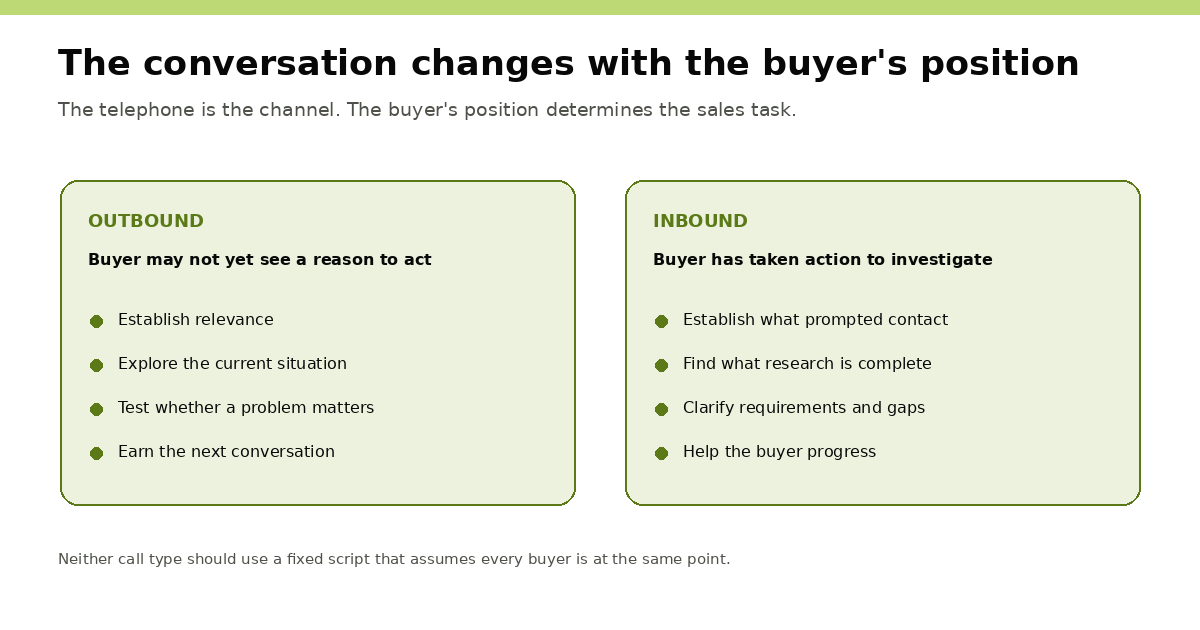
In a typical outbound call, the seller initiates contact. The prospect may not have identified the problem as something that requires action, may not be exploring solutions and may have no intention of evaluating suppliers. The first task is therefore to establish relevance and determine whether there is a problem or opportunity worth discussing.
In a typical inbound call, the buyer initiates contact. That indicates some level of active interest, but it does not prove that the buyer has fully defined the requirement or is ready to select a supplier. The salesperson needs to establish what prompted the enquiry, what the buyer has already learned and what remains unresolved.
Gartner describes B2B buying tasks as problem identification, solution exploration, requirements building, supplier selection, validation and consensus creation, and cautions that buyers revisit these tasks rather than following a predictable linear sequence. Gartner’s B2B buying journey research therefore supports buyer position as a diagnostic, not a rigid stage model.
McKinsey describes buyers translating a latent need into an explicit need through research or sales conversations before comparing suppliers and their offerings. McKinsey’s B2B customer journey research did not study telesales training specifically, so it is adjacent evidence only.
Who is Telesales Training for?
Outbound salespeople
Salespeople, SDRs and BDRs who initiate telephone conversations with prospects who may not yet be actively looking for the product or service.
Inbound salespeople
Salespeople handling enquiries from buyers who have recognised enough of a need to contact the organisation but may still be exploring solutions, defining requirements or evaluating providers.
What does Telesales Training cover?
Recognise the buyer's starting position
Identify what the buyer has already recognised, researched or decided.
Handle outbound conversations
Establish relevance with somebody who may not yet see a reason to change. Explore whether a meaningful problem exists before presenting a solution.
Handle inbound conversations
Establish what caused the buyer to make contact, what research is complete, what they believe they need and what remains unclear.
Open the call effectively
Use an opening appropriate to the buyer’s context rather than the same script for every call.
Run effective discovery
Ask questions that improve understanding of the buyer’s situation, requirements and priorities.
Communicate relevant value
Connect the offer to what has been learned rather than relying on a generic pitch.
Respond to questions and resistance
Outbound prospects may resist the conversation itself. Inbound buyers may question fit, alternatives, implementation, risk or commercial terms.
Progress the buyer
Agree a next step appropriate to the buyer’s position rather than forcing every call towards the same commitment.
Train the conversation around the buyer
We build the programme around your inbound and outbound call types, buying situations and the best practice already inside your organisation.
How is Telesales Training delivered?
Telesales Training is delivered privately in person or live online. Exercises can use the call types, propositions and buyer situations your team handles in practice.
What should change after the training?
Where are they?
Establish what the buyer has already recognised and investigated.
What matters now?
Adapt the call to the buyer’s starting point.
What next?
Seek a commitment that fits the buyer’s current decision task.
Is Telesales Training right for your team?
Designed for
- Teams that create or progress B2B opportunities by telephone.
- Outbound teams speaking to prospects who may not yet be actively buying.
- Inbound teams handling buyers who have already started investigating a need.
- Organisations that want training customised around their buyers and existing best practice.
Not designed for
- Teams where poor data or targeting is the main cause of weak outbound performance.
- Organisations where insufficient demand is the primary problem.
- Teams seeking one fixed script regardless of buyer context.
- Situations where a wider sales strategy problem needs to be resolved first.
How much does Telesales Training cost?
Price per person
Private organisational delivery. Final scope depends on participant numbers, customisation, delivery format and location.
From £720
€880 · US $990 · AUS $1445
What is included?
- Scoping around inbound and outbound call types.
- Review of relevant existing practices and internal best practice.
- Customisation around buyers, value proposition and sales process.
- Practical telephone-sales exercises and feedback.
- Application to buyer situations your team encounters.
Frequently asked questions
Is telesales only outbound calling?
No. Telesales can include inbound and outbound telephone sales. The buyer’s starting position is often different, which changes the conversation.
What is the difference between inbound and outbound sales calls?
In an outbound call the seller initiates contact and the prospect may not yet recognise a reason to act. In an inbound call the buyer has initiated contact after recognising enough of a need to investigate, although they may still be exploring solutions or defining requirements.
Does the training teach scripts?
The programme can use call structures and examples, but the emphasis is on recognising buyer context rather than applying one fixed script.
Can the training cover both inbound and outbound teams?
Yes. The programme can cover both while keeping their different buyer starting conditions clear.
Can Telesales Training be delivered online?
Yes. Delivery can be in person or live online.
Why does buyer position matter more than the telephone channel?
Two salespeople can use the same telephone system, sell the same product and speak to the same market while facing different sales tasks. The difference is what the buyer has already done before the conversation starts. An outbound prospect may not have identified a problem that justifies action. Introducing detailed product information at that point assumes a buying decision that does not yet exist.
An inbound buyer has already acted. They may have searched for a solution, visited the supplier’s website, responded to marketing or made a direct enquiry. That activity gives the salesperson a different starting point, but it should not be mistaken for a completed buying process. The buyer may still be defining the requirement, comparing approaches or trying to understand risk.
Training therefore needs to develop diagnosis before presentation. The salesperson establishes the buyer’s position and then chooses the questions, information and next action that fit it.
How should an outbound telesales conversation work?
The first requirement is relevance. The salesperson needs a credible reason for contacting the prospect, but relevance is not the same as assuming a need. A prospect can fit the target profile without experiencing the problem the supplier solves.
The opening should create enough context for a useful conversation. Discovery then tests the current situation, whether a meaningful problem or opportunity exists and whether it has sufficient priority to justify further attention. This is different from treating the call as a compressed product presentation.
The appropriate outcome may be another conversation, access to another stakeholder, permission to send relevant information or a decision that there is no current opportunity.
How should an inbound telesales conversation work?
An inbound enquiry changes the starting point because the buyer has acted. The salesperson should find out what prompted that action before deciding what information to provide.
The buyer may already understand the problem and be comparing suppliers. They may instead be early in solution exploration and uncertain about what they need. Treating every inbound contact as sales-ready can lead to premature proposals and weak qualification.
Useful discovery includes what the buyer is trying to achieve, what they have already researched, which requirements are clear, which remain uncertain and who else is involved in the decision.
Why should telesales training avoid one fixed script?
A script can provide consistency in basic information, but a single script assumes the same context for every buyer. That assumption is weak when inbound and outbound conversations can start from different buying positions.
The salesperson still needs structure. They should know the purpose of the opening, the areas discovery needs to cover, the value proposition and the commitments that can progress a sale. The difference is that structure guides judgement rather than replacing it.
Klozers builds this around the client’s own market and strongest existing practices. Where top performers already handle particular call situations effectively, those behaviours should be captured before external techniques are added.
How should managers diagnose weak telesales performance?
Training is appropriate when the limiting factor is capability. It is not a substitute for poor targeting, weak data, an irrelevant proposition or insufficient demand.
For outbound teams, managers should distinguish call activity from the quality of the opportunity set and conversation. More calls to the wrong organisations do not correct targeting. For inbound teams, managers should examine whether salespeople understand why buyers make contact and whether they adapt to different levels of buyer knowledge.
The training requirement should therefore be defined after the sales problem is understood. That keeps the programme focused on behaviours that salespeople can actually change.
Build telesales capability around how your buyers buy
We scope the programme around your inbound and outbound conversations, buyer situations and existing best practice.