
New Customer Bootcamp
The New Customer Bootcamp is two days of intensive prospecting training at your site. We research your market and build the campaign for you. Your team makes its first live call before lunch on Day 1, with our coach calling alongside them. Ninety days later, their managers assess the result on live accounts.
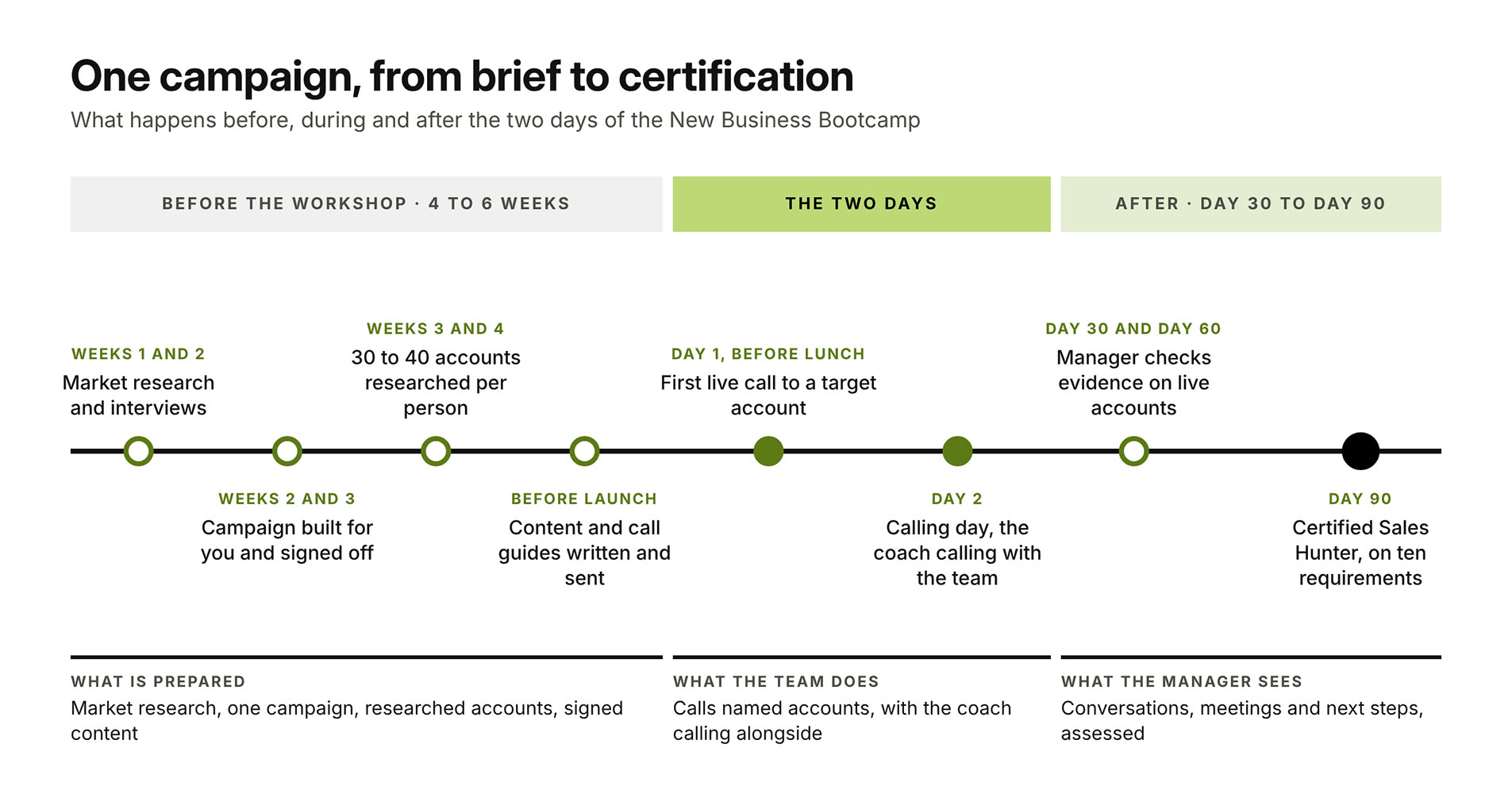
The New Customer Bootcamp runs as one campaign. The build comes first, then two days of live calling, then manager assessment at Day 30, 60 and 90.
The New Customer Bootcamp is two days of intensive prospecting training at your site. Klozers researches your market and builds the campaign, including a list of researched target accounts for each participant. Your team then calls those accounts, with a Klozers coach making live calls alongside them. Managers assess each participant on live accounts at Day 30, 60 and 90 for the Sales Certification Programme.
Key takeaways
- The first live call is before lunch on Day 1, and Day 2 is a calling day.
- A Klozers coach calls your prospects with your team, in your company’s name and from your account lists.
- We research your market and build the campaign for you: the offer, the accounts, the content and the call guides.
- Every campaign is designed to be effective and lawful in each country it targets.
- Participants who meet ten requirements on live accounts by Day 90 become Certified Sales Hunters.
Why does most prospecting training not produce new customers?
Most prospecting training happens away from the phone. People practise on each other, go back to their desks and make the real calls alone. Many put them off. The calls that decide whether you win a new customer are the ones nobody practised with help.
The reason is rarely knowledge. In a study of 189 salespeople, fear of being judged by the customer lowered sales performance (Verbeke and Bagozzi, Journal of Marketing, 2000). The authors described protective behaviour on the call as potentially the most damaging part: apologising for calling, rushing and ending the call early.
The New Customer Bootcamp moves the learning to the place where the fear appears. Your team calls real accounts at your site, with a Klozers coach making calls beside them.
Our coach calls your prospects with your team
The Klozers coach makes live calls on your accounts, in your company’s name and from your lists. Your salespeople hear how a first call to a new account sounds, then make the next one.
We research your market and build the campaign
We research your target market and interview your sales managers, product managers and marketing team. Then we build the campaign: the offer, the accounts, the content and the call guides.
Designed for each country
Every campaign is designed to be effective and lawful in the country it targets. Where a country restricts calls, written content or email, the campaign is built around those rules.
Two intensive days of calling
No slides and no role play. Every call is prepared in writing, and the coach debriefs the team after each calling block.
Certified on evidence at Day 90
Each participant’s own manager assesses ten requirements on live accounts at Day 30, 60 and 90. Those who meet them become Certified Sales Hunters under the Sales Certification Programme, valid for 12 months.
Who is the New Customer Bootcamp for?
It is for B2B companies in every sector that need to win new customers. That need often comes when existing customers buy less, or when a company enters a new sector, market or country.
- Companies of any size, selling any product or service to other businesses.
- Salespeople, account managers, consultants, pre-sales and technical salespeople, and anyone who needs support to prospect and win new business.
- Up to 15 participants, with one Klozers coach.
- Sales directors and managing directors who own the new-customer target, working with HR or finance where they hold the budget.
What happens before, during and after the New Customer Bootcamp?
The Bootcamp itself is two intensive days of calling. We prepare the campaign for you in the four to six weeks before. Managers then assess the results at Day 30, 60 and 90.
Market research and interviews
We research your target market and interview your sales managers, product managers, marketing team and anyone else who knows how you win customers.
We build the campaign
We build the campaign around five questions. What are we selling? Who are we selling to? Why would they act now? Why us? What proof do we have? Your leadership signs it off.
Account research and content
Klozers researches the target accounts for each participant and writes the content and call guides. The content goes out before Day 1, signed by the person who will make the call.
Call reluctance, then the first calls
The morning covers call reluctance and each person’s own reasons for winning new customers. The first live calling block starts before lunch.
The calling day
The content sent before Day 1 named this day. The team calls its accounts in blocks, the coach calls with them, and every block ends with a debrief.
Manager assessment
Each participant’s manager checks the evidence on live accounts. Klozers coaches the managers through each check. Day 90 decides certification.
Find out whether your market is ready for a calling day.
A 30 minute call to agree the target market, the accounts and a date for the two days.
How is the New Customer Bootcamp delivered?
- In person at your site, over two consecutive days.
- One Klozers coach present throughout, making live calls on your accounts, in your company's name, under a data processing agreement with you.
- No slides and no role play. Most of the two days is spent calling, with a debrief after every calling block.
- Calls are made in the language your prospects speak. Klozers delivers in English, German, French, Spanish, Dutch and Italian.
Optional follow-on days
Three monthly days at your site. Each is a calling day as well as a review.
- Review and Challenge
- Deepen and Improve
- Consolidate and Sustain
Priced in your proposal.


What has a campaign on named target accounts produced?
CAEM ran a 90 day campaign on 102 named target accounts. These are the results recorded in the CAEM case study.
CAEM
102 target accounts · 90 days
£167,000
from three new customers out of 102 target accounts in 90 days.
CAEM
The same 102 accounts
19
further enterprise accounts in active conversation from the 102 targeted.
Is the New Customer Bootcamp right for your team?
Designed for
Companies that need new customers, not more activity with existing ones.
Leadership that can agree one target market and one offer for 90 days.
A business with at least one customer result it can point to.
Managers who can give each participant 15 minutes every two weeks.
Teams that will protect two calling blocks a week after the workshop.
Not designed for
Companies that cannot yet show a result they have delivered for a customer. Prospects need that proof before they agree to talk, and training cannot create it.
Leadership that wants three goals from one campaign.
Teams that expect new orders by Day 90 in a market where the sales cycle is longer than 90 days.
Teams that need one specific skill fixed. A one-day workshop does that without a calling campaign.
The two days work only when there is a market to call, a result to point to and a manager to assess the evidence. Where one of those is missing, the free consultation is the place to find out, before any money is spent.
What does the New Customer Bootcamp cost?
| GBP | £14,000 |
|---|---|
| EUR | €17,500 |
| USD | $19,750 |
| CAD | $27,450 |
| AUD | $27,450 |
Prices exclude VAT. Travel, printing and postage are charged at cost.
Included in the price
- Research on your target market and the campaign built for you.
- Researched target accounts for each participant, with content and call guides.
- Two intensive days at your site with a Klozers coach.
- The Sales Certification Programme, with manager assessment at Day 30, 60 and 90.
What changes the price
- The number of participants.
- The number of target accounts researched for each participant.
What is included, and what happens after the two days?
Included
Interviews with your sales managers, product managers and marketing team.
Research on your target market, and the campaign built for you and signed off by your leadership.
Research on the target accounts for each participant.
Content and call guides for every account.
Two days at your site with a Klozers coach.
The Sales Certification Programme, with manager assessment at Day 30, 60 and 90.
After the two days
Each participant keeps two protected calling blocks a week, booked with their manager on Day 2.
Managers check progress every two weeks against the team scoreboard.
Participants who meet the ten requirements become Certified Sales Hunters, valid for 12 months and verifiable online.
The optional follow-on days add a calling day each month.
The campaign, account lists, content and call guides stay with you for the next campaign.
Questions about the New Customer Bootcamp
Is it legal to call business prospects?
Klozers designs every campaign to be effective and lawful in the country it targets. Most countries allow business calls with few conditions. Some, such as Germany, set strict rules, and the campaign is built around them.
Does the Klozers coach really call our prospects?
Yes. The coach makes live calls on your accounts, in your company’s name and from your lists, under a data processing agreement. Those calls follow the same rules as your team’s calls.
Who researches the target accounts?
Klozers does, as part of researching your market and building the campaign. The research is included in the price. Each participant and their manager check the list before the content goes out.
Our salespeople are engineers, not natural callers. Will this work?
The format is designed for them. Every call is prepared in writing, there is no role play, and a coach is beside them for the first live calls.
What if nobody books a meeting by Day 90?
The Bootcamp does not promise meetings or orders. It measures what participants did: accounts contacted, conversations with named buyers, meetings and next steps. In markets where supplier approval takes years, Day 90 measures the steps reached, and revenue is reviewed later.
Does certification affect pay or appraisal?
No. The Sales Certification Programme records evidence from live accounts. It is designed to have no effect on pay or appraisal.
How does prospecting training work on live accounts?
Prospecting training on live accounts means the team learns by calling real target accounts during the training, with a coach present. The New Customer Bootcamp is built this way. The sections below explain each part of the design and the evidence behind it.
Why do experienced salespeople stop prospecting?
Experienced salespeople usually know how to open a call. Many still avoid calling accounts that have never bought from them. Research on sales call anxiety describes four parts. They are negative views of oneself, expected negative judgement by the customer, awareness of physical symptoms, and protective behaviour on the call.
In the original study of 189 salespeople, this anxiety lowered performance, and cold calling was one of the main situations that triggered it. The authors described the protective behaviour as potentially the most damaging part. On the phone it sounds like an apology for calling, a rushed opening, a hedged request and an early goodbye.
Klozers sees the same pattern in technical sales teams. The avoidance often looks like diligence: more research on an account, another quote, another visit to an existing customer. Telling people to call more does not remove the fear. Calling, with help, under good conditions, is what changes it.
Why is the first call before lunch on Day 1?
Waiting increases dread, so the wait is kept short. The morning of Day 1 is the only time spent away from the phone. It covers call reluctance, the reasons each person has for winning new customers, and the opening lines for the first accounts.
The first calls go to the accounts most likely to welcome them, such as other sites of existing customers. The coach makes calls too. Rejection happens to the coach as well, and the team hears how it is handled.
How do we research your market and build the campaign?
A campaign gives the team one offer, one group of named accounts and one period of time. That makes the result measurable, because the learning and the outcome sit in the same accounts.
We start by researching your target market: who buys what you make, how they buy and which companies fit. Then we interview the people who know how your company wins customers: sales managers, product managers, marketing and others. From that, we build the campaign around five questions. What are we selling? Who are we selling to? Why would they act now? Why us? What proof do we have? Klozers adds its own selling principles only where the research leaves a gap.
How are the target accounts researched?
Each participant arrives with a list of researched target accounts, so training time is spent calling, not searching. For each account, the research identifies who to call and what is happening in that business now.
That makes the first sentence of every call specific to the buyer. A salesperson who opens with something true about the prospect’s business gets a different response from one who opens with their own company.
How is every campaign kept effective and lawful?
Klozers designs every campaign to be effective and lawful for the country it targets. In most countries, calling a business about a relevant offer is routine. A few countries set strict rules, and the campaign is designed around them so the team can still call with confidence.
Germany is one of the strictest, and many manufacturers sell there. It shows how far the design can go when a country requires it. What follows is a summary of published guidance, not legal advice.
Under section 7 of the German Act against Unfair Competition (UWG), a sales call to a business needs at least presumed consent. Concrete facts, known before the call, must show a real interest in the call. A general fit with the business is not enough.
In January 2025, the Federal Administrative Court upheld a ban on a company calling dental practices from directory numbers (BVerwG 6 C 3.23). The court found no interest in the calls. Because the calls breached the UWG, the company also had no legitimate interest under the GDPR. An unlawful call can therefore bring action from data protection authorities as well as competitors.
The campaign is designed around these rules:
- No unsolicited email. Advertising email needs prior express consent, including between businesses. Email is used only after consent is given and logged.
- No unsolicited sales messages on LinkedIn. Courts increasingly treat these like email, and being connected is not consent.
- Written content by post as the first contact for new accounts. Clearly marked advertising content addressed to a named person is generally allowed, with a notice on the data source and the right to object.
- Calls to three groups only: people who chose a call time, existing business relationships, and accounts with documented concrete grounds. Nobody who stayed silent is called.
- Caller ID shown on every call, and objections removed the same day.
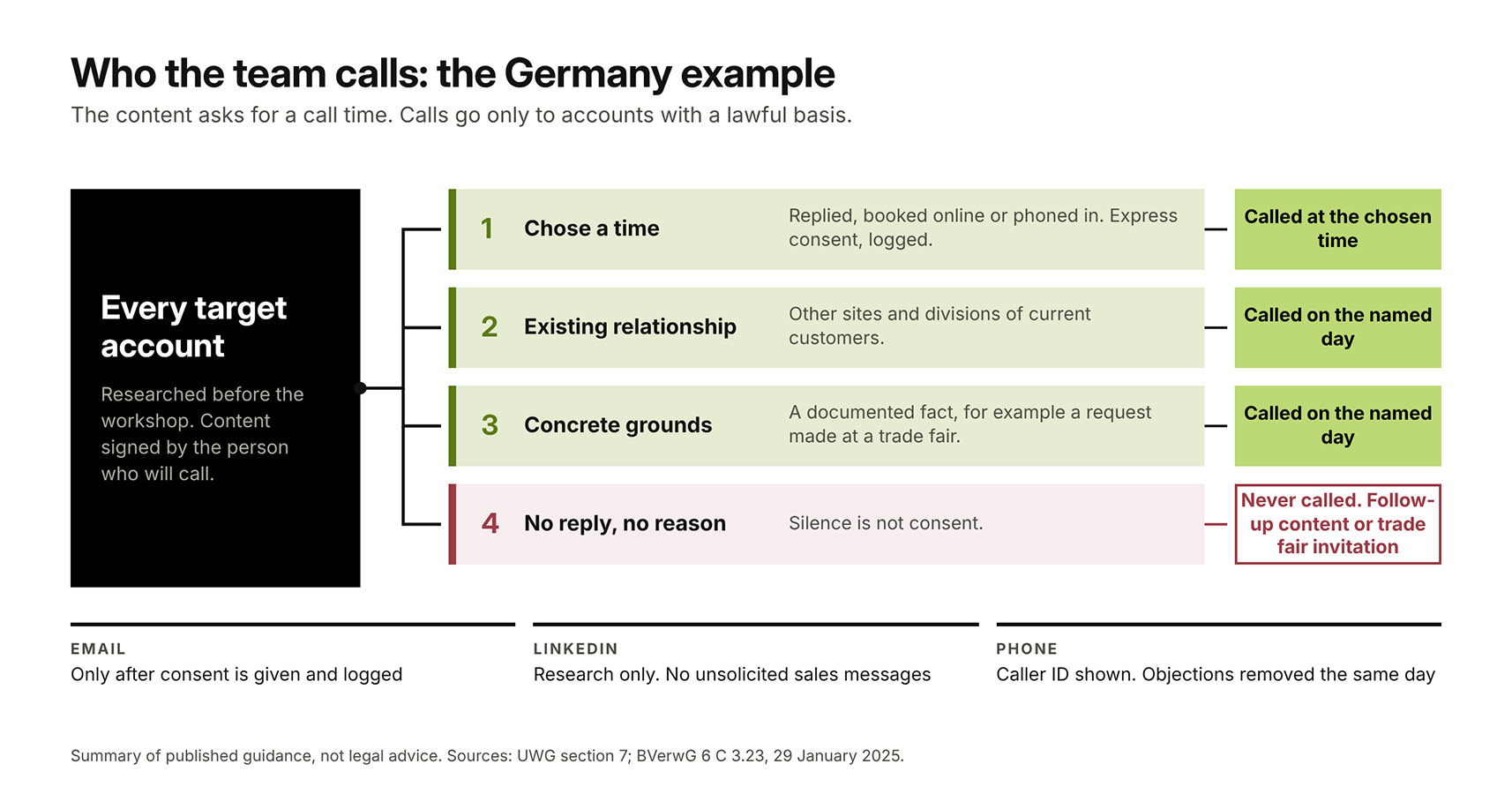
How a campaign is designed for Germany: the content asks for a call time, and the team calls only three groups. Summary of published guidance, not legal advice. Sources: UWG section 7; BVerwG 6 C 3.23, 29 January 2025.
German employment law affects the coaching as well. Where a company has a works council, systems able to record performance need its agreement. In a German campaign, the scoreboard shows team totals by default and no calls are recorded.
What happens after each calling block?
After each block, the coach debriefs the team on every call with the same three questions. What did the buyer say? Which of the eight buying group roles does that person hold? What is the next step? A friendly Coach who takes the call is not the Economic Owner who owns the problem, and the debrief makes that distinction on every call.
Rejections go on the board alongside successes, because each one says something about timing, contact or fit. New objections, and the answers that worked, go into a shared list for the next block.
What does the coach do during the calls?
The coach moves between participants, helps with call sheets between calls and watches for protective behaviour, such as apologising or ending the call early. Each person gets one specific change at the debrief, not a list.
When a participant freezes, the coach makes the next call from that participant’s account sheet, then hands the following call back. The coach also makes calls on your accounts, including calls that end in a no. Your team hears how an experienced caller handles both outcomes.
How does the habit last after Day 2?
Two days can start a habit. They cannot finish one. Before leaving, each participant writes if-then plans for the moments when calling is hardest. One example is “If the receptionist asks what it is about, I say what is happening in their business.”
Plans in this form showed a medium to large effect on reaching goals across 94 tests (Gollwitzer and Sheeran, 2006). That research did not study salespeople, so we use it as general evidence about plans, not as proof about prospecting.
Each participant also keeps a private reason for winning new customers, about named people who benefit. Dials, conversations and meetings go on a team board. Two protected calling blocks a week are booked in the calendar with the manager on Day 2. A missed block is rebooked in the same week.
How are the results measured?
The baseline is recorded on Day 1: meetings, opportunities and pipeline on the campaign accounts. For a new market, that baseline is usually zero.
At Day 30, 60 and 90, each participant’s own manager assesses ten requirements on live accounts. Klozers designs the requirements and issues the certification, but never marks a requirement as met. Participants who meet all ten become Certified Sales Hunters, valid for 12 months and verifiable online.
The report for your leadership at Day 90 shows accounts contacted, conversations with named buyers, meetings held and qualification steps reached. In sectors where a new supplier takes years to approve, revenue is reviewed at 12 and 24 months, not at Day 90.
A 30 minute consultation to agree the target market, the accounts and a date for the two days.