
90 Day Sales Plan: Free Editable Template and Practical Guide
A 90 day sales plan turns your sales priorities into a focused quarter of execution. The Klozers approach uses four quadrants that apply to every sales role: Finding, Klozing, Growing and Developing.
By Iain Swanston, Founder, Klozers
- Updated 15 September 2026
A 90 day sales plan is a short execution plan that turns sales priorities into specific outcomes and actions for the next quarter. At Klozers, we organise the plan into four areas: Finding new contacts, leads, deals and opportunities; Klozing uncovered deals; Growing existing clients; and Developing the knowledge, skills and behaviours required to improve sales performance.
- A 90 day sales plan is not a to-do list. It focuses the work that matters most during the quarter.
- Every salesperson has four jobs: Finding, Klozing, Growing and Developing.
- The weighting changes according to role, market and sales model, but the four quadrants still apply.
- Each priority should become a specific action that can be inspected and reviewed.
- Review at days 30, 60 and 90 so there is time to remove blockers and change the plan.
What are the four parts of a Klozers 90 day sales plan?
The Klozers framework divides sales work into four quadrants. The strength of the system is that the same four areas apply regardless of what you sell. What changes is the weighting and the actions inside each quadrant.
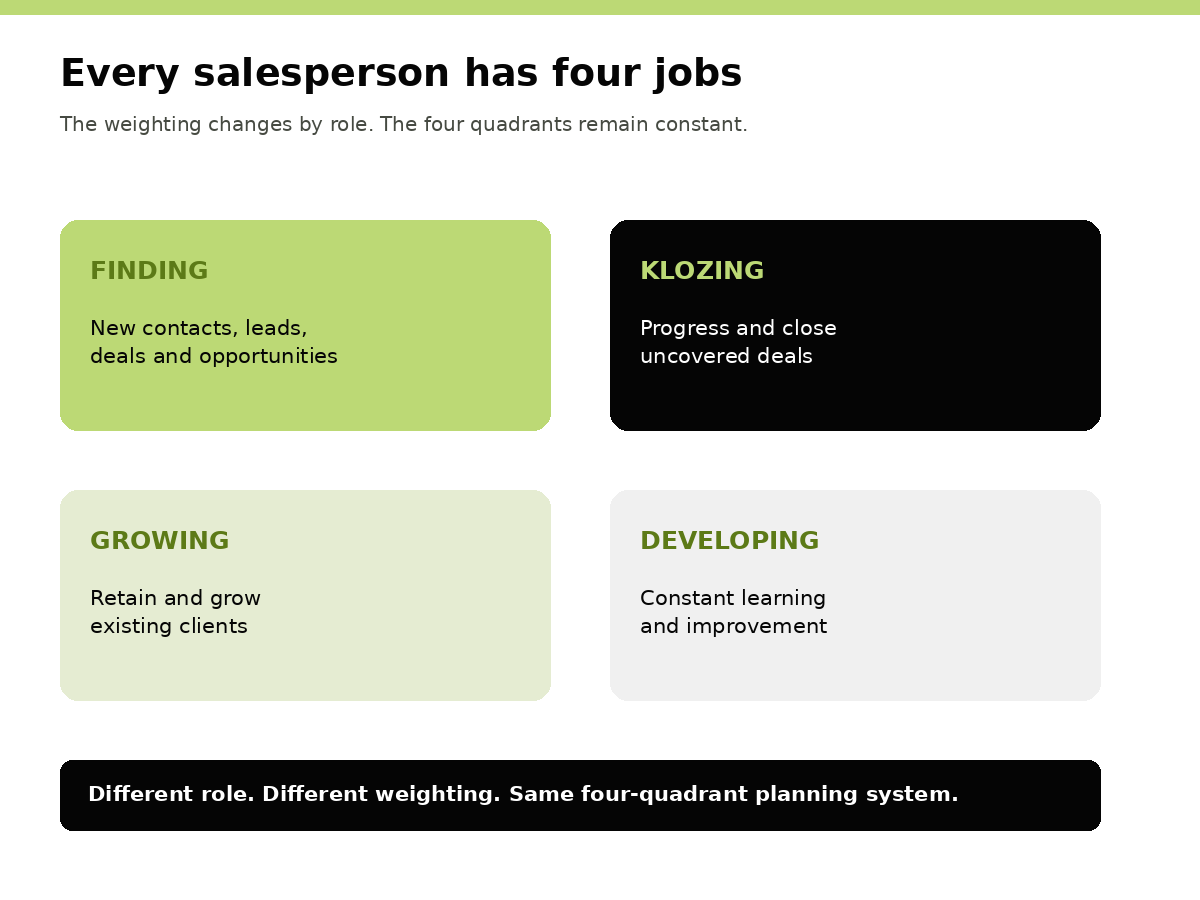
Finding new contacts, leads, deals and opportunities.
Klozing is a Klozers play on the word closing. Once you have uncovered a deal, it covers the process you go through to progress and close that opportunity.
The process of retaining and growing your existing client base.
The constant learning and improvement required to become and remain a top performer in sales.
An SDR may put more weight into Finding. An account manager may put more weight into Growing. An AE with a live opportunity portfolio may have significant work in Klozing. The actions differ, but the framework still forces each salesperson to consider the complete sales job.
How is a 90 day sales plan different from an annual sales plan?
An annual sales plan sets the wider revenue sources, priorities, routes, capacity and measures. A 90 day plan converts the most important parts of that plan into work that can be executed and reviewed during the next quarter.
It should not repeat every routine task in the salesperson’s job. The existing Klozers methodology explicitly treats the 90 day plan as something other than a to-do list. The purpose is to identify the high-value actions that deserve attention and accountability.
If the organisation has not yet agreed which markets, customers, routes or value propositions it intends to prioritise, a 90 day plan can create activity without direction. That is a strategy problem rather than a planning problem. The Sales Strategy Workshop is designed to make those decisions before transferring a dated 90-day execution plan to the team.
How do you build a 90 day sales plan?
Start with the commercial outcome the plan is intended to support. Then work through all four quadrants and decide what needs to happen during the next 90 days.
For each quadrant, define the outcome you want, the actions you will take, who owns them, when they are due and what evidence will show progress. Keep the list focused. Adding more actions can dilute attention rather than improve execution.
Do not fill every quadrant with activity simply to make the plan look complete. A salesperson may have only one material Developing priority this quarter and several Klozing priorities. The framework creates coverage, not equal weighting.
What should you include under Finding?
Finding covers the work required to create new contacts, leads, deals and opportunities. Examples might include selecting target accounts, reaching new contacts, developing referral sources, following up inbound enquiries, activating partners or creating new qualified opportunities. The plan should reflect the actual strategy rather than prescribe a universal prospecting activity target.
What should you include under Klozing?
Klozing is the Klozers play on closing. It begins once a deal or opportunity has been uncovered and covers the process required to progress and close it.
Actions may include improving qualification, gaining access to the right stakeholders, strengthening discovery, building the value case, agreeing next steps, managing competition, progressing a proposal or preparing for a negotiation.
The plan should not encourage salespeople to keep dead deals simply to preserve pipeline cover. If an opportunity no longer has a credible route to a decision, disqualifying it can be better sales management than adding another follow-up action. Use the sales pipeline to inspect whether live opportunities remain qualified and are actually progressing.
What should you include under Growing?
Growing covers both retaining existing clients and expanding those relationships. Depending on the role, actions could include account reviews, stakeholder mapping, renewal preparation, identifying new departments or use cases, improving adoption, creating referrals or developing an account plan.
Growth should not be confused with pushing more products into every account. Start with the customer’s objectives and the value you can legitimately add.
What should you include under Developing?
Developing is the process of constant learning and improvement required to become and remain a top performer in sales.
The priority should be specific to the salesperson. One person may need to improve discovery. Another may need stronger commercial negotiation, account planning, product knowledge, prospecting or access to senior decision-makers.
Turn development into application. Identify what will be learned, how it will be practised, where it will be applied on live work and what evidence will show improvement.
How should you review a 90 day sales plan?
Review the plan during the quarter, not only at the end. The replacement Klozers template uses 30, 60 and 90-day inspection points.
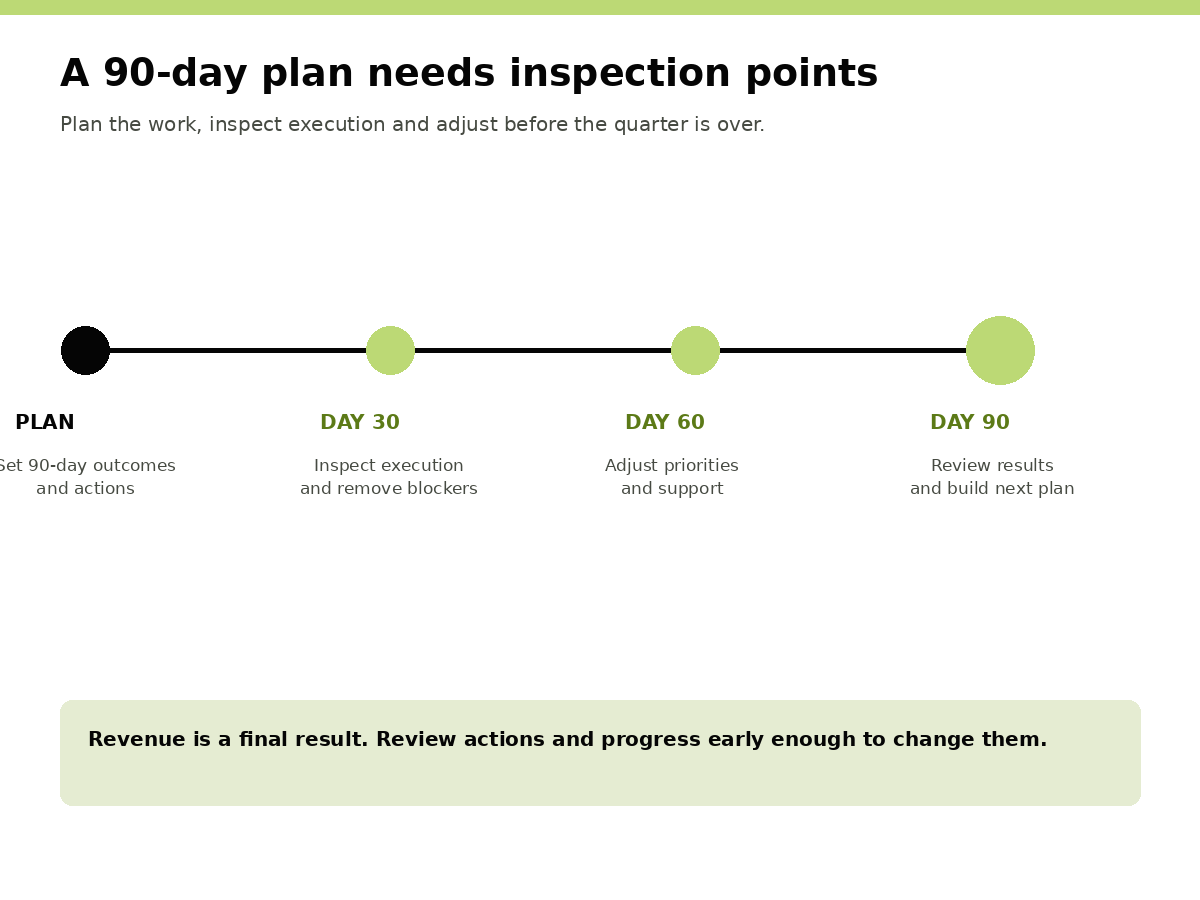
At day 30, inspect what has been completed, what is blocked and what needs to change. At day 60, look at progress, assumptions and where support is required. At day 90, review the outcome, capture what was learned and decide what should carry into the next plan.
Managers can use the same plan for coaching. Ask what is working, what is not progressing, what support is required and what the salesperson will commit to before the next review.
Download the editable Klozers 90 Day Sales Plan Template
The replacement template uses the current Klozers four-quadrant framework: Finding, Klozing, Growing and Developing. It includes planning pages for each quadrant, an execution register and 30, 60 and 90-day reviews.
PowerPoint format so you can edit and use the plan with your own sales team.
90 day sales plan FAQs
Is a 90 day sales plan the same for every salesperson?
No. The four quadrants apply across sales roles, but the weighting and actions change. An SDR, AE and account manager should not have identical plans.
Why does Klozers spell closing as Klozing?
Klozing is a Klozers play on the word closing. In the four-quadrant system it describes the process used after a deal has been uncovered to progress and close that opportunity.
Should a 90 day sales plan include personal development?
Yes, where the development is relevant to sales performance. The Developing quadrant covers the continuous learning and improvement needed to become and remain a top sales performer.
We can help you identify the priorities, owners, measures and first 90 days required to put the strategy into practice.