
How to Sell Value Not Price
Product before value. Research the hypothesis, let the buyer validate the case, and make the cost of inaction visible.
By Iain Swanston, Founder, Klozers
- Updated 15 October 2026
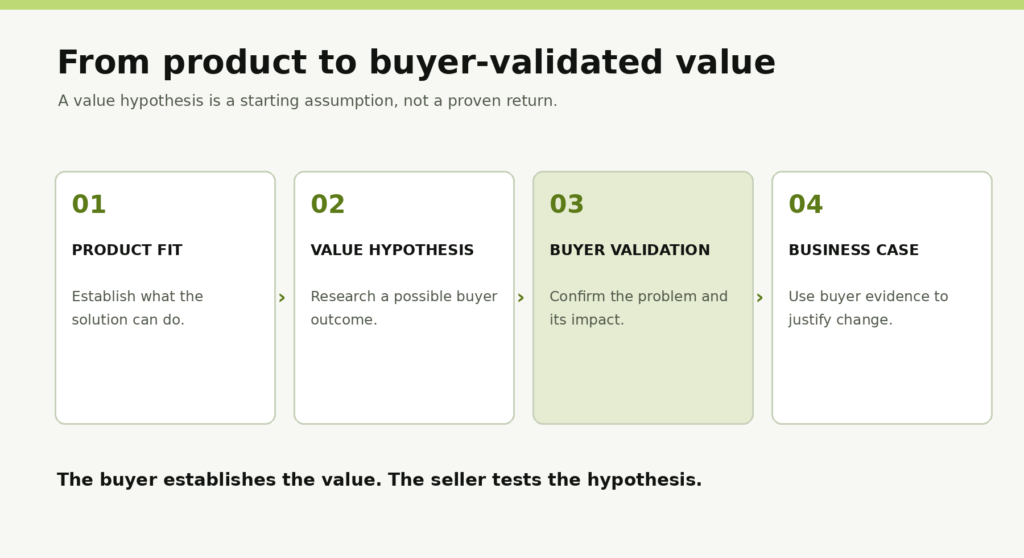
To sell value rather than price, establish what your product can do, research a value hypothesis for the prospect, and test it in discovery. Build the value case with the buyer’s figures. Only then compare the cost of change with the cost of remaining as they are. A seller’s estimate is not buyer-validated value.
What does selling value rather than price mean?
Selling value means helping a buyer judge a proposed investment against the commercial result it could deliver. Price is the amount charged. Value is the improvement the buyer believes is achievable, relevant and worth paying for. A buyer who cannot explain that improvement has little basis for distinguishing two competing prices.
Product before value. You must understand your product, its limitations and where it can genuinely help before forming a credible value hypothesis. This does not mean opening every sales conversation with a product presentation. Product knowledge informs the hypothesis; buyer discovery determines whether that hypothesis is valid.
The distinction matters in complex B2B purchases. You are not only competing with another supplier. You are also competing with the existing process, the perceived risk of change and other projects seeking the same budget.
Start with a researched value hypothesis
A value hypothesis is a testable suggestion about how a product could improve a particular prospect’s business. It combines a known product capability with a researched account priority and a possible commercial consequence. It should never be presented as an established fact about the prospect.
Research the organisation’s priorities, operating model, recent changes and likely measures of success. Then prepare a statement such as: “We believe changes to production schedules may be creating avoidable overtime. Is that an issue you recognise, or are your constraints elsewhere?” A rejection is useful evidence: revise the hypothesis rather than defending it.
An academic discussion of executive-level selling distinguishes a value hypothesis from value validated by the customer. Without customer confirmation and real inputs, the proposed benefit remains an assumption.
Use Gap to Value to establish the buyer's case
Klozers uses Gap to Value to examine the difference between the buyer’s current position and required outcome. The conversation moves through seven stages: define the gap, identify symptoms, investigate root cause, establish business impact, quantify financial cost, understand emotional cost, and establish the value of closing the gap.
The final stage is decisive. The buyer states what closing the gap is worth. If the salesperson supplies the number and the buyer never confirms it, the proposal contains an untested claim. Business impact, financial cost and personal consequence must be considered separately, not compressed into a single question about return on investment.
For an Economic Owner, the issue may be achieving an operational target. For the Economic Buyer, it may be releasing investment against competing priorities. These are different roles and may require different evidence.
Working example: manufacturing scheduling software
Consider a hypothetical software supplier approaching a manufacturer. The salesperson knows the product can support production scheduling and hypothesises that schedule changes might be increasing overtime. They do not assume the manufacturer has this problem or that the software will solve it.
During discovery, the Operations Director confirms approximately 100 additional overtime hours each month at an incremental cost of £45 per hour. Subject to checking that these are genuinely avoidable costs, that is £54,000 a year. The buyer also estimates £36,000 in avoidable production disruption, provided this does not duplicate the overtime figure. The total estimated annual problem cost is £90,000.
The salesperson asks what proportion could realistically be removed. The buyer suggests 50%, giving a potential annual benefit of £45,000. The software costs £20,000 annually, plus £10,000 to implement in year one. On these illustrative assumptions, the potential first-year net benefit is £15,000.
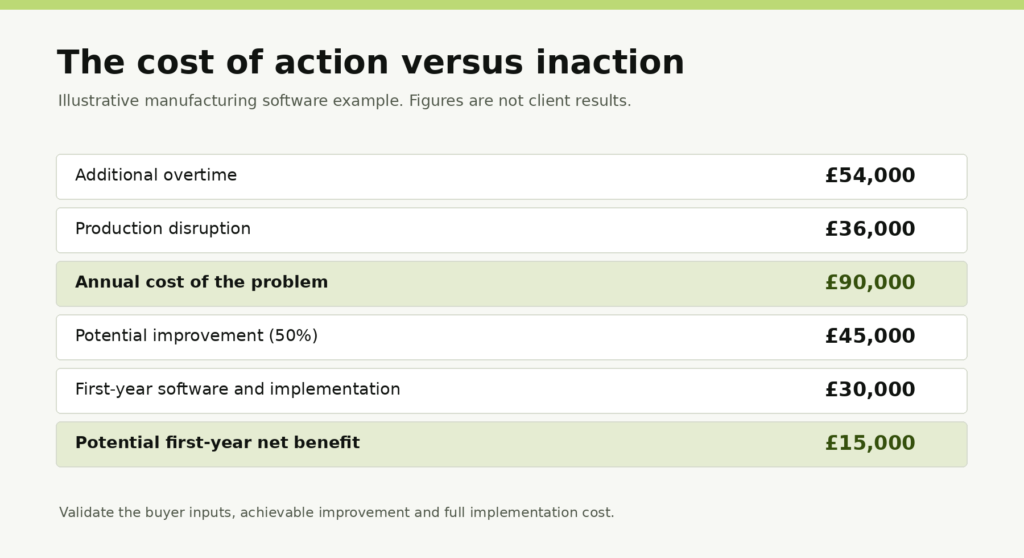
That is a useful value case, but not proof of a return. The team still needs to validate the baseline, determine whether savings become cash savings, assess adoption risk and agree how results will be measured. The case should be revised or rejected if the evidence does not support it.
Why the status quo can defeat a strong proposal
Remaining with the existing process avoids an immediate purchase, implementation work and the risk of a failed change. Those benefits of inaction are real. The buyer must decide whether the cost of continuing the problem exceeds the risk and cost of solving it.
A Gartner researcher reported that 94% of surveyed enterprise technology buying teams had abandoned at least one buying effort without a purchase during the preceding two years. This does not mean 94% of deals end in no decision. The finding concerns the prevalence of abandoned buying efforts among the surveyed teams, not the proportion of opportunities lost.
Ask three questions in order: Why change? What does the current situation cost? Why now? What happens if the decision is delayed? Why this solution? What credible evidence shows the proposed product is suitable? Do not assume a competitor is the only alternative. Budget may go to another internal initiative.
How sales managers make value selling repeatable
A workshop alone cannot establish a lasting behaviour. Managers need to inspect whether sellers prepare account-specific hypotheses, record what buyers confirmed, separate verified inputs from assumptions and obtain agreement on the next buying decision. This makes value selling a change-management responsibility as well as a selling skill.
In a live deal review, ask: What product capability supports the hypothesis? Which buyer confirmed the problem? What numbers did they supply? What is still unverified? Who owns the business outcome? Who can release the budget? What would make the customer decide not to proceed?
Klozers’ value-based selling training can be used to practise these conversations on live opportunities. For the related discipline of explaining a differentiated offer, see how to create a unique value proposition.
Common mistakes when selling value
Claiming a return before discovery: an industry average or sales calculator output is not a customer commitment. Confusing enthusiasm with qualification: a technical evaluator can like the product without owning the business outcome or investment decision. Ignoring implementation: a benefit case must include the cost, time and operational risk of change. Arguing about discounts too early: if the buyer has not agreed the value, reducing the price rarely resolves the underlying uncertainty.
Instead, record the value hypothesis, the buyer’s corrections, the supporting evidence and the next decision gate. This gives sales leaders a practical way to assess whether a value case exists before approving a proposal.
Test one value hypothesis this week
Choose one commercial problem and check whether a change in selling behaviour would address it.
- Choose one active prospect and identify a relevant product capability.
- Write a falsifiable hypothesis about a possible business outcome.
- Ask the buyer to confirm, reject or correct it.
- Record their cost drivers and evidence without inventing missing figures.
- Agree whether the case justifies changing the current approach.
We design practical sales training around your team, its real opportunities and the behaviours managers need to reinforce.

Iain has trained and coached B2B sales teams since 2008. He was Lead Trainer and Coach at Microsoft Scotland. Before that he sold capital equipment and managed sales teams in the UK and North America. He served as an Associate at Strathclyde University Business School, where he delivered the sales content for the Masters in Entrepreneurship from 2015 to 2019.