
Channel Planning in Sales Management: Choosing the Right Route to Market
Channel planning is deciding how your product or service reaches the customer and which routes deserve your people, time and investment. The important question is not simply who takes the order. It is where customers buy, where the decision is influenced and what each route contributes.
By Iain Swanston, Founder, Klozers
- Updated 15 September 2026
Channel planning is the process of deciding which routes you will use to reach and sell to customers. Those routes can include direct sales, distributors, resellers, agents, partners, inbound and outbound activity, or a combination. Good channel planning starts with how customers actually buy and where the buying decision can be influenced, then decides where the business should invest.
- Do not choose a channel simply because competitors use it or because it appears cheaper.
- The route that books the revenue is not necessarily the route that created demand or influenced the decision.
- Direct and indirect channels can work together. Decide what job each route performs.
- When you sell through partners, you need a commercial case for the end customer and a separate reason for the partner to sell and prioritise you.
- Measure demand origin, influence, opportunity progression, revenue and the resources required to support each route.
How should you choose a sales channel?
Start with evidence from your own customers and revenue. Which markets, customer types and routes already produce sales? Where do enquiries originate? Who influences the buying decision? Which routes can your people influence and support?
Do not start by deciding that you need distributors, more direct salespeople or a new outbound channel and then search for evidence to justify the choice. A channel only makes sense when it fits how customers buy and the commercial role you need it to perform.
- Where do customers actually buy?
Map the routes that produce revenue today, including routes that may not be obvious from the CRM.
- Where is the decision influenced?
Identify the people and organisations that create preference, specify the solution or control access to the purchase.
- What does the customer need from the route?
This may include expertise, local support, availability, integration, procurement convenience or an existing supplier relationship.
- What should you keep direct?
Decide which customer interactions, knowledge or relationships are too important to delegate.
- What capacity do you have?
Partners still require recruitment, enablement, support and management. A new route creates work as well as reach.
- How will you judge it?
Agree what you will measure before shifting people, margin or budget into the route.
Channel is one decision inside the wider go-to-market strategy. If you need to decide which markets, customers and routes deserve investment together, see our Sales Strategy Workshop.
Where is the buying decision actually influenced?
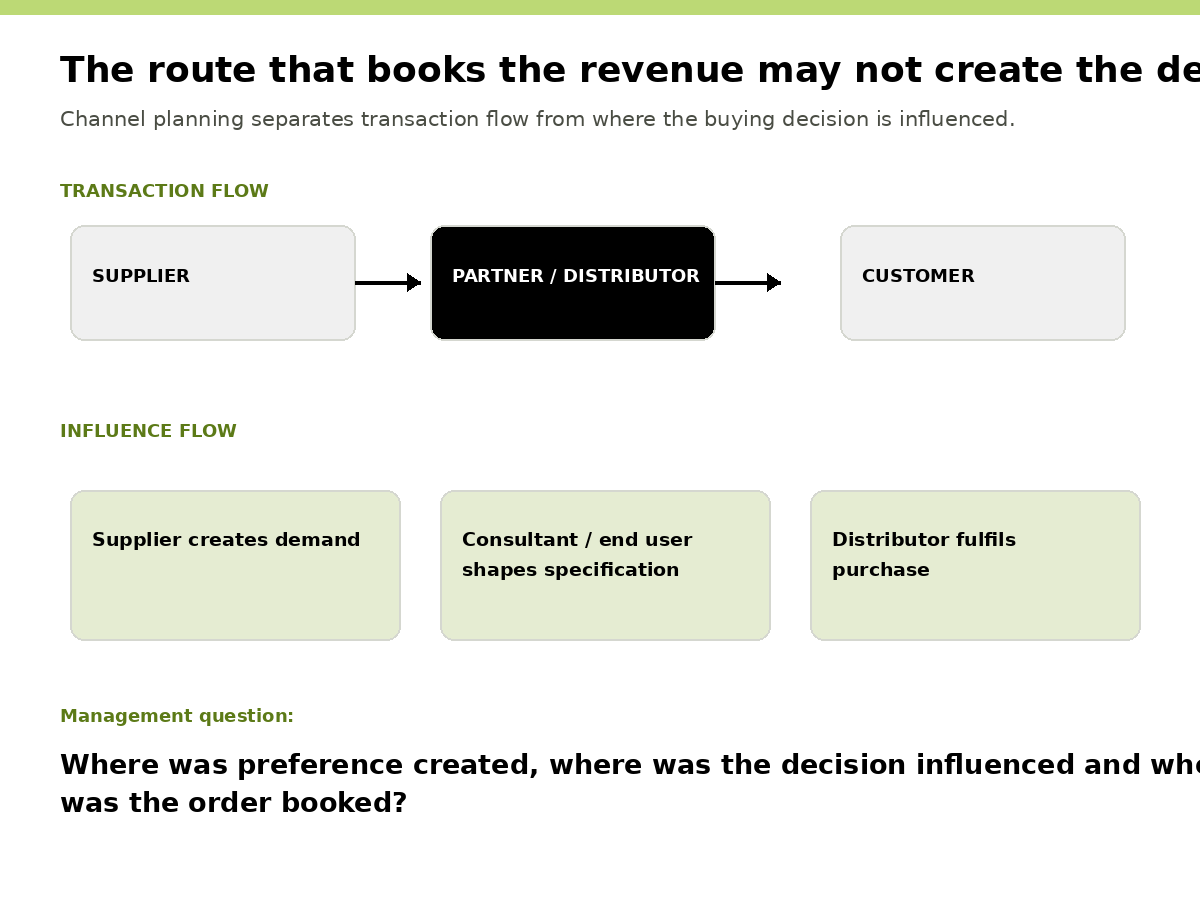
The organisation taking the order may not be the organisation that created the demand or influenced the choice.
A manufacturer might invoice through a distributor while an end user requests the brand, a consultant writes the specification, procurement controls the approved supplier list and the manufacturer creates the original demand. Looking only at booked revenue can make the distributor appear responsible for a sale that was created elsewhere.
Should you use direct or indirect sales channels?
This does not need to be an either-or decision. Many B2B companies use different routes for different jobs.
Can suit strategic accounts, complex opportunities and situations where the supplier needs close control of discovery, solution design or the customer relationship.
Can provide local relationships, logistics, technical support, procurement access or market coverage the supplier does not have internally.
Can create demand that is then fulfilled directly or through a partner. The source of the enquiry and the route that invoices the order may be different.
Can identify and develop opportunities that are later transacted through a distributor or reseller.
The useful question is not “Which single channel is best?” It is “What job does each route perform, and is that job commercially worth the resources required?”
Why does a partner channel need two commercial cases?
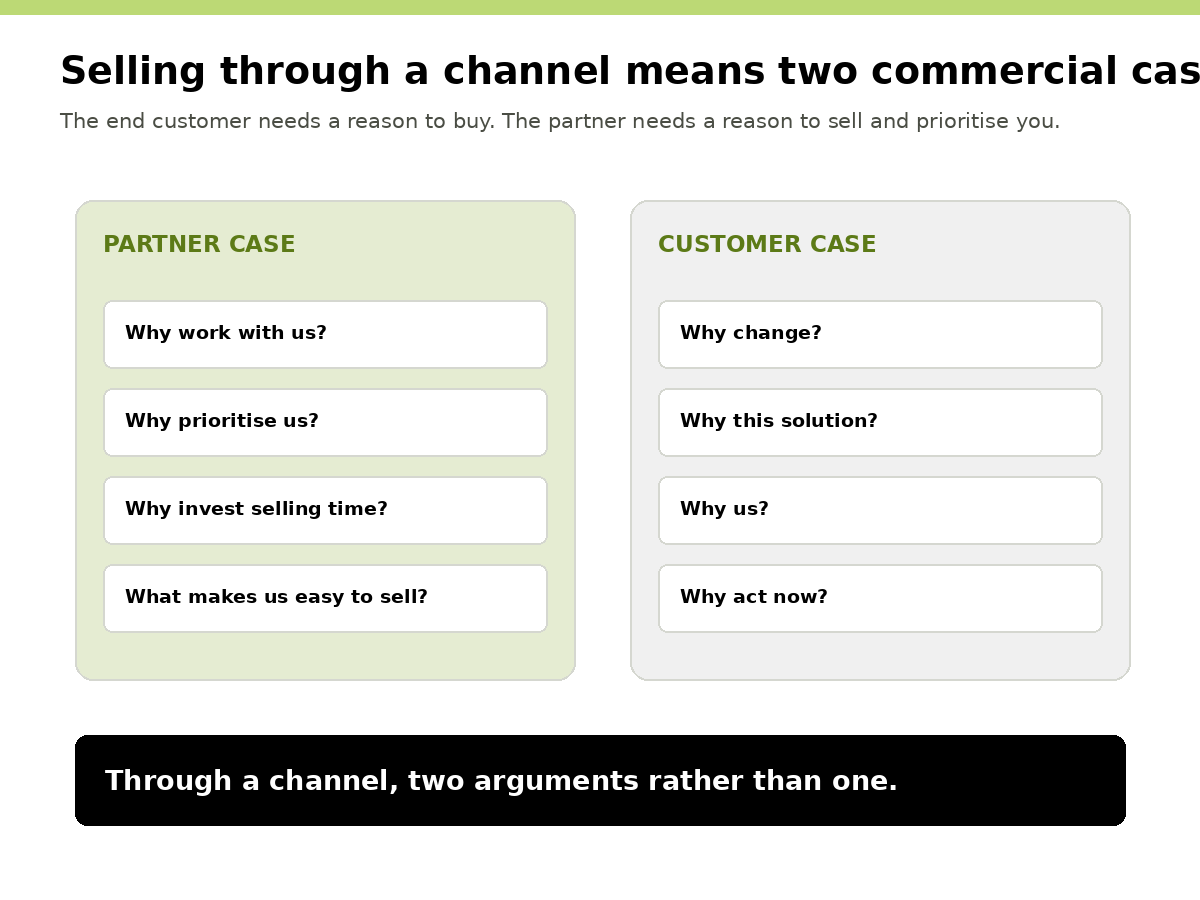
Appointing a distributor or reseller does not remove the need to sell. You first need a reason for the partner to work with you. Then the partner needs a reason the end customer should buy.
If the partner represents several suppliers, margin alone may not make your offer a priority. They may also consider demand, ease of selling, support, differentiation, availability and the commercial opportunity compared with other products they could spend time on.
This is not theoretical for Klozers. In one approved Sales Strategy Workshop example, an international technology business selling through partners had a European territory producing one third of the revenue of an equivalent UK territory for seven years. The work produced a ranked country list, a partner-facing case separate from the end-user case, and an enquiry plan for partners.
How do you avoid channel conflict?
Conflict often appears when direct and indirect routes overlap but nobody has agreed the rules.
A supplier may generate the enquiry directly, the customer may ask its normal distributor for a price, and the distributor may then book the order. If the business credits only the invoiced revenue, it can draw the wrong conclusion about which activity created the sale.
Define which accounts and opportunities belong to each route, how company-generated and partner-generated enquiries are handled, who owns the customer relationship, and what happens when more than one route contributes to the same sale. Pricing and commercial rules also need to be clear enough that direct teams and partners are not competing under different assumptions.
The objective is not to remove every overlap. It is to make the rules explicit enough that the business can use the right route without encouraging internal competition for credit.
How should you measure channel performance?
Revenue matters, but revenue alone can hide how the sale was created. Measure the route that booked the order alongside the source of demand and the resources used to create and support it.
Useful measures will vary by business, but may include enquiry source, qualified opportunities, progression, revenue, margin, time to revenue, partner activity and the internal time required to support the route. We do not recommend a universal threshold because channel economics vary by market, product and commercial model.
Where a route appears weak, investigate before replacing it. The issue may be the market, proposition, partner case, enablement, capacity, enquiry handling or the route itself. Different causes require different decisions.
Channel planning FAQs
What is a sales channel?
A sales channel is a route through which a business reaches and sells to customers. It can be direct, such as an internal sales team, or indirect, such as a distributor, reseller, agent or partner.
What is the difference between direct and indirect sales channels?
Direct channels involve the supplier selling to the customer itself. Indirect channels involve another organisation in the route to market. Many B2B companies use both.
How do you choose the right sales channel?
Start with how customers buy, where decisions are influenced, the commercial role the route needs to perform, the resources required to support it and evidence from current revenue and enquiries.
Do distributors generate demand?
Some do, but it should not be assumed. A distributor may create demand, influence the choice, fulfil demand created elsewhere, or perform several of those roles. Measure the contribution rather than inferring it from invoiced revenue alone.
What causes channel conflict?
Common causes include overlapping account ownership, unclear enquiry rules, inconsistent pricing, competition between direct and partner teams, and disagreement over who created or owns an opportunity.
We will start with what already works, define the gaps and build the workshop around your live opportunities.