
Sales Management Training
Private sales management training for organisations that need frontline managers to turn sales strategy into consistent execution through clear standards, pipeline inspection, coaching and accountability.
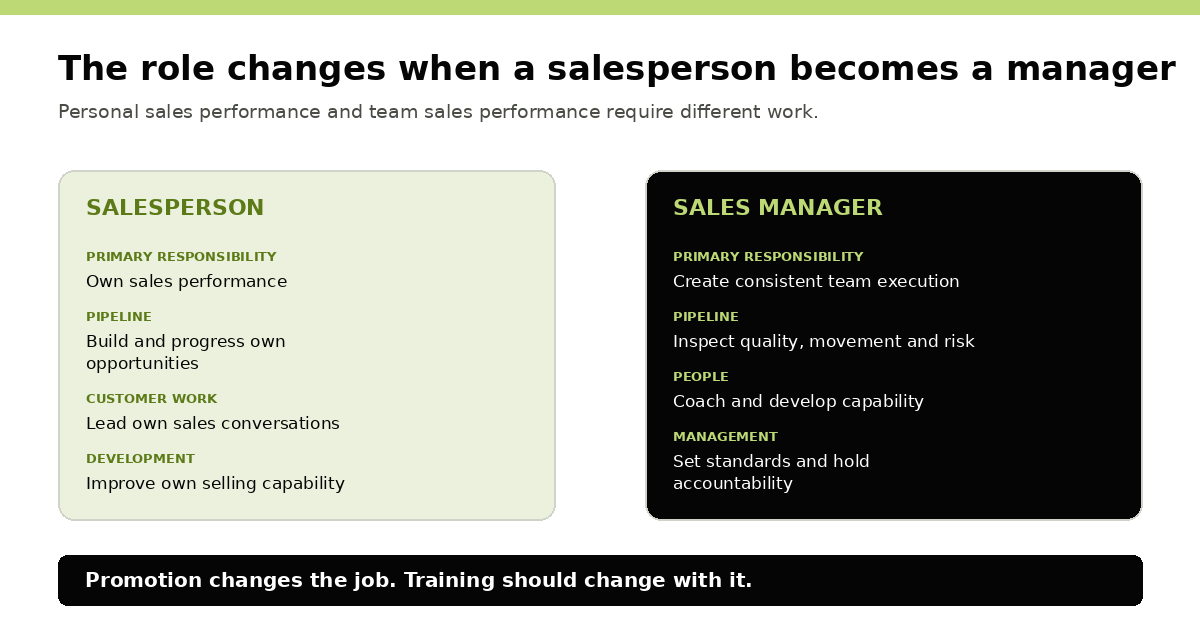
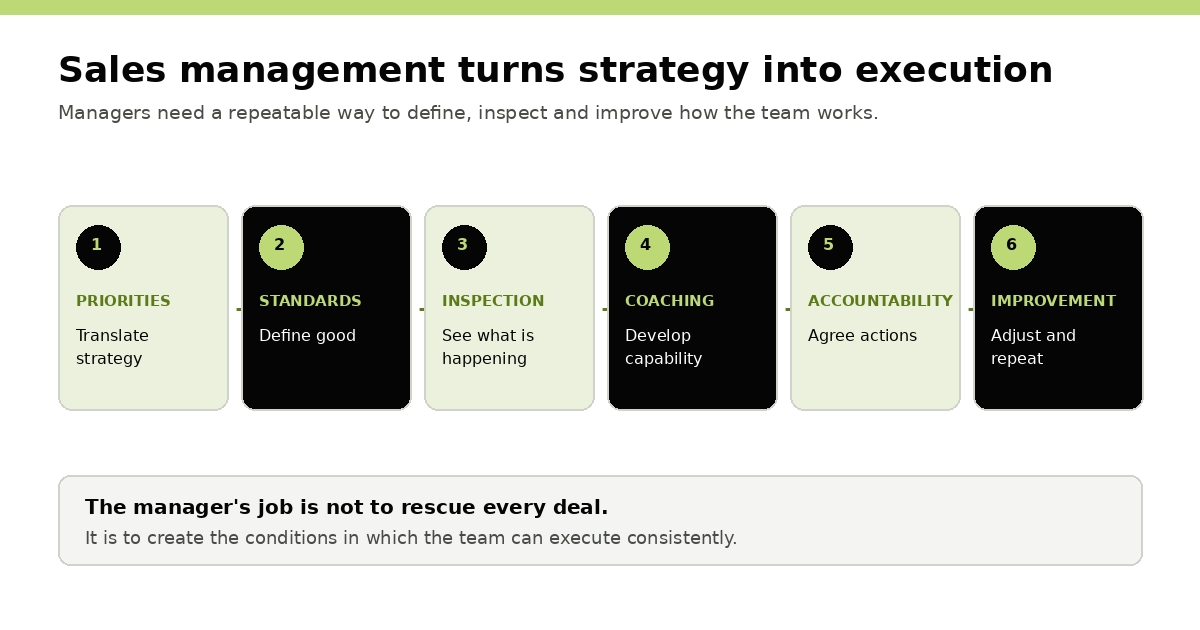
Sales management training develops the practical skills managers need to turn sales strategy into consistent team execution. It helps managers set priorities and standards, inspect pipeline and performance, coach salespeople, create accountability and improve the sales system rather than simply helping individual reps close deals.
Key takeaways
- Managing salespeople is a different job from being a successful salesperson.
- Managers need explicit standards before they can inspect performance or create fair accountability.
- Pipeline reviews should identify risk and action rather than repeat CRM information.
- Coaching should address the specific capability, behaviour or system constraint limiting execution.
- Klozers starts with the organisation’s existing good practice before adding external methods.
What problem should sales management training solve?
Many sales managers reach the role because they were successful salespeople. Their new responsibility is different: instead of owning only their own opportunities and number, they must create the conditions in which a team can execute consistently.
That requires practical management routines for priorities, standards, pipeline, coaching and accountability. Klozers starts with the sales environment the manager actually leads, captures internal best practice and adds tools only where there is a defined gap.
Who is this training for?
This is private development for organisations that need stronger frontline sales management capability.

New sales managers
People moving from individual sales performance into responsibility for a team.

Experienced sales managers
Managers who need a more consistent approach to pipeline, coaching, performance and accountability.

Sales Directors and CROs
Leaders who need frontline managers to execute sales strategy consistently across teams.

HR and L&D leaders
Teams building practical manager capability around the organisation’s real sales environment.
What the sales management programme covers
The final programme is scoped against the management capability that needs to improve. The modules below describe the behaviours managers should be able to apply afterwards.
Module 1: Turn strategy into clear team priorities
Managers learn to translate commercial objectives into a small number of priorities the team can execute, with clear ownership and measures rather than disconnected activity.
Module 2: Set and inspect sales execution standards
Managers define what good looks like across the areas they manage, then use evidence from pipeline, activity and live opportunities to inspect whether those standards are being applied.
Module 3: Coach the constraint, not the symptom
Managers practise distinguishing between skill gaps, behaviour issues, process problems, capacity constraints and strategic problems before choosing the appropriate coaching response.
Module 4: Create accountability and continuous improvement
Managers agree actions, owners, dates and measures, inspect completion and use recurring patterns to decide what the team or sales system needs to improve next.
Build managers around the way your team actually sells
We start with your strategy, current management practices and internal best performers. The programme then focuses on the management behaviours that need to change in your sales environment.
How it is delivered
Managers work on their own team, pipeline, performance conversations and management routines rather than generic case studies. Teaching is kept short so the majority of the time can be used for application, practice and feedback.
Teach the concept
Introduce the management principle or standard and why it matters.
Apply it live
Use a current team, pipeline or performance situation from the manager’s own work.
Capture the action
Record what changes, who owns it, how it will be measured and when it will be reviewed.
The loop repeats across the agreed management priorities so participants leave with changes they can apply immediately.
Delivery options
| Format | Detail |
|---|---|
| Private, in-person workshops | Delivered for one client organisation, using its team, pipeline, standards and management situations. |
| Live online for distributed teams | Shorter interactive sessions for managers working across locations, with application between sessions. |
Qualifying the format matters. A simulation is useful when the team has something meaningful to apply. Where the first requirement is capability development, bespoke sales training is usually the better starting point.
How sales management certification works
Where certification is included, it provides evidence that agreed management behaviours have been applied in live work rather than recording attendance alone.
Candidate
Awarded after the programme · expires Day 90
Confirms completion of the agreed development programme and the initial application plan.
Certified
Awarded Day 90 · valid 12 months
Confirms that agreed requirements have been evidenced in live work and assessed through the defined process.
What gets certified is your standard, not ours
Certification requirements are written against the execution topics selected during scoping. Each requirement must be observable, tied to a checkpoint and capable of being evidenced in live work.
Why it holds up
- Your manager assesses and Klozers issues.
- Certification expires and renewal is based on evidence.
- The scope and validity are visible on the certificate.

Proof
Gallup workplace research
Managers have a major influence on the conditions in which teams work.
70%
Gallup reports that managers account for 70% of the variance in team-level engagement.
CCL study of nearly 300 emerging leaders
The transition into management is a distinct development challenge.
26%
CCL reports that 26% of first-time managers in its research felt they were not ready to lead others.
Gallup 2026
Training managers can change management performance measures.
20–28%
Gallup reports improvements of 20% to 28% in management performance metrics among managers receiving best-practice training.
Gallup research is workplace research rather than sales-specific research. CCL’s study concerns first-time managers across functions and did not study sales management specifically.
Is this right for your team?
| Designed for | Not designed for |
|---|---|
| Organisations developing new or existing sales managers. | Individuals looking for a public course date or open enrolment. |
| Teams that need more consistent pipeline, coaching or performance management. | Teams seeking motivational content without changes to management practice. |
| Sales leaders who want management routines aligned with sales strategy. | Businesses that only need help closing one live opportunity. |
| Businesses that want to retain effective internal practice rather than replace it with an off-the-shelf methodology. |
If the problem is wider than manager capability, we will say so. A strategy, process or sales-system problem should not be disguised as a training requirement.
Investment
This existing course page currently carries a published per-person rate. The refreshed page retains that applicable pricing rather than inferring a new commercial model.
| GBP | £1,260 |
|---|---|
| EUR | €1,530 |
| USD | $1,790 |
| AUD | $2,650 |
| CAD | $2,370 |
Private organisational delivery. Final scope depends on team size, customisation and delivery requirements.
Every programme includes
- Number of managers and sessions required.
- Depth of discovery and programme design.
- Delivery locations and languages.
- Certification and post-training reinforcement.
All prices exclude applicable taxes.
What is included
- Discovery to understand the management requirement and current internal practice.
- Programme design around the agreed management priorities.
- Practical work on live team, pipeline and performance situations.
- Action planning and agreed measures for application after the training.
After the programme
Where reinforcement is included in the agreed scope, managers continue applying the standards and actions in their normal management rhythm, with follow-up support and certification where appropriate.
Frequently asked questions
What is sales management training?
Sales management training develops the practical skills required to lead sales execution through other people. It typically covers priorities, standards, pipeline and performance inspection, coaching, accountability and team development.
Is sales management training only for new managers?
No. New managers need help making the transition from individual contributor, while experienced managers may need a more consistent operating approach across pipeline, coaching, performance and accountability.
Can you train one sales manager?
Klozers does not position this page as a public course for individual enrolment. The programme is scoped for organisations. A consultation establishes whether training, coaching or another form of support is the appropriate route.
Will you replace our existing sales methodology?
No. Klozers starts by identifying the practices and management routines that already work in your organisation. External tools and methods are added only where they fill a genuine gap.
Can sales management training include certification?
Yes, where certification is appropriate to the programme. Certification is based on evidence that agreed behaviours have been applied after the training rather than attendance alone.
Why does the move from salesperson to sales manager require different skills?
A salesperson is primarily accountable for personal selling activity, customer conversations, opportunities and results. A manager becomes accountable for creating conditions in which several people can execute consistently. The change sounds obvious, but it alters where the manager should spend time and how success is produced.
A strong salesperson can often compensate personally for gaps in preparation, process or judgement. A manager cannot sustainably compensate for the same gaps across an entire team by joining every call or rescuing every deal. The role requires the manager to make effective practice visible, teachable and inspectable so that performance is less dependent on one person’s intervention.
This is why promotion based only on individual sales results can create difficulty. The behaviours that helped someone win personally are useful experience, but management also requires coaching, delegation, performance conversations, prioritisation and judgement about where to intervene. The Center for Creative Leadership studied nearly 300 emerging leaders and found that 26% of first-time managers felt they were not ready to lead others and almost 60% reported receiving no training when they moved into their first leadership role. That research covers management generally rather than sales management specifically, but it supports the point that the move into management is a distinct development transition.
For a sales manager, the practical implication is that development should be built around the new job. Training should not simply give an experienced salesperson more advanced selling techniques. It should help them establish how their team will work, how they will inspect execution and how they will develop people without taking the work back from them.
How should sales managers turn strategy into execution?
Sales strategy makes choices about markets, customers, routes to market, value propositions and where resources should be concentrated. The frontline manager has to convert those choices into what the team does this week and this month. If that translation is weak, a strategy can exist on a slide while the team continues with the same priorities and habits.
The first management task is therefore clarity. Managers need to know which activities and opportunities deserve attention, what should stop, what standards apply and how progress will be measured. That does not mean increasing the number of KPIs. It means connecting the measures used by the team to the commercial decisions already made by leadership.
For example, if the strategy requires greater penetration of existing accounts, the manager should be able to see whether account plans identify whitespace, whether relationships extend beyond one contact and whether agreed account-growth actions are happening. If the strategy requires new-logo growth, the manager needs visibility of prospecting quality, new opportunity creation and the early qualification decisions that determine whether pipeline is credible.
The management rhythm then makes those priorities real. One-to-ones, pipeline reviews, opportunity reviews and coaching sessions should reinforce the same priorities rather than becoming separate administrative meetings. This is why Klozers starts with the client’s strategy and existing practice. A generic management model cannot tell a manager which commercial choices matter most in that organisation.
How should sales managers use standards without creating bureaucracy?
A standard describes the behaviour or evidence expected when work is done well. It gives managers and salespeople a shared reference point. Without a standard, a manager can see that a target was missed but may struggle to identify what should have happened differently. The conversation then becomes subjective: work harder, make more calls, be more confident or improve the forecast.
Useful sales standards are observable. They can cover areas such as opportunity qualification, pipeline hygiene, account planning, prospecting preparation, stakeholder coverage, next-step discipline and forecast evidence. The objective is not to prescribe every sentence a salesperson says. It is to make the important parts of execution explicit enough that a manager can inspect and coach them.
Standards also protect good internal practice. If top performers already handle a particular stage of the sales process effectively, their approach can be captured and made available to the rest of the team. This is preferable to discarding working practice simply because an external methodology uses different terminology.
The manager then has two separate questions. Was the agreed standard applied? And did the standard produce the intended result? If the answer to the first is no, the issue may be execution, capability or accountability. If the standard was applied consistently but results remain weak, the process or strategy may need to change. That distinction prevents training from being used as the automatic answer to every performance problem.
What should happen in a sales pipeline review?
A pipeline review should improve decisions. It should help the manager and salesperson establish which opportunities are credible, what has changed, where risk is building and what action is required. It should not become a meeting in which the salesperson reads information that is already visible in the CRM.
Good inspection tests evidence rather than optimism. A deal described as likely to close should have observable reasons for that confidence: a recognised business need, access to the right stakeholders, an understood decision process, a credible next step and evidence that the opportunity is moving. The exact criteria should match the organisation’s sales process rather than being imported automatically from an external methodology.
The review should also look beyond individual deals. A manager needs to understand the shape of the pipeline. Is enough new pipeline being created? Are opportunities accumulating at one stage? Are late-stage deals repeatedly moving dates? Are salespeople holding opportunities that no longer have credible next actions? These patterns can indicate where coaching, process changes or prospecting attention are required.
The output of the review is action. The salesperson and manager should leave knowing what needs to happen, who owns it and when it will be inspected again. That turns pipeline management from reporting into a management mechanism.
How should sales managers coach and create accountability?
Coaching begins with diagnosis. If a salesperson is not creating enough opportunities, the cause could be targeting, message relevance, activity level, confidence, skill, capacity or a weak market proposition. Giving the same coaching response to each cause is unlikely to help. The manager needs enough evidence to decide what is actually constraining performance.
The same principle applies inside live deals. A salesperson who lacks access to the Economic Buyer has a different problem from one who has not established value, and both are different from a deal that should have been disqualified. The manager’s job is to help the salesperson think through the problem and improve the capability that will be useful again, not simply provide the answer for the current opportunity.
Accountability follows once expectations are clear. Agree the outcome or behaviour, the owner, the date and the evidence that will show whether it happened. The manager can then inspect the commitment without controlling every action the salesperson takes. This creates a clearer distinction between autonomy and absence of management.
Gallup reports that managers account for 70% of the variance in team-level engagement. Its 2026 manager-development material also reports improvements of 20% to 28% in management performance metrics among managers receiving best-practice training. This is workplace research rather than sales-specific research, so it does not prove that a particular sales management programme will produce those outcomes. It does show why the quality of management practice deserves deliberate development rather than being left to experience alone.
The final test is whether the manager can sustain the behaviour after the training. That is why application, follow-up and, where appropriate, certification matter. The programme should leave managers with routines they can continue using in their normal working week, not a set of notes that require another training event to reactivate them.
Managers also need to know when not to coach. If the evidence shows that several capable salespeople are encountering the same obstacle, treating each case as an individual development issue can hide a wider problem. The constraint may sit in targeting, proposition, pricing, process, capacity or the sales strategy itself. A manager who can separate individual capability from a systemic issue gives leadership better information and avoids asking the team to compensate for a problem they do not control.
This is one reason the programme uses live management situations. A theoretical example can test whether somebody understands a model, but it cannot show whether the model fits the organisation’s buyers, sales cycle, CRM stages, account structure or leadership expectations. Working on current situations exposes those differences and allows the manager to decide what should be retained, changed or escalated.
Development should therefore leave a manager with a clearer operating rhythm. They should know what they inspect weekly, what belongs in a one-to-one, what evidence is required in a pipeline review, when coaching is appropriate, how commitments are recorded and when a recurring problem needs to move beyond the individual salesperson. That is the practical difference between attending management training and improving the way sales is managed.
Tell us where management execution needs to improve. We will establish whether training is the right intervention and scope the programme around the way your team actually sells.