
Effective Sales Coaching: How to Reinforce Better Sales Behaviours
By Klozers, Sales leadership and development
- Updated 17 October 2026
What makes sales coaching effective?
A sales manager can spend an hour reviewing a forecast without coaching anyone. A forecast conversation may identify a delayed deal, but it does not necessarily reveal the selling behaviour behind that delay. Effective coaching looks at something the salesperson did, or could have done, and identifies a specific improvement.
That distinction matters to HR and L&D leaders who need to understand what happens after training, and to Sales Directors responsible for how consistently the team executes. The Economic Buyer may approve a development investment; the Economic Owner is responsible for the operational outcome. Those responsibilities should not be confused.
Start with standards, not opinions
The starting point is an agreed definition of acceptable selling behaviour. Without it, different managers may reward different actions or coach according to personal preference. A standard should describe something observable and capable of consistent inspection, rather than an aspiration such as “build stronger relationships”.
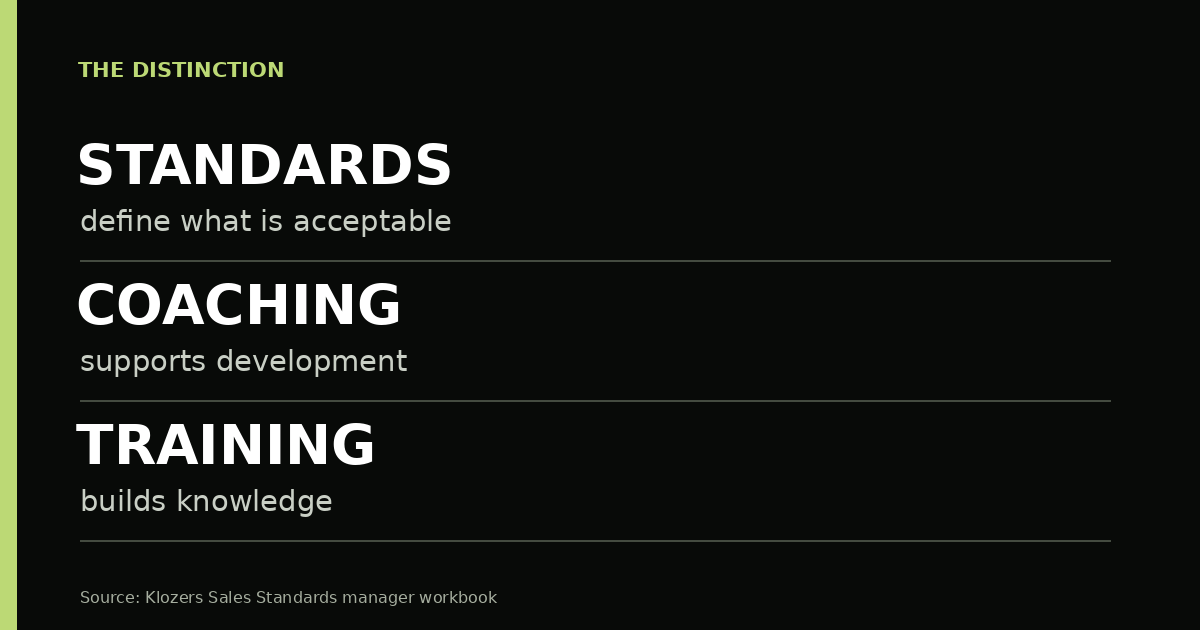
Klozers distinguishes three functions: sales training builds knowledge; sales coaching supports development; sales standards define what is acceptable. This distinction is documented in its Sales Standards manager workbook. Standards apply across tenure and performance levels; coaching responds to the development need revealed by observation.
Organisations should first examine their own successful selling practices and commercial priorities. They can then agree a limited number of relevant standards. The point is not to import a generic methodology or to make every conversation identical. It is to make important expectations clear and assessable.
Coaching is not the same as standards inspection
Inspection asks whether a behaviour met the standard. Coaching explores how the salesperson can improve. The two activities are related, but combining them without distinction creates confusion. A manager may need to address a repeated standards breach rather than treat it as an optional development topic.
For example, a manager might establish whether a salesperson has a credible, buyer-validated value hypothesis. That is an inspection question. If the evidence is absent because the salesperson struggles to ask commercial questions, coaching can focus on practising those questions. If the person knows how to do it but repeatedly chooses not to, the response may require accountability rather than further instruction.
The Klozers Sales Standards workbook uses a dedicated manager inspection routine and explicitly says that it is not a pipeline review or a coaching session. Its detailed rules were designed for a specific engagement and should not be treated as a universal coaching script.
Ten principles of effective sales coaching
Establish whether the salesperson needs knowledge, practice or a clear management expectation. More coaching will not resolve every repeated failure to apply an understood standard.
Invite the salesperson to explain the decision they made and the evidence behind it. Questions reveal whether they understand the situation before the manager suggests alternatives.
How to structure a productive coaching conversation
Begin with the agreed behaviour and a specific example. Ask the salesperson to describe what they intended, what happened and what evidence supports their view. Explore an alternative approach, practise it where useful and agree when it will be applied. At the next appropriate opportunity, review the evidence together.
This is an editorial description of a coaching conversation, not a named Klozers proprietary process. The exact questions and format should reflect the sales activity, the person’s experience and the standards in force.
How to measure whether coaching is working
Start with evidence that the targeted behaviour is being applied. Managers can examine the quality of relevant customer conversations, whether agreed actions occurred and whether standards are met consistently. Commercial measures, such as opportunity progression or conversion, provide additional context but can be affected by factors outside coaching.
INFERRED: An improvement following coaching may be consistent with coaching having helped, but it does not independently prove causation. Avoid promising a particular revenue or retention outcome without appropriate evidence.
How sales certification reinforces coaching and accountability
Coaching conversations can lose their effect when no one checks what happens afterwards. The Klozers Sales Certification Programme provides a defined accountability mechanism connected to live selling activity. It is not an attendance certificate issued simply because someone completed training.
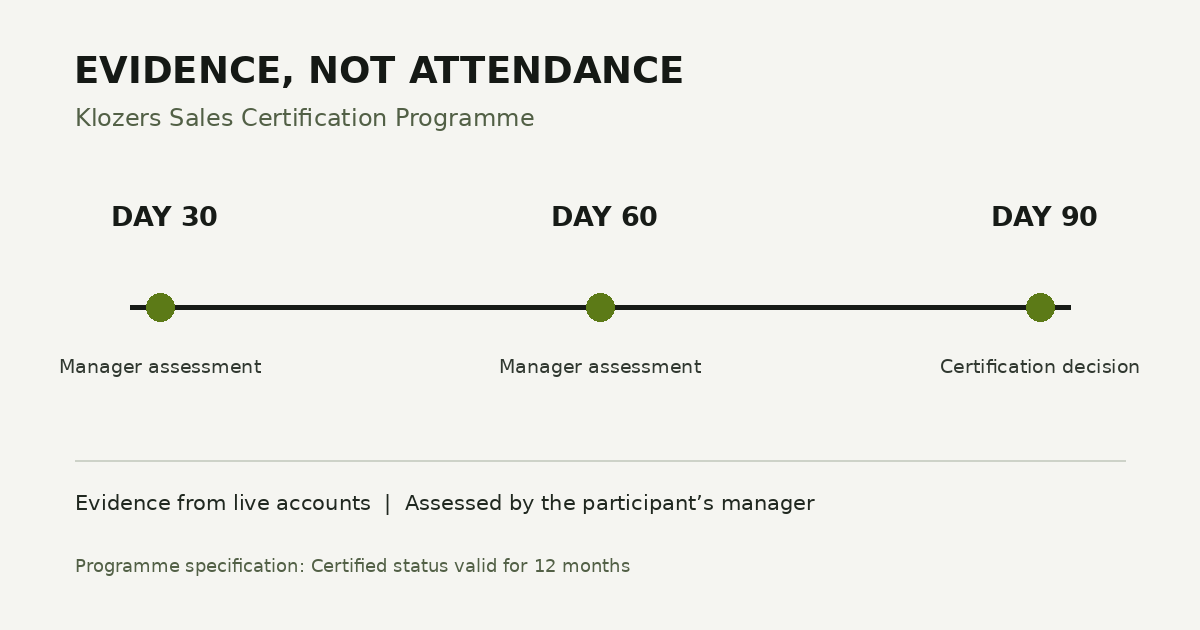
According to the programme specification, the salesperson’s certification is based on ten observable execution requirements: leadership selects four relevant topics, with two requirements for each, plus two common requirements. Evidence comes from live accounts and is assessed by the participant’s own manager at Day 30, Day 60 and Day 90. Klozers issues the certification rather than assessing its own delivery.
The programme also distinguishes a temporary Candidate status from Certified status earned after the evidence period. Certified status is valid for 12 months, with renewal based on evidence. A separate Certified Coach designation recognises managers who conduct the required checkpoints and assessments and pass a sample audit.
This is where certification supports effective coaching: standards are explicit, managers have a reason to inspect application, and salespeople must demonstrate the agreed behaviour in their work. Certification supplies accountability; it does not replace the manager’s coaching or guarantee a particular commercial result.
See B2B sales training with certification for the related programme topic. Publication check: the certification-specific commercial URL should be verified before publishing this link.
Reinforce coaching after the training event
Training provides opportunities to build knowledge and practise skills. When salespeople return to customer work, managers need to observe whether those skills are applied. Standards make expectations explicit, coaching supports development, and certification can create an evidence-based review period.
For a wider view of how this fits a sales development programme, see sales coaching, coaching sales behaviours and bespoke sales training. The right design starts with the team’s existing strengths, agreed commercial priorities and the behaviours that need to change.
Key takeaways
- Agree observable standards before coaching against them.
- Distinguish inspection, development and accountability.
- Practise one useful improvement and review application in live work.
- Use certification to evidence behaviour over time, not simply attendance.