
Advanced Sales Training: Why Experienced Sales Teams Need More Than Advanced Techniques
Build a team that diagnoses before it presents. This private, in-person workshop is for B2B teams that need stronger discovery, clearer value conversations and more consistent progression on live opportunities.
By Iain Swanston, Founder, Klozers
- Updated 17 October 2026
What is advanced sales training?
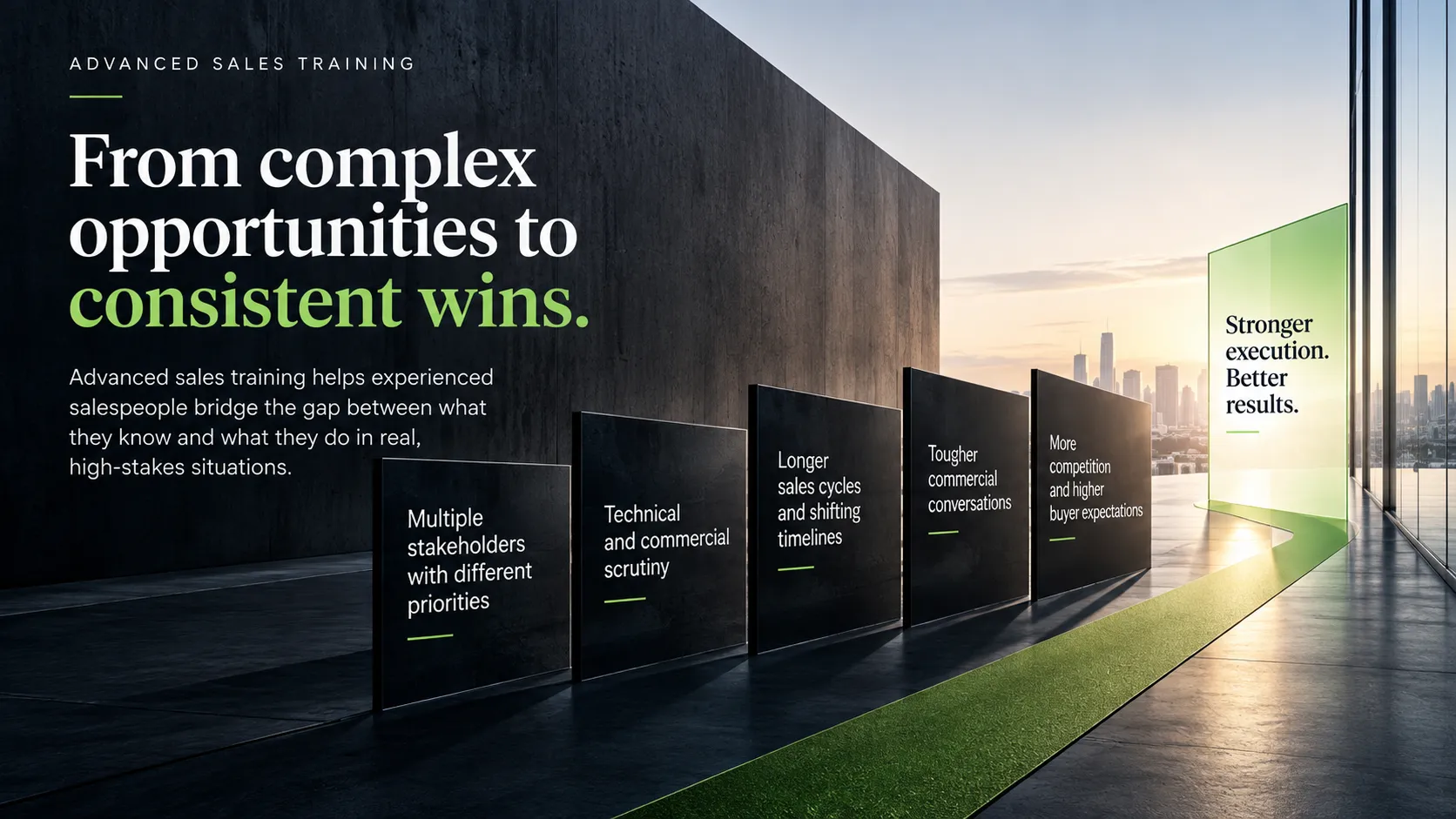
Advanced sales training develops the capabilities experienced salespeople need when opportunities become more demanding. It can involve complex buying groups, unfamiliar markets, commercial negotiation, account planning and conversations where the consequences of a poor decision are significant.
It should not mean giving experienced sellers a longer list of techniques. First establish whether the problem is missing knowledge, difficulty applying existing skills or an absence of consistent execution standards. Each calls for a different response.
For an HR or L&D leader, the question is not whether a course looks advanced. It is whether the development will change the behaviour the organisation needs in real opportunities.
Start with the fundamentals
Experienced salespeople can still have inconsistent fundamentals. Before introducing specialist content, check the quality of discovery, qualification, listening, value discussions and agreed next steps. These are not beginner topics when the customer situation is complex.
The existing Klozers article made this point clearly: advanced training is of limited value if the team is not already proficient and consistent in core selling behaviours. That principle remains. A new enterprise programme cannot compensate for weak discovery or an unclear sales process.
Consider a team moving from smaller customers to enterprise accounts. The sellers may be successful in their current market but need to adapt to longer buying cycles, more stakeholders and different evidence requirements. The priority is not to discard their strengths. It is to retain what works and develop the capabilities the new market demands.
Three gaps that can look like a training problem
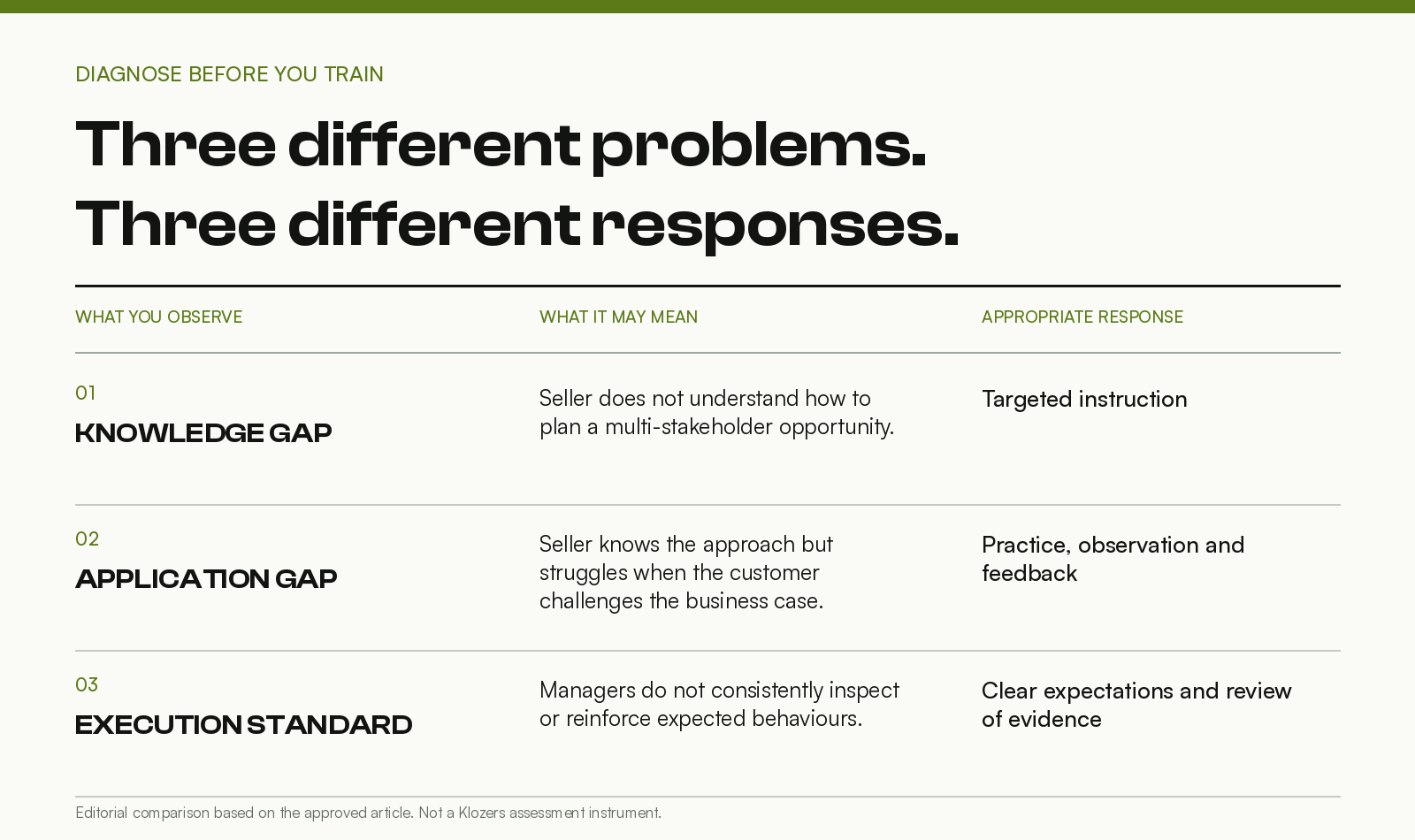
Knowledge gap
Application gap
A seller can describe the right approach but struggles when the customer challenges the business case or introduces a new stakeholder. Practice, observation and feedback are more relevant than repeating the theory.
Execution standard
The team knows the expected approach, but managers do not inspect or reinforce it consistently. More content alone will not establish a shared standard. Leaders need clear behavioural expectations and a practical way to review evidence.
Where advanced B2B selling becomes difficult
Complex opportunities expose capability gaps that routine deals may not reveal. The following situations provide useful starting points for a development brief.
- Multiple stakeholders: the seller has a supportive contact but cannot establish access to the Economic Owner or understand the wider buying group.
- Commercial value: the team can describe features but cannot establish the cost of the current problem or explain the value of change.
- Qualification: opportunities remain in the forecast despite limited evidence of customer commitment.
- Negotiation: sellers offer discounts before understanding what the customer values and which conditions can be exchanged.
- New markets: successful approaches in one segment do not transfer automatically to enterprise accounts or different industries.
These are examples of situations to diagnose, not a claim that every experienced team has the same problems. Select priorities using evidence from actual sales work.
Why simulation matters for experienced sellers
For example, a seller may need to explain an investment case to a sceptical Economic Owner, address a technical evaluator’s concerns and maintain a clear next step. The training should test the specific behaviour required, not simply reward a persuasive presentation.
Simulation is a development mechanism, not a substitute for an agreed execution standard. The team still needs to know which behaviours matter, how they are observed and what managers will reinforce afterwards. See sales simulation for experienced teams.
Build on what your best people already do
Klozers’ approach begins with the organisation’s commercial requirements and existing best practice. Before programme design, the team examines how its strongest performers handle relevant customer situations. Effective internal practice is retained; additional approaches are introduced where gaps remain.
This is especially important for experienced teams. Replacing successful habits with a standard external methodology can create unnecessary resistance and may fail to address the real problem. A bespoke programme can focus on the accounts, conversations and decisions that matter to the business.
The original article described a programme for a team moving into larger accounts. Its useful principle was to combine relevant learning with a campaign and workplace application. We retain that principle without repeating the original client numbers or presenting them as independently verified outcomes.
What managers must reinforce after the session
Reinforcement should be designed before the training takes place. Agree who will observe the behaviour, when they will review it and what evidence they need. A manager who was not involved in the original brief may otherwise evaluate activity rather than the capability the programme was intended to develop.
For instance, if the requirement is better enterprise qualification, the follow-up discussion can examine whether the seller understands the buying group, has access to the Economic Owner and has secured a meaningful customer commitment. A completed CRM field does not by itself prove the customer has agreed to act. The manager should examine the underlying conversation and next step.
Different roles may also need different evidence. An account executive working on a complex new-business opportunity faces different decisions from an account manager expanding an established relationship. The organisation can retain common standards while tailoring the practice situations and coaching conversations to each role.
A workshop can reveal a gap and help a seller practise a better response. It cannot, on its own, ensure the behaviour becomes routine. Managers need to review how the skill is used in live work.
Agree what evidence would demonstrate improvement. For example, has the seller identified the Economic Owner? Is the next customer commitment recorded with a date and purpose? Has the customer confirmed the business problem and the value of addressing it? These are observable indicators, not invented performance statistics.
Manager conversations should focus on the required behaviour and the evidence available, rather than attendance or confidence ratings alone. This also explains why advanced training can fail to transfer into everyday selling.
How to design an advanced sales training programme
The existing article recommends starting with business objectives, identifying capability requirements, selecting appropriate activities and deciding how learning will be applied. That sequence remains useful when updated for execution standards.
- Define the commercial requirement. Identify the sales situations that need to improve and why they matter.
- Establish the baseline. Review real opportunities, current practices and the behaviours already demonstrated by strong performers.
- Separate the gaps. Decide whether the main issue is knowledge, application or reinforcement.
- Design relevant practice. Use challenging scenarios and live opportunity work where appropriate.
- Agree evidence and reinforcement. Give managers clear behaviours to inspect and participants actions to apply after training.
This is an editorial programme-design sequence, not a newly named Klozers proprietary framework. Where a team needs several capabilities developed over time, a longer programme may be more suitable than a single workshop.
When is bespoke advanced sales training appropriate?
Bespoke training is appropriate when the business has a defined capability requirement, experienced participants and real situations in which to apply the learning. It can be particularly relevant when entering a new market, moving into larger accounts or changing how complex opportunities are managed.
It is less appropriate when leaders cannot agree what good execution looks like or will not reinforce the required behaviours. In that case, clarify the standards and management responsibilities before commissioning additional content.
HR and L&D leaders may organise the programme, while the Sales Director or CRO owns the commercial application. These responsibilities should be agreed without treating the Economic Buyer and Economic Owner as interchangeable roles.
Explore bespoke training for experienced sales teams to see how development can be built around your existing best practice and real opportunities.